





The Babak Lab shared a post on LinkedIn:
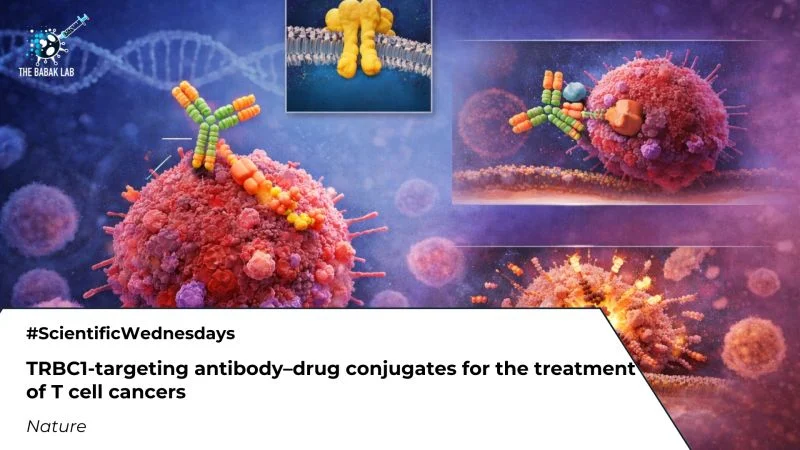
“Scientific Wednesdays: TRBC1-Targeting ADCs for T-Cell Malignancies
A new Nature study introduces TRBC1-targeting antibody-drug conjugates (ADCs) as a precision strategy for treating T-cell leukemias and lymphomas 0 a space where many targeted approaches have failed.
Key Focus
The study addresses a fundamental problem in T-cell cancer therapy: how to selectively kill malignant T cells without wiping out the entire T-cell compartment.
Key Insights
- T-cell malignancies are clonal: cancer cells express either TRBC1 or TRBC2, but not both
- TRBC1 is present on ~50% of normal T cells, while the remaining TRBC2+ T cells can sustain immune function
- This creates a therapeutic window: killing all TRBC1+ cells is compatible with life, unlike pan-T-cell targeting
- CAR-T approaches failed in this setting due to fratricide – engineered T cells killed each other because they shared the same TCR
- targets
- ADCs avoid this problem: they do not require living effector cells and therefore bypass CAR-T self-killing entirely
- TRBC1-targeting ADCs selectively eliminated malignant T cells in preclinical models while sparing TRBC2+ T cells
Conclusion
This work is not about “another ADC”, but about choosing the right modality for the biology. By exploiting T-cell clonality and avoiding CAR-T fratricide, TRBC1-targeting ADCs offer a realistic and elegant path toward precision therapy for T-cell cancers.
Image generated using Sora by OpenAI.”
Title: TRBC1-targeting antibody–drug conjugates for the treatment of T cell cancers
Authors: Tushar Nichakawade, Jiaxin Ge, Brian Mog, Bum Seok Lee, Alexander Pearlman, Michael Hwang, Sarah DiNapoli, Nicolas Wyhs, Nikita Marcou, Stephanie Glavaris, Maximilian Konig, Sandra Gabelli, Evangeline Watson, Cole Sterling, Nina Wagner-Johnston, Sima Rozati, Lode Swinnen, Ephraim Fuchs, Drew Pardoll, Kathy Gabrielson, Nickolas Papadopoulos, Chetan Bettegowda, Kenneth Kinzler, Shibin Zhou, Suman Paul
Read the Full Article.
More from The Babak Lab.