
Terrence Connolly, Chief Executive Officer at K36 Therapeutics, shared a post by Rakesh V., Biotech Leader & Operator–Investor, Member of Scientific Advisory Board (Investment Fund) at Multiple Myeloma Research Foundation, adding:
“A new Nature paper provides strong external validation for what we’ve long believed at K36 Therapeutics, Inc.: NSD2 is a clinically meaningful, targetable and druggable driver of treatment-resistant prostate cancer.
The study shows that blocking NSD2 can push difficult-to-treat tumors that no longer respond to androgen receptor-based (hormone) therapies back into a state where they once again respond. This reversal into AR responsiveness is extremely rare, because once tumors change into this treatment-resistant form, they almost never go aback.
Key findings:
- Tumors turned AR-signaling back on, returning to a state where hormone-driven pathways function normally.
- The epigenetic rewiring caused by NSD2 was reversed, pushing the cancer cells back toward a more treatable state.
- The tumors once again responded to AR-targeted drugs, showing renewed effectiveness of standard hormone therapies.
This reinforces our target and indication selection as we advance KTX-2001, now enrolling in the STRIKE-001 Phase 1 trial for metastatic prostate cancer.
Quoting Rakesh V.‘s post:
“A compelling data set in Nature this week points to a potentially actionable mechanism in treatment-resistant prostate cancer.
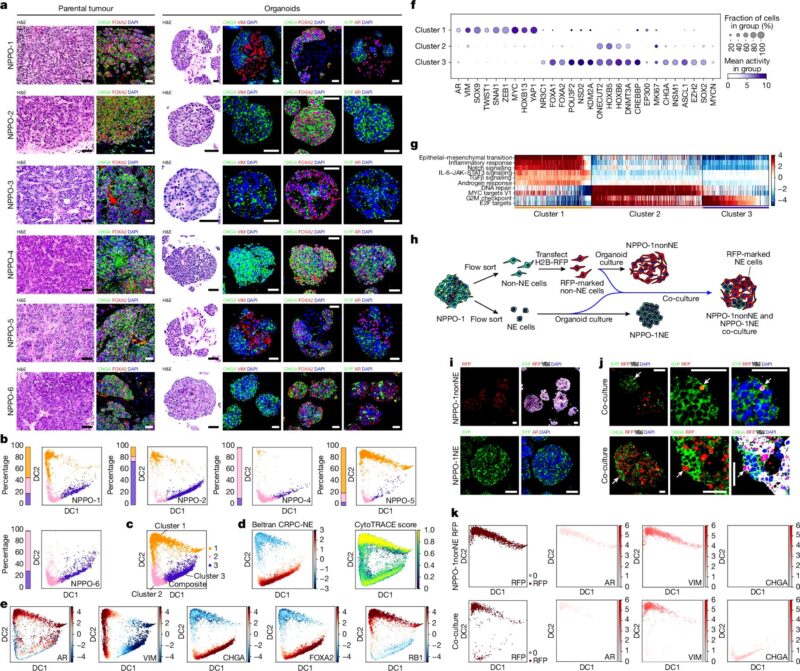
In multiple orthogonal systems — mouse models, patient-derived organoids, and genetic/chemical inhibition studies — the authors demonstrate that targeting NSD2 drives a directional shift in cell state: from a neuroendocrine, AR-independent phenotype back toward an AR-responsive state.
What’s notable is the consistency of the evidence:
- Transcriptomic data show restoration of AR-signaling programs.
- Chromatin profiling confirms reversal of the NSD2-driven epigenetic landscape.
- Functional assays demonstrate renewed sensitivity to AR-targeted therapies.
For a field where lineage plasticity is often a one-way trajectory, this is a rare example of a reversible, targetable mechanism supported by clean, multi-layered data.
From a development standpoint, it frames NSD2 as more than a descriptive marker — it positions it as a potential leverage point to re-sensitize resistant tumors and extend the utility of existing therapeutics.”
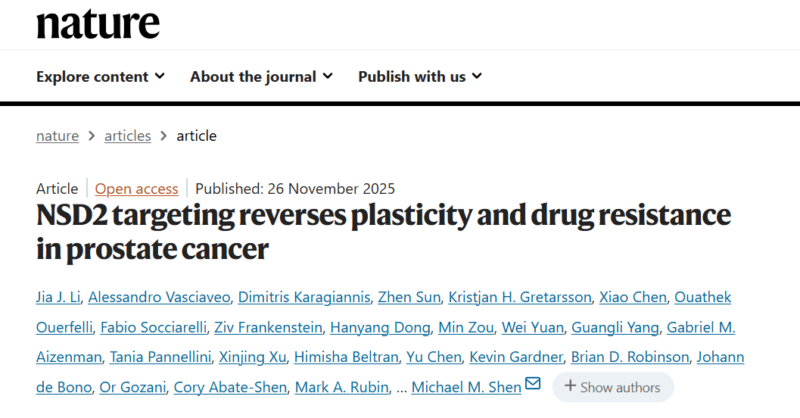
Title: NSD2 targeting reverses plasticity and drug resistance in prostate cancer
Authors: Jia J. Li, Alessandro Vasciaveo, Dimitris Karagiannis, Zhen Sun, Kristjan H. Gretarsson, Xiao Chen, Ouathek Ouerfelli, Fabio Socciarelli, Ziv Frankenstein, Hanyang Dong, Min Zou, Wei Yuan, Guangli Yang, Gabriel M. Aizenman, Tania Pannellini, Xinjing Xu, Himisha Beltran, Yu Chen, Kevin Gardner, Brian D. Robinson, Johann de Bono, Or Gozani, Cory Abate-Shen, Mark A. Rubin, Michael M. Shen
Read the Full Article.
You can also read:
Lord Cameron Reveals He Had Prostate Cancer