






Tamara Hussong Milagre, President of EVITA and ePAG Representative at European Reference Network GENTURIS, shared a post on LinkedIn about a recent article she and her colleagues co-authored, adding:
“Hereditary Cancer Genetic Testing in Europe: What We Learned from 21 Countries
Today I’m proud to share the publication of an important ERN GENTURIS study I co‑authored, mapping how hereditary cancer germline testing is actually performed across Europe.
And the message is clear: where you live still shapes the kind of genetic testing you can access.
Why this matters:
Hereditary cancer testing saves lives, not only for the person diagnosed but for entire families. Yet until now, we lacked a clear picture of how different European countries organize and deliver these services.
This study fills that gap.
What we found (in simple terms):
All 21 countries surveyed use multigene panels for hereditary cancer, but the size and content of these panels vary widely.
Some countries test 10–20 genes; others test more than 200.
Founder mutations still guide first‑tier testing in several countries (e.g., Poland, Portugal, Latvia, Lithuania, Greece).
In these populations, a handful of recurrent BRCA1/2 variants explain most hereditary breast/ovarian cancer cases.
Whole‑exome sequencing (WES) is available in routine care in just over half of the countries.
Whole‑genome sequencing (WGS) is used routinely in only 6 countries.
Polygenic risk scores (PRS), often discussed, rarely implemented.
Only Germany and Austria use PRS clinically for breast cancer risk.
Testing tumour tissue from deceased relatives (using stored FFPE blocks) is legally permitted in ~90% of countries and a crucial tool for families seeking answers.
Who can order genetic tests?
Clinical geneticists everywhere.
But in 9 countries, any physician can order germline testing; that´s a major structural difference.
Genetic counsellors and nurses play very different roles across Europe, with varying levels of recognition and autonomy.
What this means for patients and families:
Despite major progress, access to hereditary cancer testing in Europe is still unequal.
Your chances of receiving comprehensive testing or timely testing depend heavily on national policies, reimbursement systems, and laboratory infrastructure.
This is exactly why ERN GENTURIS exists: to reduce inequalities and promote EU‑wide standards of care.
My personal reflection:
As a patient advocate, I see every day how crucial it is that families receive the right test at the right time.
This study is a step toward harmonizing practices, sharing best models, and ensuring that no family is left behind because of their postcode.
If you work in genetics, oncology, public health, or patient advocacy, I encourage you to read the full article and join the conversation on how we can build a more equitable European landscape for hereditary cancer prevention.”
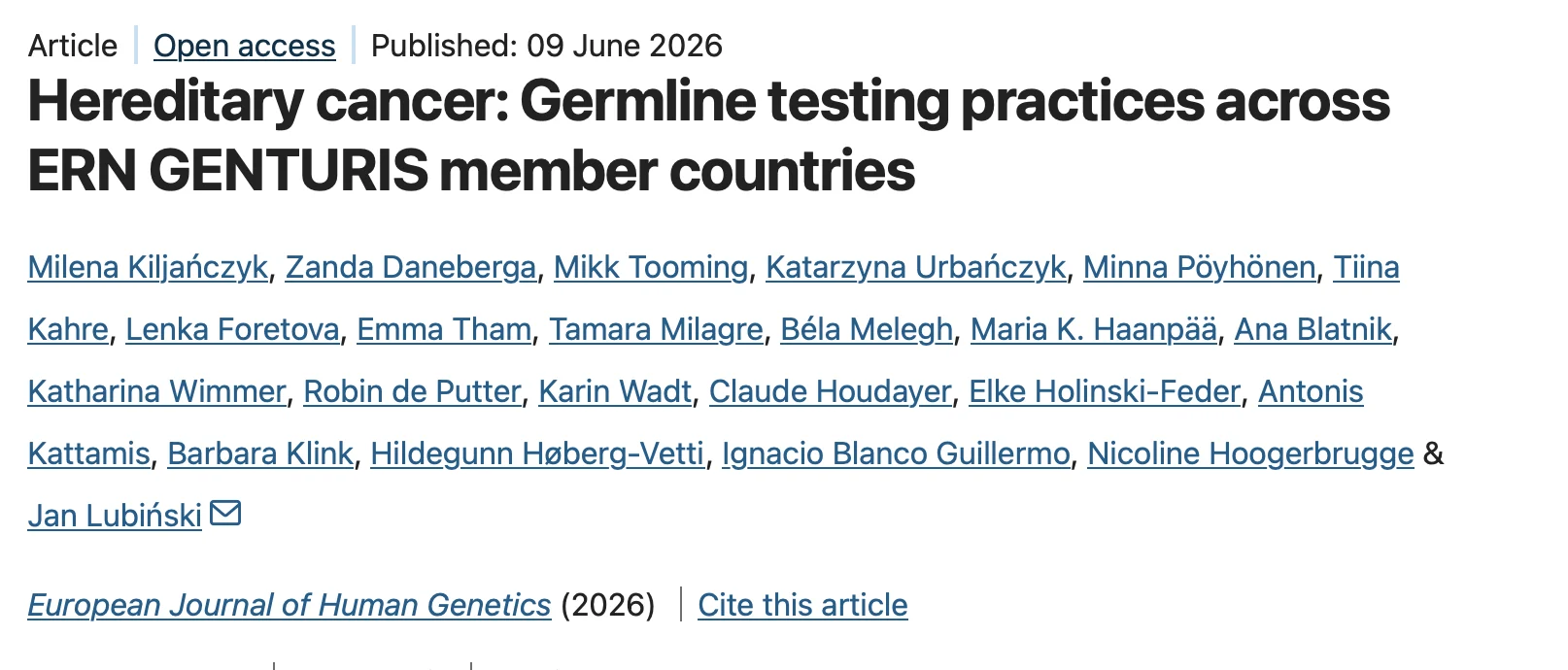
Title: Hereditary cancer: Germline testing practices across ERN GENTURIS member countries
Authors: Milena Kiljańczyk, Zanda Daneberga, Mikk Tooming, Katarzyna Urbańczyk, Minna Pöyhönen, Tiina Kahre, Lenka Foretova, Emma Tham, Tamara Milagre, Béla Melegh, Maria Haanpää, Ana Blatnik, Katharina Wimmer, Robin de Putter, Karin Wadt, Claude Houdayer, Elke Holinski-Feder, Antonis Kattamis, Barbara Klink, Hildegunn Høberg-Vetti, Ignacio Blanco Guillermo, Nicoline Hoogerbrugge, Jan Lubiński
Read the Full Article on European Journal of Human Genetics
More posts featuring Tamara Hussong Milagre.