






Talha Badar, Hematology/Oncology Specialist at Mayo Clinic shared a post on X:
”Optimizing Venetoclax Duration in AML (Ven + HMA)
Key observations from available data:
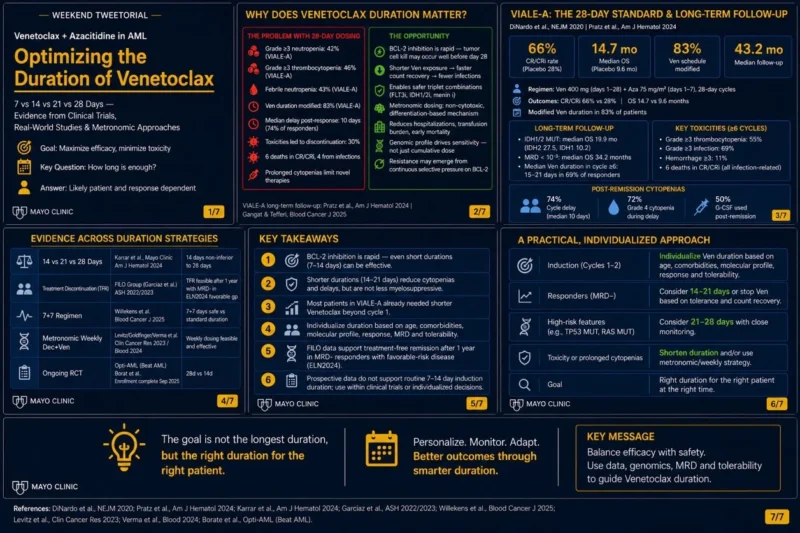
- VIALE-A established efficacy (CR/CRi 66%, median OS 14.7 mo), not necessarily the ideal duration for every patient; Persistent cytopenias and infectious complications remain major barriers to prolonged exposure.
- Karrar et al. (Mayo) suggest shorter durations (14 vs 21 vs 28 days) may be feasible in selected patients, but shorter duration should NOT be assumed to be intrinsically less myelosuppressive (AJH)
- Prospective evidence does NOT currently support routine universal 7–14 day induction Venetoclax.
- 7+7 French study showed comparable response after 2nd cycle but toxicity was similar to 28 day venetoclax.
- FILO data raise an important concept: treatment-free remission may be feasible after prolonged MRD-negative remission in favorable-risk disease (ELN2024), highlighting the importance of biology rather than fixed duration.
- Metronomic/weekly Dec+Ven approaches and ongoing randomized studies (Opti-AML/Beat AML) may further redefine exposure strategies.
Current practice increasingly individualizes Venetoclax duration based on:
- Age/frailty
- Comorbidities
- Molecular profile/genomics
- Disease burden and response kinetics
- MRD status
- Cytopenias/infection risk
- Tolerability and treatment goals
The question may no longer be:
‘How long should Venetoclax be given?’
Instead:
‘For which patient, at what disease state, and for how long?’
Right patient. Right biology. Right duration.”
Other Articles Featuring Talha Bada on OncoDaily.