






Sushil Beriwal, Vice President of Varian and Academic Chief of Allegheny Health Network, shared a post by Dorin Comaniciu, SVP and Chief Expert Healthcare AI at Siemens Healthineers on LinkedIn, adding:
“AI in radiation oncology is evolving rapidly.
In this work, we present a proof-of-principle demonstration showing how AI models can predict achievable dose distributions before treatment planning begins to create MLC fluence for final delivery in a second .
While early, this approach highlights how AI may eventually help guide:
- Treatment planning strategy.
- Organ-at-risk sparing.
- Planning efficiency.
Many steps remain before routine clinical implementation — but the potential is exciting.”
Quoting Dorin Comaniciu‘s post:
“I would like to share a fascinating physics-inspired AI paper that may change the way we think about Radiation Therapy Planning. While the work is still awaiting peer review, here is what ChatGPT 5.2 says about it.
AI End-to-End Radiation Treatment Planning Under One Second.
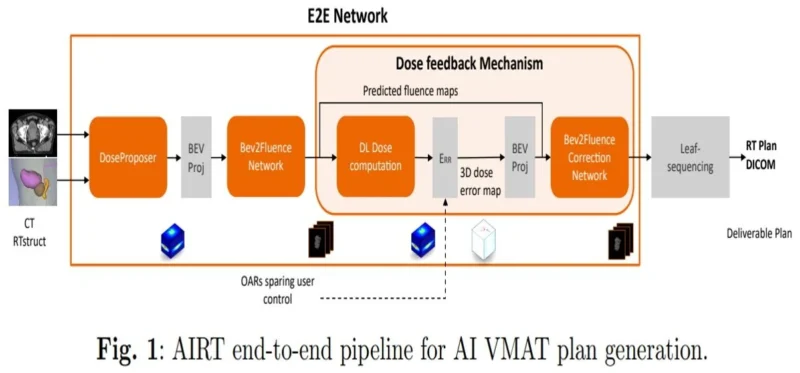
This paper presents AIRT, an end-to-end deep learning framework for automated radiation therapy (RT) planning that generates clinically deliverable VMAT prostate treatment plans in under one second directly from CT images and anatomical contours.
Main Contributions.
Fully end-to-end RT planning pipeline: The system maps CT images and structures directly to a deliverable RT plan without iterative optimization in a treatment planning system (TPS). Sub-second inference: The pipeline generates complete VMAT plans, including fluence prediction and leaf sequencing, in <1 s on a single GPU.
Differentiable dose-feedback mechanism: A key novelty is a feedback loop using a differentiable dose engine to correct predicted fluence maps and improve plan quality in a single forward pass.
Deliverability-aware training: Adversarial loss is used to enforce fluence patterns that are compatible with multi-leaf collimator sequencing.
Results
The method was trained on more than 10,000 prostate treatment plans and evaluated against Eclipse RapidPlan clinical plans.
Key findings:
- Comparable target coverage and OAR sparing relative to clinical plans.
- Non-inferiority demonstrated statistically across major dose-volume metrics.
- Planning time reduced from minutes to <1 second, enabling interactive planning workflows.
- Overall Assessment
This work represents a significant step toward real-time AI-driven radiation therapy planning, showing that clinically deliverable plans can be generated extremely rapidly using a fully differentiable pipeline. If generalized across sites and validated clinically, this approach could substantially streamline radiotherapy workflows and reduce dependence on iterative planning systems.”
Title: AI End-to-End Radiation Treatment Planning Under One Second
Authors: Simon Arberet, Riqiang Gao, Martin Kraus, Florin C. Ghesu, Wilko Verbakel, Mamadou Diallo, Anthony Magliari, Venkatesan Karuppusamy, Sushil Beriwal, REQUITE Consortium, Ali Kamen, Dorin Comaniciu
Read The Full Article
Other articles about Radiation Therapy on OncoDaily.