





Susheel Kumar Yeshala, Consultant Medical Oncologist at American Oncology Institute, shared a post on LinkedIn:
“New Publication | Multicentric Indian Real-World Evidence
Happy to share that our multicentric retrospective real-world study evaluating PARP inhibitors (PARPi) as first-line maintenance therapy in advanced ovarian cancer has been published online in the international peer-reviewed journal Journal of Ovarian Research (Springer Nature)
Why this study is important
While landmark PARPi trials (SOLO-1, PRIMA, ATHENA-MONO) have reshaped frontline ovarian cancer management, these data largely come from controlled, resource-rich settings. Real-world evidence from low- and middle-income countries (LMICs) like India remains limited. Our study aimed to bridge this critical evidence gap.
Key highlights
- Multicentric Indian real-world data from 6 tertiary cancer centres
- 46 patients with BRCA-mutated or HRD-positive advanced high-grade serous ovarian cancer
- First-line maintenance with Olaparib or Rucaparib following platinum response
- Median follow-up: 22.5 months
- Median PFS not reached
- 12- and 18-month PFS: 97.8% and 86.9%
- No significant difference in outcomes between:
– Olaparib vs Rucaparib
– BRCA-mutated vs non-BRCA HRD-positive disease
– Standard-dose vs dose-reduced PARPi
Real-world insights relevant to LMIC practice
- Dose modifications due to toxicity or financial constraints were common
- Dose reduction did not compromise efficacy
- PARPi were well tolerated, with low rates of grade ≥3 toxicity
- Variability and turnaround time in BRCA/HRD testing remain important real-world challenges
Important context
This was an investigator-initiated, non-pharma-sponsored study, conducted before olaparib biosimilars became widely available in India. Treatment decisions therefore largely reflected real-world clinical judgement rather than market-driven prescribing, strengthening the validity and interpretability of the findings.
Take-home message
Despite real-world constraints, PARP inhibitors are feasible, effective, and tolerable in routine clinical practice in LMIC settings, with outcomes comparable to global trial data. This supports confident integration of PARPi into frontline maintenance therapy beyond clinical trial populations.
Grateful to my mentor Dr. Soumya Surath Panda Sir, and all senior faculty/co-authors, Network of Oncology Clinical Trials in India (NOCI) for their academic rigor, teamwork, and commitment to generating meaningful real-world evidence. Looking forward to continued collaboration and discussion.”
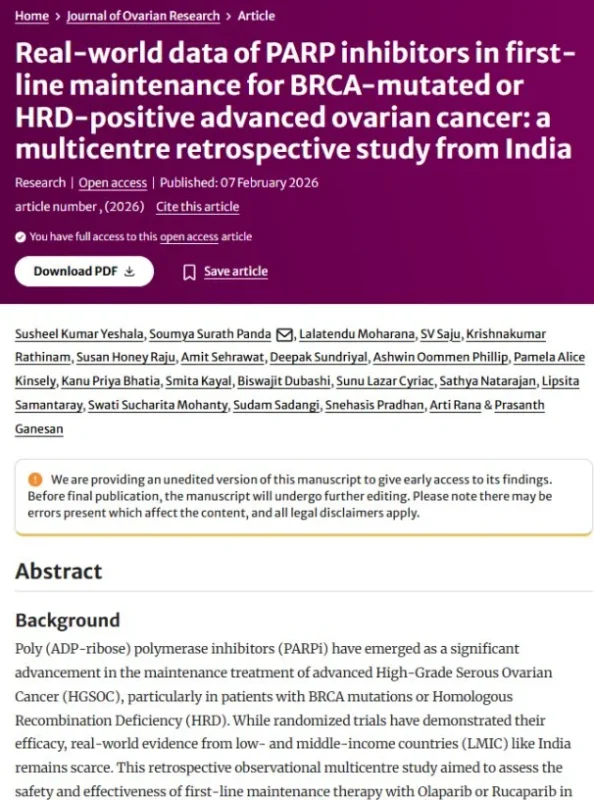
Title: Real-world data of PARP inhibitors in first-line maintenance for BRCA-mutated or HRD-positive advanced ovarian cancer: a multicentre retrospective study from India
Authors: Susheel Kumar Yeshala, Soumya Surath Panda, Lalatendu Moharana, SV Saju, Krishnakumar Rathinam, Susan Honey Raju, Amit Sehrawat, Deepak Sundriyal, Ashwin Oommen Phillip, Pamela Alice Kinsely, Kanu Priya Bhatia, Smita Kayal, Biswajit Dubashi, Sunu Lazar Cyriac, Sathya Natarajan, Lipsita Samantaray,
Swati Sucharita Mohanty, Sudam Sadangi, Snehasis Pradhan, Arti Rana, Prasanth Ganesan.
Other articles featuring Susheel Kumar Yeshala