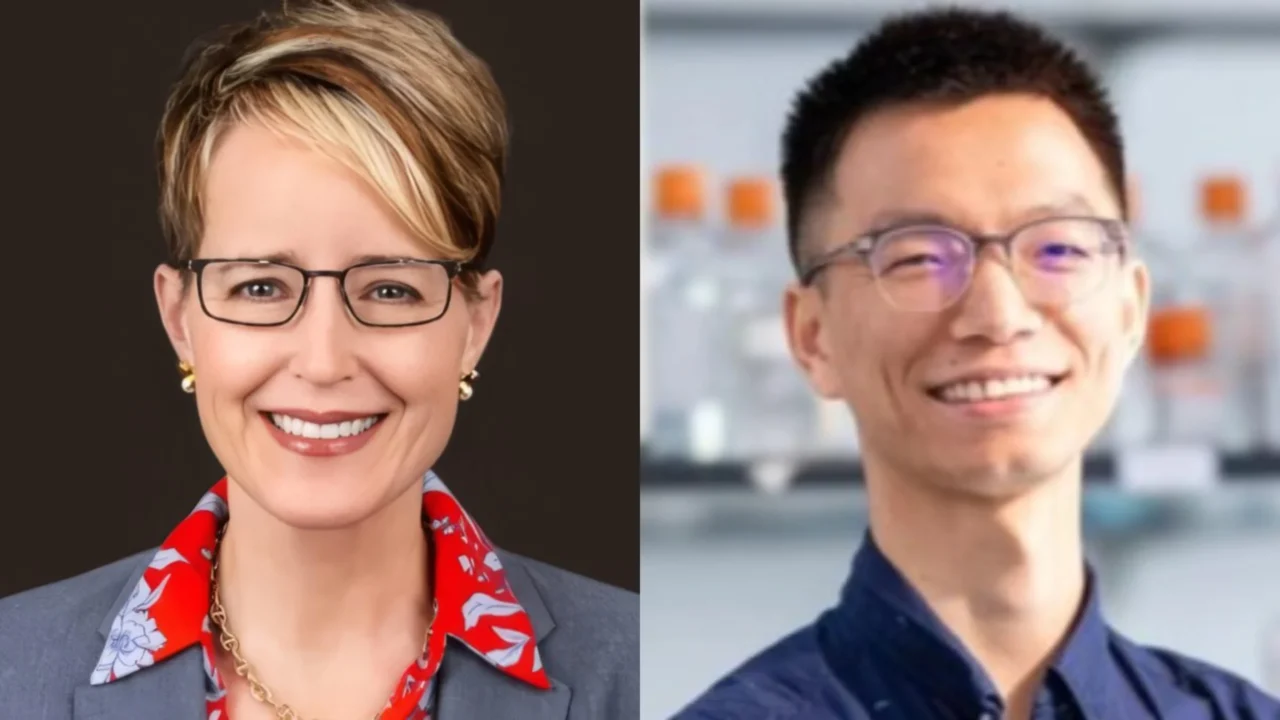
Susanna Fletcher Greer, Chief Scientific Officer at The V Foundation, shared on LinkedIn:
“One of the greatest frustrations in treating ovarian cancer is that chemotherapy often works well initially, only to lose its effectiveness over time. We have traditionally searched for the answer inside cancer cells themselves, looking for the genetic changes that allow tumors to survive treatment.
A new study from Dr. Nan Zhang, a 2024 V Scholar (Nan Zhang, Ph.D. – The Wistar Institute) at The Wistar Institute suggests another important piece of the puzzle: the body’s own response to chemotherapy.
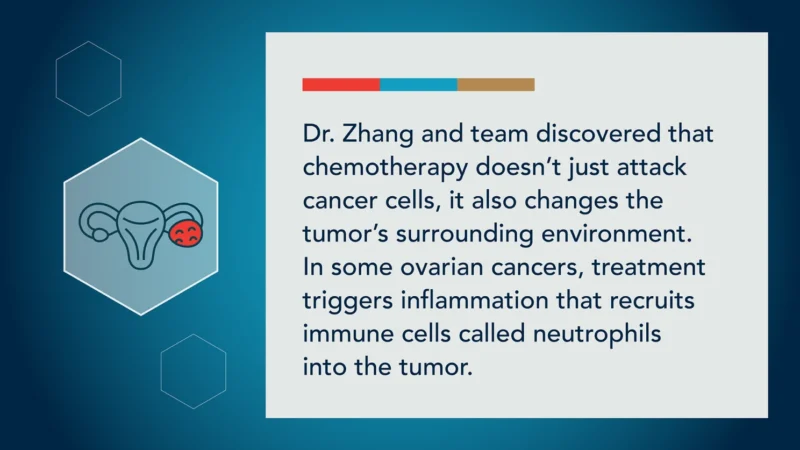
Dr. Zhang and team discovered that chemotherapy doesn’t just attack cancer cells, it also changes the tumor’s surrounding environment. In some ovarian cancers, treatment triggers inflammation that recruits immune cells called neutrophils into the tumor. Rather than helping eliminate the cancer, these cells release web-like structures known as neutrophil extracellular traps (NETs) that appear to protect cancer cells from chemotherapy while also dampening the body’s anti-tumor immune response.
Dr. Zhang identified a key inflammatory signal, IL1β, that controls this entire process. When they blocked IL1β, or its receptor, in preclinical models, fewer neutrophils accumulated around the tumor, immune cells mounted a stronger attack against the cancer, and chemotherapy became significantly more effective. Yes! Importantly, they also found evidence of increased neutrophils and NET formation in tumor samples from women after chemotherapy, suggesting this mechanism plays a role in patients.
Why is this discovery exciting?For starters, it challenges a long-held assumption that chemotherapy resistance is driven primarily by changes within cancer cells. Instead, it highlights the powerful influence of the tumor microenvironment, the complex community of immune cells, fibroblasts, blood vessels, and other normal tissues that surround a tumor. Sometimes, the environment around a cancer can determine whether treatment succeeds or fails. Not that different from the influence our colleagues have on our successes and failures; everything is a team effort.
Perhaps most importantly, this work points to a new therapeutic strategy. Rather than developing entirely new chemotherapy drugs, we be able to improve the treatments we already have by blocking the inflammatory signals that allow tumors to recover after chemotherapy.
Studies like this illustrate to me why basic and translational research are so incredibly important. Every time researchers uncover another reason cancer resists treatment, they reveal a new opportunity to intervene. By understanding not only the cancer itself but also the body’s response to therapy, Dr. Zhang is opening the door to more durable responses, and ultimately better outcomes, for women facing ovarian cancer.”
Title: Chemotherapy induces an IL1β-dependent neutrophil recruitment and activation that promote chemoresistance in metastatic ovarian cancer
Authors: Taito Miyamoto, Yujie Ye, Marlaine M. Soliman, Bryan S. Manning, Brennah Murphy, Linna Zhu, Chunlei Shao, Gauri Mirji, Moeko Minakuchi, Kohei Hamada, Rin Mizuno, Mana Taki, Koji Yamanoi, Ryusuke Murakami, Masaki Mandai, Ying Ye, Jayamanna Wickramasinghe, Yulia Nefedova, Rahul Shinde, Andrew Kossenkov, Nan Zhang
Read the full article.
You may also find this interesting:
Conquer Cancer Career Development Award in Ovarian Cancer 2027