






Susanna Fletcher Greer, Chief Scientific Officer of the V Foundation, shared a post on LinkedIn:
“I don’t watch a lot of TV, but I loved The Bear. If you’ve seen it, you know that kitchen survives not through creativity or speed alone, but through relentless discipline. That mindset turns out to be a surprisingly good way to think about how certain leukemias stay alive.

Chaos in the Kitchen: New Path to Fighting Leukemia
I don’t watch a ton of TV, but I LOVED The Bear. If you watched (and if not, you should!), you know how that kitchen works: it’s busy and intense.
The Bear’skitchen is a place where everything works because there are rules. Ingredients that aren’t used are quickly thrown away. Stations are obsessively cleaned. Mess and extra stuff isn’t allowed to pile up, because in a high-pressure space, even small clutter can bring the whole system down.
This paper from the V Foundation funded grantee Dr. Markus Müschen at Yale Universityshows that a type of leukemia ‘runs’ its cells a similar way
In many cancers, a protein called beta catenin behaves like a chef who never yelling for ‘more!.’ And more beta catenin often results in more growth. More division. More chaos. That’s why so much cancer research has focused on shutting this protein down.
But in B cell acute lymphoblastic leukemia, or B-ALL, Dr. Müschen and team found the opposite thing happens: these leukemia cells survive by keeping beta catenin on a short leash. As soon as it shows up, the cell tags it and basically throws it out. It reminds me of the Bear, like a discipled kitchen.
To understand how beta catenin works in B-ALL cells, the Müschen team blocked the ‘kitchen cleanup.’ They used drugs that interfere with the cell’s ability to get rid of beta catenin. The result was that beta catenin piled up where it wasn’t supposed to be. What was surprising was that instead of making these leukemia cells grow faster, the whole operation collapsed. The buildup shut down a growth engine inside the leukemia cells, and the cells died.
If you’re facing relapsed or treatment-resistant leukemia, one of the hardest moments is hearing that standard treatment options are narrowing. I love this study because it points to a completely different vulnerability we can target in B-ALL. Not something the cancer is addicted to, but something it desperately needs to get rid of.
Even more encouraging, some of the drugs the team used have already been tested for other diseases. That alone significantly raises the real possibility that their insights will move more quickly toward testing for patients who need new options.
I love when research that changes how we think, what I am reminded of here is that all cancers don’t use proteins to break cell growth rules in the same ways. It’s true that cancers survive by speeding everything up. But we are learning that others survive by keeping absolute control. Just like the kitchen in The Bear.
And sometimes, the smartest way to fight back is not to stop chaos, but to introduce it exactly where cancers can’t tolerate it.
Check out Dr. Müschen’s paper here Targeting β-catenin degradation with GSK3β inhibitors induces cell death in acute lymphoblastic leukemia | Nature Cancer and find the lab at Markus Müschen, MD, PhD | Yale School of Medicine.”
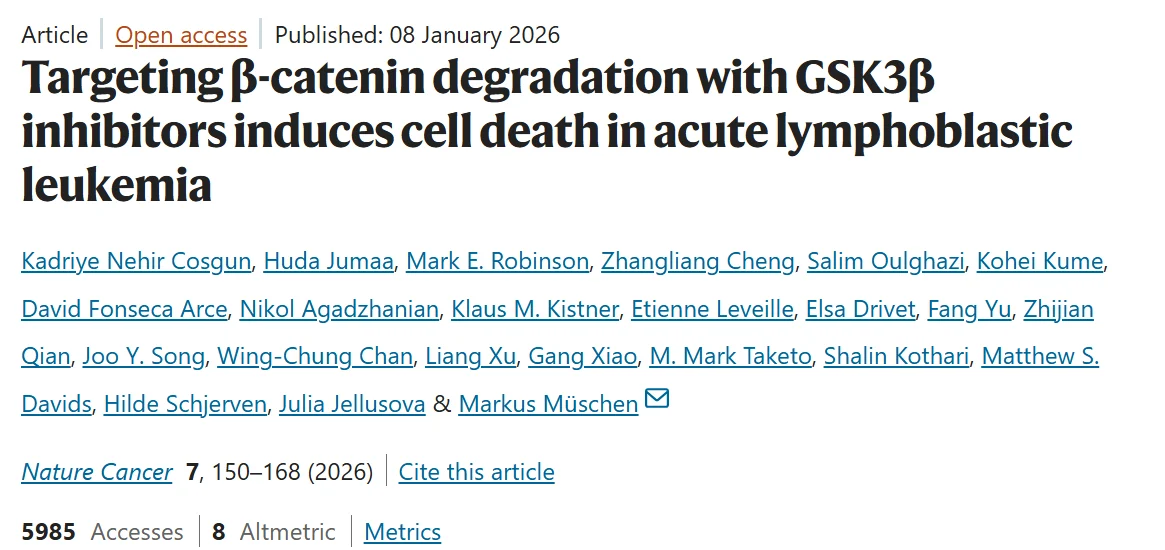
Title: Targeting β-catenin degradation with GSK3β inhibitors induces cell death in acute lymphoblastic leukemia
Authors: Kadriye Nehir Cosgun, Huda Jumaa, Mark E. Robinson, Zhangliang Cheng, Salim Oulghazi, Kohei Kume, David Fonseca Arce, Nikol Agadzhanian, Klaus M. Kistner, Etienne Leveille, Elsa Drivet, Fang Yu, Zhijian Qian, Joo Y. Song, Wing-Chung Chan, Liang Xu, Gang Xiao, M. Mark Taketo, Shalin Kothari, Matthew S. Davids, Hilde Schjerven, Julia Jellusova, Markus Müschen
More posts featuring Susanna Fletcher Greer on OncoDaily.