Shrinidhi Nathany, Consultant Molecular Hematology and Oncology at Fortis Memorial Research Institute, India, shared a post on LinkedIn:
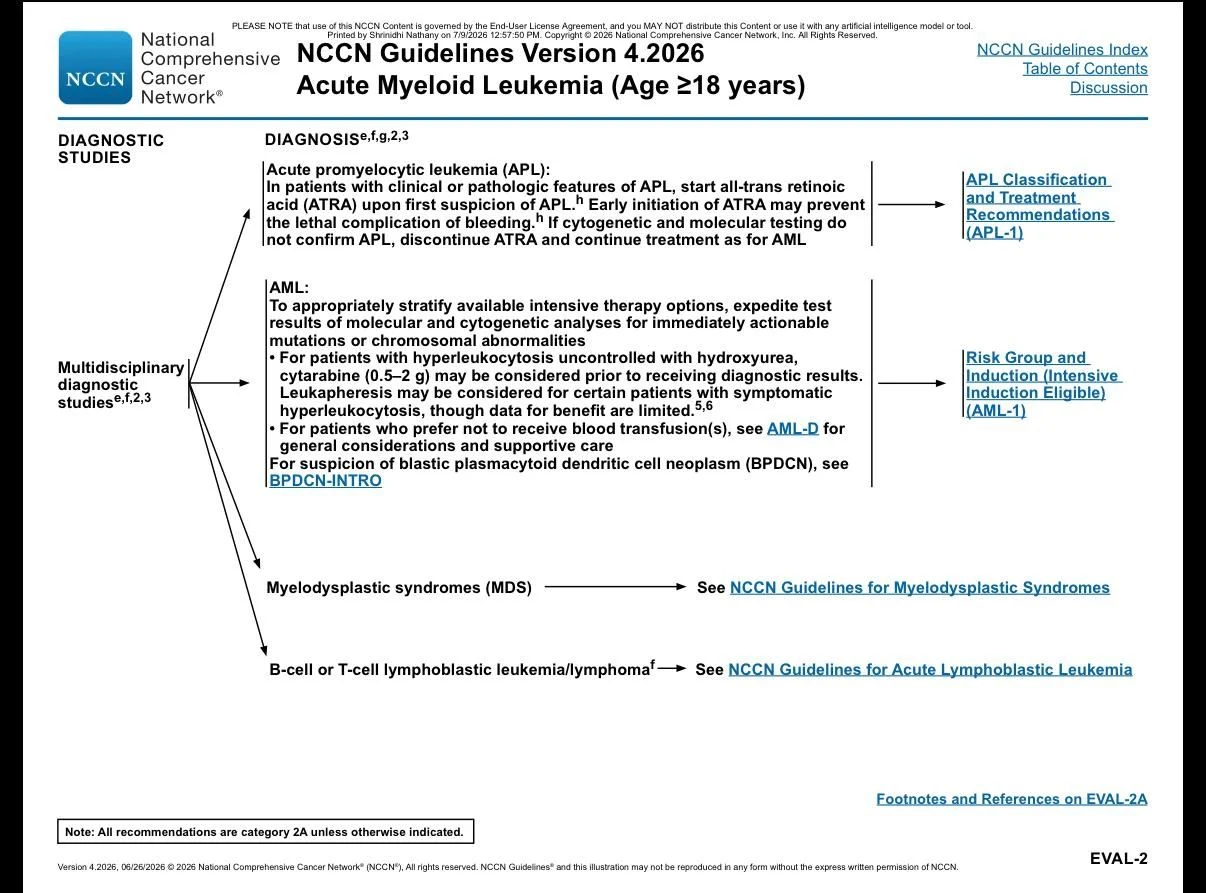
“NCCN AML V4.2026 AML: says expedite molecular testing and do MRD by molecular too!
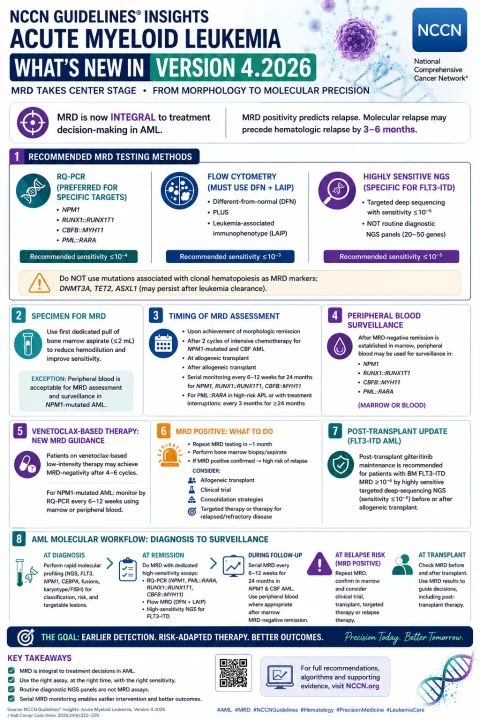
The 2026 NCCN AML update says: rapid molecular profiling should guide diagnosis and therapy, but MRD requires dedicated high-sensitivity assays, with PCR for NPM1/CBF/PML::RARA, expert flow MRD using DFN plus LAIP, and highly sensitive deep NGS specifically for FLT3-ITD.
MRD Takes Center Stage.
The latest NCCN Guidelines Insights for Acute Myeloid Leukemia (Version 3.2026) mark an important shift in how we think about remission and disease monitoring in AML.
The message is clear: a morphologic complete remission is no longer the finish line. Molecular remission matters.
Some of the key updates include:
- MRD is now recognized as an integral component of treatment decision-making.
- Standard diagnostic NGS panels should not be used for MRD because they lack the required sensitivity.
- RQ-PCR remains the preferred MRD modality for NPM1, RUNX1::RUNX1T1, CBFB::MYH11, and PML::RARA.
- Flow cytometry MRD should incorporate both Different-from-Normal (DFN) and Leukemia-Associated Immunophenotype (LAIP) approaches.
- For FLT3-ITD AML, NCCN now recommends highly sensitive targeted deep sequencing (≤10⁻⁵ sensitivity) for MRD assessment.
- Mutations associated with clonal hematopoiesis such as DNMT3A, TET2, and ASXL1 should not be interpreted as reliable MRD markers.
- Serial MRD monitoring every 6-12 weeks for 24 months is recommended for NPM1-mutated and Core Binding Factor AML.
- New guidance has also been introduced for venetoclax-treated AML and post-transplant FLT3-ITD maintenance with gilteritinib based on MRD status.
For those of us working in molecular hematology, this update reinforces an important principle:
Rapid molecular profiling and MRD testing are complementary, not interchangeable.
Rapid genomics identifies the biology that drives the leukemia. High-sensitivity MRD testing tells us whether that biology has truly been eradicated.
As precision medicine evolves, the future of AML management will increasingly depend not only on identifying mutations at diagnosis, but on tracking them with the right assay, at the right time, and with the right sensitivity.
Precision begins with diagnosis. It succeeds with monitoring.”
Other articles featuring Shrinidhi Nathany on OncoDaily.