





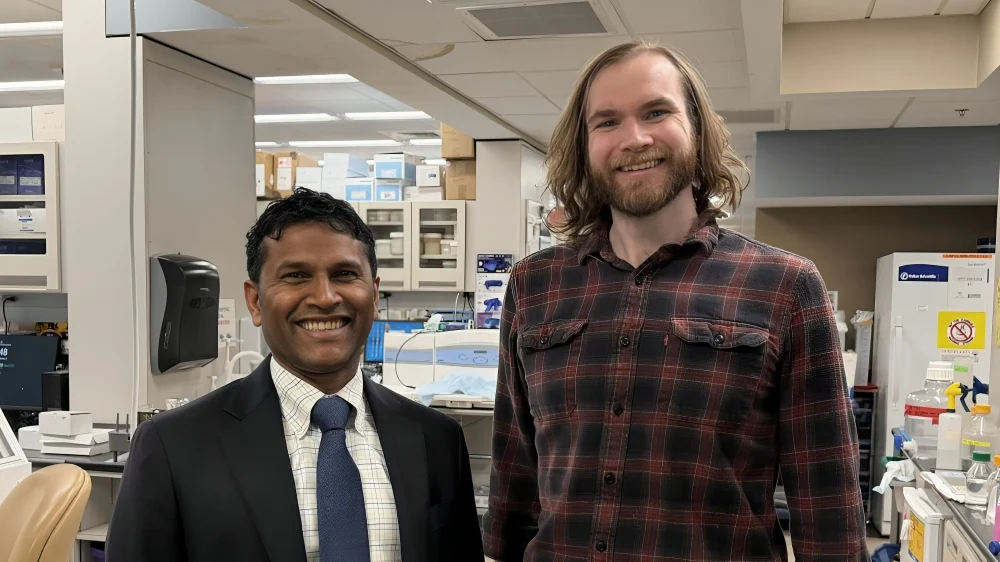
Sendurai Mani, Associate Director of Translational Oncology, Dean’s Chair of Translational Oncology, and Professor of Medicine at Brown University, and Co-Founder and CSO of Iylon Precision Oncology, shared a post on LinkedIn:
“Why do we show up every day, knowing most experiments will fail?
I am incredibly lucky to have brilliant students and trainees in my lab at Brown University, the Legorreta Cancer Center, and at The Warren Alpert Medical School of Brown University. They embody curiosity, resilience, and a profound commitment to their research. Scientific research is often a challenging journey marked with uncertainty and setbacks, yet they consistently work with deep passion and persistence. I plan to share a series of conversations focused on who they are, what drives their science, and the passion and perseverance behind their work.
Today, I share the story of Dr. Nick Kuburich, Research Associate.
1. How would you describe yourself beyond your academic role?
I am someone that is motivated by solving hard problems at their root rather than working around them. I enjoy interacting with others and have a constant drive to keep moving. In my personal life, I enjoy playing video games with my wife and friends, watching shows, and I am currently learning Japanese.
2. What first sparked your interest in research?
My high school AP Biology teacher, Mr. Thomas Culp, was instrumental in my love for biology. He was an excellent teacher and someone whom I aspire to be as a mentor and educator. He passed away much too young in a car accident a year after I took his class when I was a senior in high school, but I think of him often.
3. When research doesn’t go as planned, what keeps you moving forward?
I believe all results have a meaningful outcome, even when they are failures. If the results do not support my hypothesis, then this just means that it must be reframed. It is not a step back, but a step in the right direction towards the truth.
4. What personal value, belief, or motivation drives your commitment to your work?
I am deeply interested in biology and science, and I feel that cancer research is the best way I can apply my interests to make a positive impact on the world. I am very fortunate to be doing research because it has never felt like work to me since I started in 2018 in the Mani lab at MD Anderson Cancer Center.
5. What question are you most curious to answer right now and why?
How can we improve the lives of cancer patients by coming up with innovative treatments at the basic biology level? How can I best use my interests and experience to help those who need it most?
6. What do you hope this research journey helps you become?
I hope to inspire others to do research, specially mentees that will become the next generation of scientists.”
Other articles featuring Sendurai Mani.