Saurabh Zanwar, Assistant Professor at Mayo Clinic, shared on X:
” As response-adapted myeloma trials increasingly use early MRD negativity to guide treatment randomization and possible de-escalation, a key question is: Does MRD negativity after ASCT overcome the adverse biology of high-risk cytogenetics?
Our latest Leukemia Journal study suggests not necessarily. Take-home message.
MRD negativity after ASCT does not fully overcome the adverse prognostic impact of high-risk cytogenetics.
Title: Cytogenetics-based clinical trajectories in patients with MRD negativity post autologous transplant for multiple myeloma
Authors: Estefania Gauto Mariotti, Shaji Kumar, Wilson Gonsalves, Prashant Kapoor, Francis Buadi, Suzanne Hayman, Nadine Abdallah, Moritz Binder, Joselle Cook, Angela Dispenzieri, David Dingli, Morie A. Gertz, Taxiarchis Kourelis, Nelson Leung, Yi Lin, Mustaqeem Siddiqui, Ronald Go, Eli Muchtar, Rahma Warsame, Dragan Jevremovic, Robert A. Kyle, S. Vincent Rajkumar, Saurabh Zanwar
Among 351 newly diagnosed MM patients who achieved MRD negativity (~2×10⁻⁶ sensitivity) by day 100 after ASCT, outcomes remained strongly influenced by baseline cytogenetics.
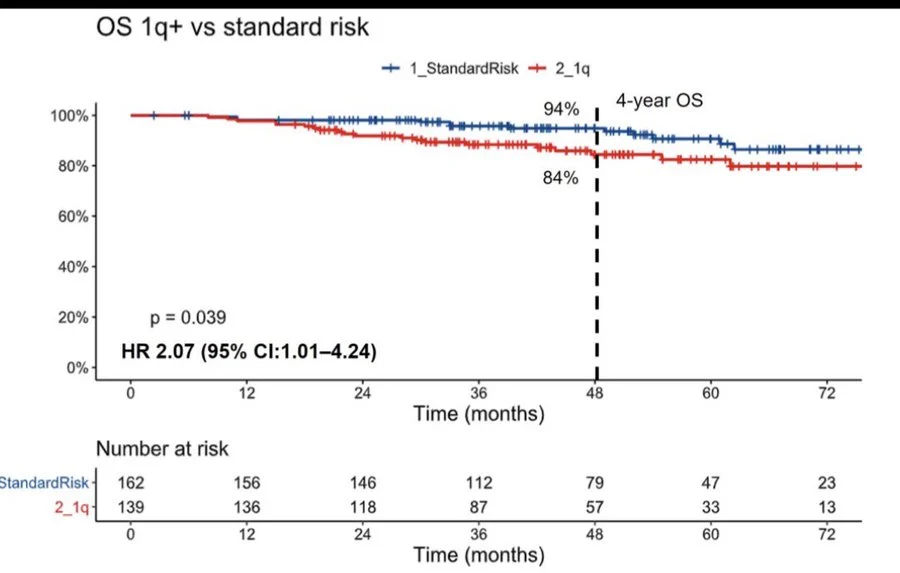
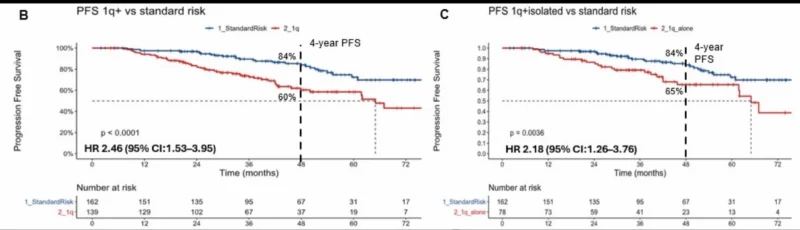
The most striking finding was chromosome 1q21 gain/amplification. Despite MRD negativity:
- Standard-risk: 4-year PFS 84%
- 1q21+: 60% (HR 2.46)
- Isolated 1q21+: 65% (HR 2.18)
Importantly, isolated 1q alone remained prognostic – even without another high-risk lesion. This challenges the notion that 1q requires additional coexisting abnormalities before becoming clinically meaningful.
Among MRD-negative patients:
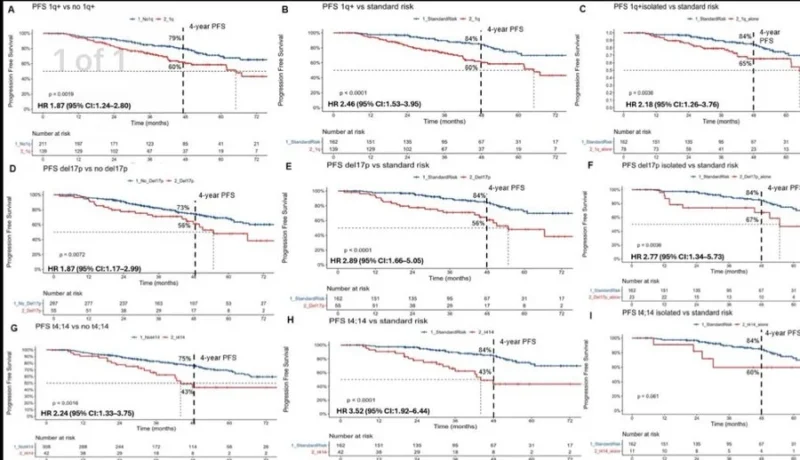
- del(17p): 4-year PFS 56% (HR 2.89)
- Isolated del17p: 67% (HR 2.77)
- t(4;14): 4-year PFS 43% (HR 3.52)
- isolated t(4;14): 4-year PFS 60% (HR 3.52)
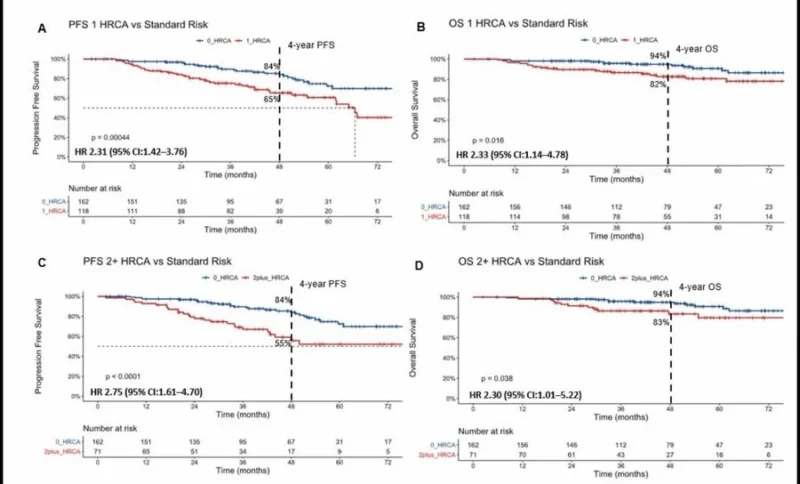
Patients with ≥2 HRCAs had the poorest outcomes (4-year PFS 55%), but even a single HRCA carried substantial residual risk (65%).
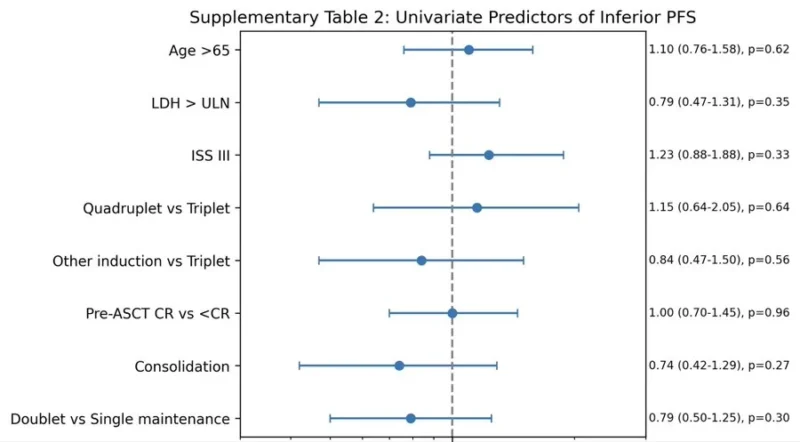
What predicted inferior PFS after MRD negativity?
- Age
- ISS III
- LDH
- Quadruplet vs triplet induction
- Pre-ASCT CR
- Consolidation
- type of maintenance
High-risk cytogenetics emerged as the only established prognostic marker for PFS in this MRD neg cohort.
Why is this study important? IFM2009 and GEM2012 had suggested MRD negativity may attenuate cytogenetic risk or adverse impact of R-ISS3.
This cohort of patients, despite uniform MRD negativity post ASCT and treated with:
- contemporary therapies
- more frequently doublet maintenance and consolidation in HRCAs.
Yet HRCA, including isolated abnormalities, remained independently associated with inferior PFS.
Congratulations to Estefania Gauto Mariotti for leading this work and bringing it to publication following last year’s ASH oral presentation! Grateful to the entire Mayo myeloma group for their support throughout this effort.”
Other articles about Myeloma on OncoDaily.