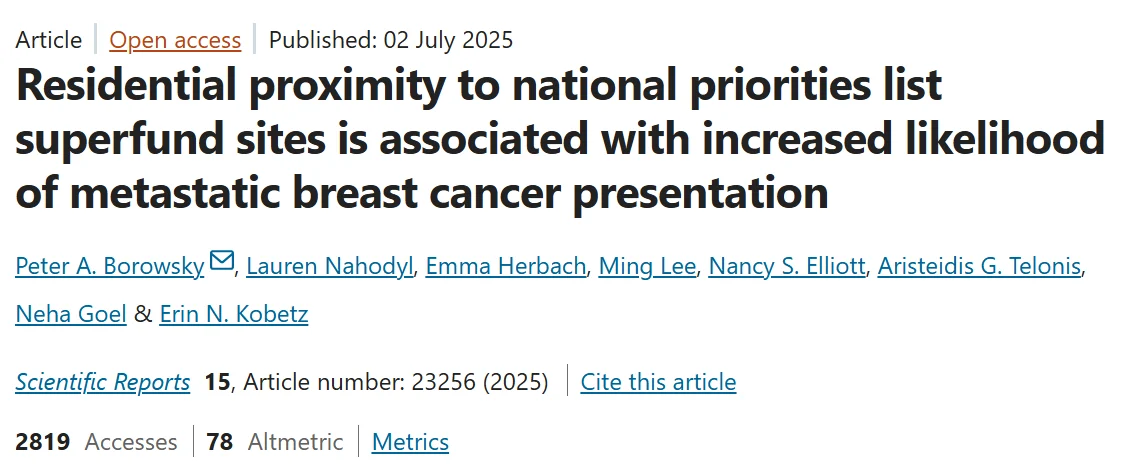
Sarah Sammons, Breast Medical Oncologist and Senior Physician at Dana-Farber’s Breast Oncology Center, shared a post on LinkedIn about recent article Peter A. Borowsky and colleagues authored:
“Patients with breast cancer often ask why – and too often, we don’t have concrete answers. I’ve long believed environmental exposures may be a missing piece.
Key findings from our population-based study:
• 21,505 women with breast cancer analyzed (Florida Cancer Data System, 2015–2019)
• ~10% lived in areas with ≥1 NPL Superfund site
• Living near a Superfund site (toxic waste) was associated with ~30% higher odds of metastatic disease at diagnosis
• The association persisted after adjusting for age, race, ethnicity, insurance, and income
These data suggest environmental exposures may influence not just cancer risk, but tumor biology and aggressiveness. While causality can’t be assumed, this reinforces the need to better integrate environmental health into how we think about cancer prevention, disparities, and outcomes.”
Title: Residential proximity to national priorities list superfund sites is associated with increased likelihood of metastatic breast cancer presentation
Authors: Peter A. Borowsky, Lauren Nahodyl, Emma Herbach, Ming Lee, Nancy S. Elliott, Aristeidis G. Telonis, Neha Goel, Erin N. Kobetz