





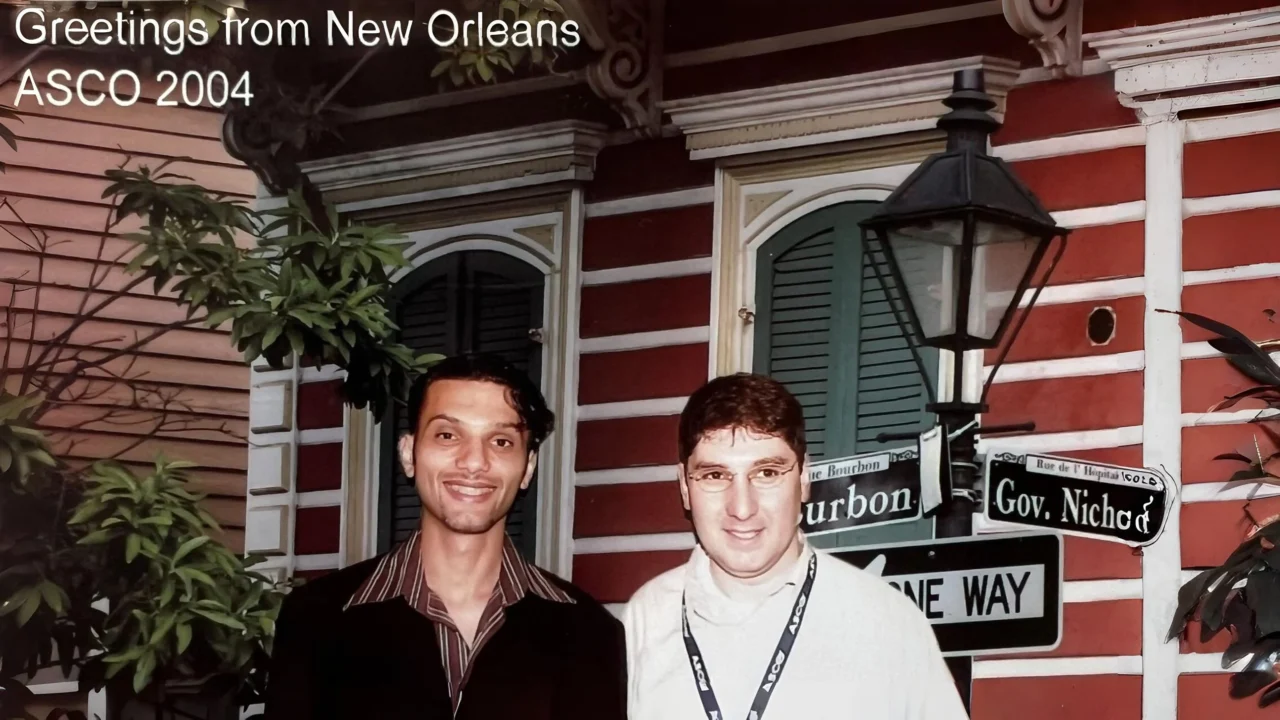
Salah-Eddin Al-Batran, Director Institute of Clinical Research at University Cancer Center Franfkurt, shared a post on LinkedIn:
“From FLO to FLOT to D-FLOT: A Twenty Year Journey
Looking back at this photo taken twenty one years ago at the 2004 ASCO Congress with my colleague and friend Akin Atmaca beside me it is almost hard to believe how much has happened since then.
At that time we were young researchers full of ideas, driven by the hope that we could change something meaningful for patients. What followed was a journey none of us could have imagined at that time.
Around 2004 my colleagues and I reported on the FLO regimen as the first oxaliplatin based therapy for gastric and esophageal cancer which was more tolerable than the cisplatin based therapies.
In 2008, we published the first small trial with FLOT in advanced patients where the addition of docetaxel induced deeper and more frequent responses.
A few years later in 2012 we observed that FLOT produced high pathological response rates in localized stage.
In 2016 we published our study on the use of FLOT in older adult patients which confirmed that the regimen was feasible.
In 2017 we published the landmark FLOT4 trial which demonstrated that FLOT could outperform the ECF regimen in curable disease and provide patients with a survival benefit of 9%.
It still took years to establish FLOT worldwide in esophageal and junctional tumors. Many researchers continued to prefer chemoradiation for this group. A new breakthrough came with the ESOPEC trial which independently confirmed that FLOT also outperformed chemoradiation with CROSS. From that moment the global acceptance of FLOT accelerated and it became the fundamental backbone of perioperative therapy.
Seeing now that FLOT can be further improved with the addition of durvalumab (+7% in OS) in the MATTERHORN study presented at ESMO 2025 and that D-FLOT has now been approved in the US is a deeply moving moment for all of us who have been part of this long journey. It shows that persistence, collaboration and an unwavering belief in scientific progress can truly change standards of care.
I am deeply grateful to my colleagues in Germany for their trust and their persistence throughout this journey. And I am proud that our collective efforts continue to move the field forward for patients with gastric and esophageal cancer.”
More posts featuring Salah-Eddin Al-Batran on OncoDaily.