





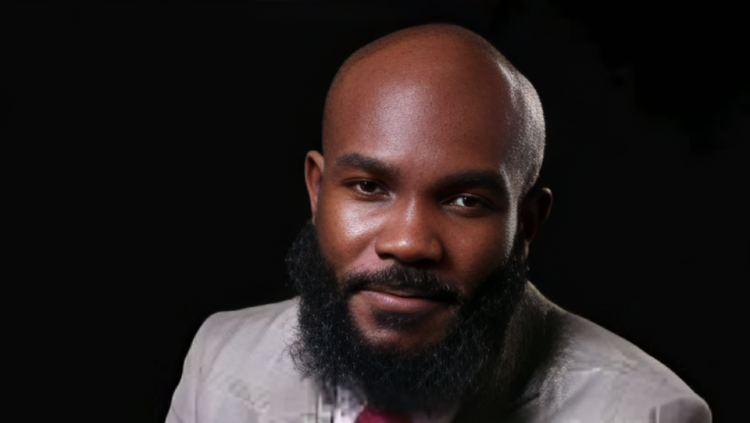
Runcie C.W. Chidebe, Executive Director at Project PINK BLUE, shared a post on LinkedIn about a paper he co-authored with colleagues published in Supportive Care in Cancer:
“New Publication!
In 2016, when I attended the Union for International Cancer Control (UICC) World Cancer Congress in Paris, I saw many cancer patients and survivors at the Patient Pavilion; however, I was devastated that almost all patients and survivors were White or from high-income countries.
Black and African patients were missing. Instead of being angry or frustrated, I transformed my devastation into action and a solution.
By 2017, I founded the Abuja Breast Cancer Support Group, and in 2019, I founded the Network of People Impacted by Cancer in Nigeria. Through these cancer support groups, I have supported thousands of cancer patients in Nigeria and helped them attend and speak at conferences in the U.S., Portugal, Italy, and across Africa.
I remember when we started, we adopted the use of ‘Champion’ to ensure that we don’t have issues with clinicians adopting 5 years post-treatment before a patient could be referred to as a survivor. As of today, the support groups are led by patients and thriving.
Many people have been asking me how we, Project PINK BLUE, did it. I decided to put our strategies into a manuscript and share them with you all.
We found that Cancer Support Group:
- When patients are connected, they have a collective voice.
- The support group provides an opportunity for patients to become advocates.
- Support groups enable patient education about the disease.
- At our support group, we match patients with mentors and have older patients support newer ones.
- Support group promotes peer support and provides a platform for patients to be seen, heard, and understood.
Based on our findings, we argue as follows:
- That CSGs serve as a source of supportive care.
- The new Nigeria National Strategic Cancer Control Plan should prioritize and allocate a budget for supportive care.
- National Institute for Cancer Research and Treatment should consider spearheading the campaign for all Oncology Centers of Excellence (OCE) to establish cancer support groups in their facilities.
- Cancer patients need a voice in their care, and the CSG provides this voice, enabling them to participate in the decision-making process concerning their treatment.
- Personal narrative of a single cancer patient or survivor holds far more weight than that of a thousand non-cancer patients.
- CSOs in Nigeria need to set up support groups in their locality. When patients see other patients, they trust the treatment and the likelihood of survival more.
Conclusion: If Nigeria, Africa, and many LMICs want to make progress in their cancer control efforts, then meaningful engagement, culturally sensitive support, and collaboration with cancer patients must be prioritized.
Special thanks to my co-authors, especially the patient authors Swat and Mide.”
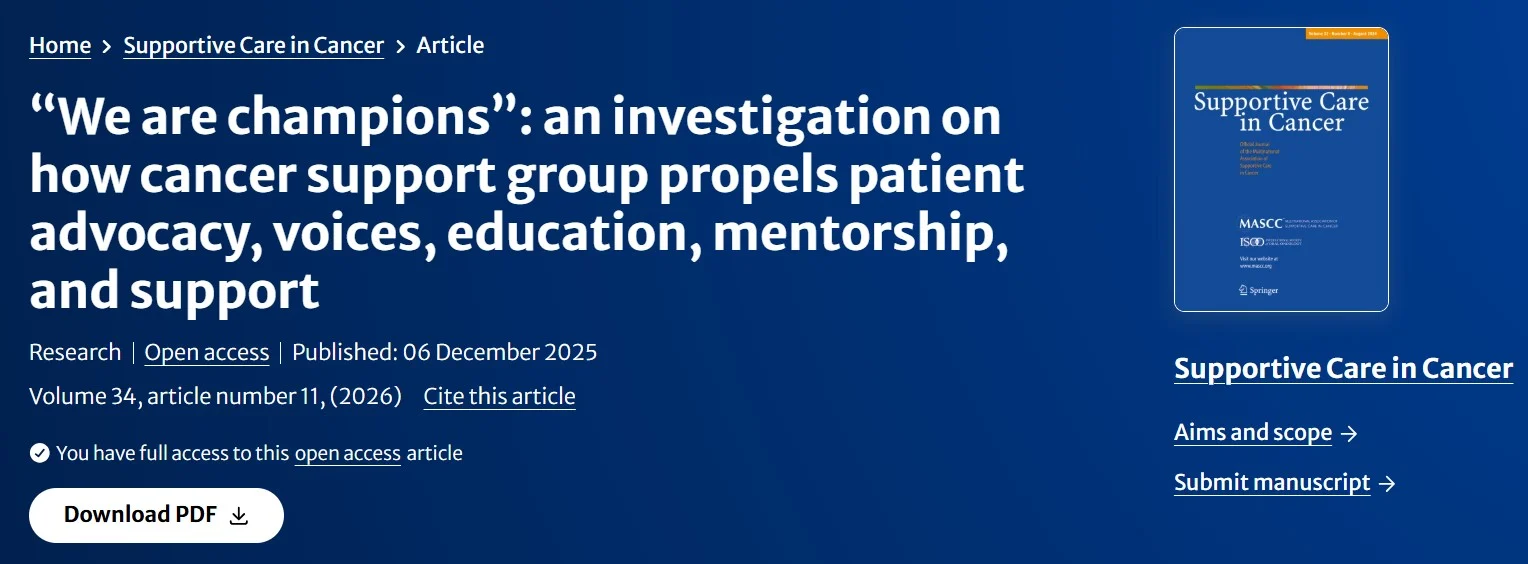
Title: “We are champions”: an investigation on how cancer support group propels patient advocacy, voices, education, mentorship, and support
Authors: Runcie C. W. Chidebe, Swat Kasa Gimba, Agha A. Agha, Oluwatobiloba D. Oguntoyinbo, Leigh Leibel, Banwo Faridah Mobolanle, Ahmed Danquah, Mide Agbola, Chinwendu V. Igboekulie, Aman Shrestha, Chioma Nwakanma-Akanno, Ifeoma J. Okoye, Maria Chidi C. Onyedibe
You can read the full article in Supportive Care in Cancer.
More posts featuring Runcie C.W. Chidebe.