





Roupen Odabashian, Hematology/Oncology Fellow at the Karmanos Cancer Institute, shared a post on LinkedIn:
“Midjourney just announced a 60-second full-body scanner that claims to rival an MRI. As an oncologist who sees cancer patients every week, here is the part I can’t stop thinking about.
They are calling it “Ultrasonic CT” (powered by a $74M partnership with Butterfly Network). No X-rays. No radiation. Just you descending into a shallow pool of water while underwater sensors use sound waves to map your body.
The estimated cost? Around $100 a scan.
The dream is incredible: a full-body scanner in every mall, making health checks as routine as stepping on a bathroom scale.
But here is the reality check from the clinic:
The Evidence Gap: We have a polished prototype, but medicine runs on peer-reviewed data. Right now, there is no published proof of diagnostic accuracy for cancer detection—only for body composition.
The Physics Ceiling: Ultrasound can’t travel through bone or air. This leaves the brain, lungs, heart, and bowel largely out of reach—which is exactly where many cancers live and spread.
Getting screening right isn’t just about making the scan cheap. It’s about making it cheap AND accurate enough to be worth doing.
I am cautiously optimistic I would love to have this technology in every mall.
We are one step closer to the mass screening tools we desperately need, but we still have a long way to go. I break down the technology, the clinical realities, and why “cheap” cuts both ways in my latest article.
I want to know your thoughts: If a 60-second body scan opened in your neighborhood tomorrow for $100, would you get one every year? And if it found something, then what? Let me know in the comments.
A 60-Second Body Scanner That Claims to Rival an MRI: An Oncologist’s Honest Take on Midjourney Medical
An AI art company just announced a 60-second full body scanner that it claims is in some ways better than an MRI.
As an oncologist who sits across from cancer patients every week, here is the part I cannot stop thinking about.
I see a lot of cancer. It breaks my heart every single time. The young patients, and the older ones who have lived full lives, all of them are scared, and the disease is brutal to live with and brutal to treat.
No one should die from cancer.
So let me be honest about where we actually stand.
We have gotten very good at buying time. We prolong survival by years now, and that is real progress. But for most advanced cancers, we are not curing people. They do not wake up one morning with their old life handed back to them.
That is why screening matters so much. The earlier we catch it, the more often we actually win.
Here is the tension most people miss:
- Today, the evidence recommends against whole body screening scans for healthy people.
- Not because looking inside your body is bad, but because we do not yet have proof that scanning everyone saves more lives than it costs.
- Guidelines weigh the benefits against false positives, unnecessary procedures, and finite healthcare resources.
“Recommended against” does not mean “never.” It means “we do not have the evidence yet.”
We need better screening tools. And we need to educate people about what those tools can and cannot do.
My dream is simple. A full body scanner in every mall. The same way you can step on a scale and know your weight, you should be able to know what is going on inside your body. We are still far from that.
Which brings me to Midjourney.
Yes, the AI image company. They just launched Midjourney Medical and a full body ultrasound they call “Ultrasonic CT.” The fuller name is Fullbody Ultrasonic Computational Tomography. Despite the “CT” in the name, there is no X-ray and no radiation. It is sound.
Here is how it actually works:
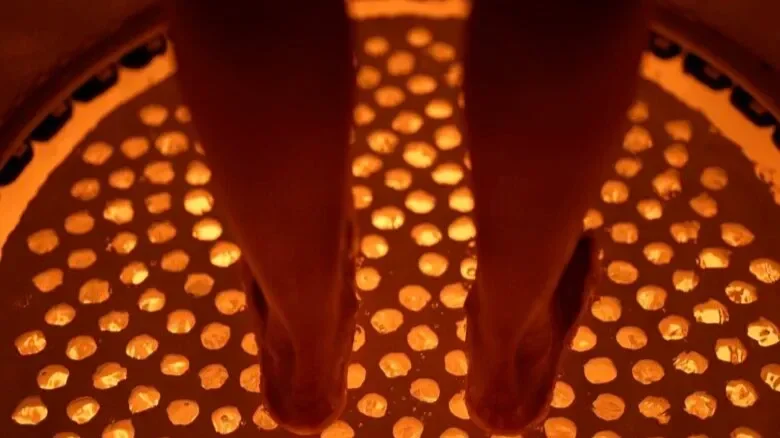
- You step onto a platform and slowly descend into a shallow pool of water, sinking at about two inches per second.
- As you move, you pass through a ring of underwater sensors. Picture each one like a dolphin using echolocation, firing ultrasonic waves through your body from every angle.
- The platform pulls you through at roughly 4 cm per second, aiming to capture the whole body in about 60 seconds.
- A compute cluster then reconstructs those echoes into 3D cross sections of muscle, fat, bone, and organs, reportedly down to a fraction of a millimeter.
- No radiation. No giant magnets. Just sound and water.
A few things worth knowing under the hood:
- The imaging is not Midjourney’s famous art AI. It is licensed from Butterfly Network, the ultrasound on chip company, in a deal worth up to roughly 74 million dollars. The prototype uses 40 of their chip modules, packing around half a million tiny sensors.
- The underlying idea, ultrasound tomography, is real and most mature in dedicated breast imaging. This is not science fiction. It is an ambitious stretch of something that already exists.
- At launch it maps body composition: fat, muscle, bone, and organs. It is not a diagnostic device and has no FDA clearance.
- This is a first generation prototype. The roadmap talks about custom silicon by 2028 and a fleet of 50,000 scanners doing a billion scans a month by 2031.
- The first “Midjourney Spa” opens in San Francisco in late 2027. Early estimates put a scan around $100.
Now the part that matters most to me as a physician: the evidence is not there yet.
Right now, what exists is a working prototype and a polished marketing site. What does not exist is the thing medicine actually runs on: published, peer reviewed, independently validated data.
- “Comparable to, and in some ways better than, MRI” is the company’s own framing from a launch event, not a validated finding. A beautiful image of a thigh next to an MRI is a demo, not proof of diagnostic accuracy.
- There are no published trials. No sensitivity and specificity numbers. No blinded reads by radiologists. No data on how it performs across real, messy human bodies rather than a controlled phantom.
- Physics sets a hard ceiling. Ultrasound cannot travel through bone or air, so the brain behind the skull, the lungs, the heart, and much of the gas filled bowel stay largely out of reach. That is exactly where an enormous amount of cancer lives and spreads.
- Body composition mapping, the launch use case, is the one thing ultrasound is genuinely validated for. Measuring fat and muscle against gold standards like DXA has solid evidence behind it. Whole body cancer detection does not.
- Even Butterfly, the company supplying the technology, is careful, saying it will support claims “with valid clinical data as applicable.” Read that slowly. The data still has to be generated.
And here is the deeper screening problem, the one that has nothing to do with Midjourney specifically:
Finding more is not the same as helping more. Almost every organ in your body grows harmless little lumps: cysts, polyps, lipomas, nodules. We are still not great at telling these apart from the dangerous ones at a glance. Scan a million healthy people and you will surface a mountain of them. Most lead nowhere except anxiety, repeat scans, biopsies, and occasionally a real complication from chasing something that was never going to hurt you.
That is why catching cancer earlier does not automatically save lives. It has to be the right cancer, caught at the right moment, with a treatment that actually changes the outcome. We have proven that for breast, colon, and lung within specific protocols. We have not proven it for scanning everyone, everywhere, all the time. That is what “the evidence recommends against it” really means. It is not “never.” It is “not yet shown to do more good than harm.”
Which brings me to the piece people underestimate: price.
In screening, price is not a footnote. It is close to the whole game. The cost of a test decides whether it stays a boutique luxury for the worried wealthy or becomes something an entire population can actually use.
- A whole body MRI runs around $2,000 out of pocket, needs a referral, and ties up a scarce machine for an hour. That is why it will never be a population screening tool.
- Midjourney is betting the other way. Ultrasound chips follow far better cost curves than giant MRI magnets, so at scale the price could fall hard and fast. Early estimates float around $100 a scan.
- Cheap enough, and you unlock something genuinely new: screening as a habit, not a rare event. That is the dream behind my bathroom scale comparison.
But cheap cuts both ways, and this is the part I want people to sit with.
A $100 scan sold to healthy people is exactly the setup that can trigger a financial and emotional avalanche. If the scan is cheap but the false positives are not, you have not saved anyone money. You have just pushed the cost downstream onto frightened people and an already strained system: the follow up MRI, the biopsy, the specialist visit, the sleepless months waiting for results.
So the price that makes mass screening possible is the same price that makes mass overdiagnosis possible. The number that excites me is the same number that worries me.
Getting screening right is not about making the scan cheap. It is about making it cheap AND accurate enough to be worth doing. We are not there yet.
So what is my take?
We are one step closer to the screening tools we desperately need. And we still have a long way to go.
I am cautiously optimistic. I would love to see something like this become cheap, safe, and sitting in every mall and health center one day. We are not there yet. But for the first time in a while, I can see the road.
If a 60-second body scan opened in your neighborhood tomorrow, would you get one every year? And if it found something, then what?”
Other articles featuring Roupen Odabashian on OncoDaily.