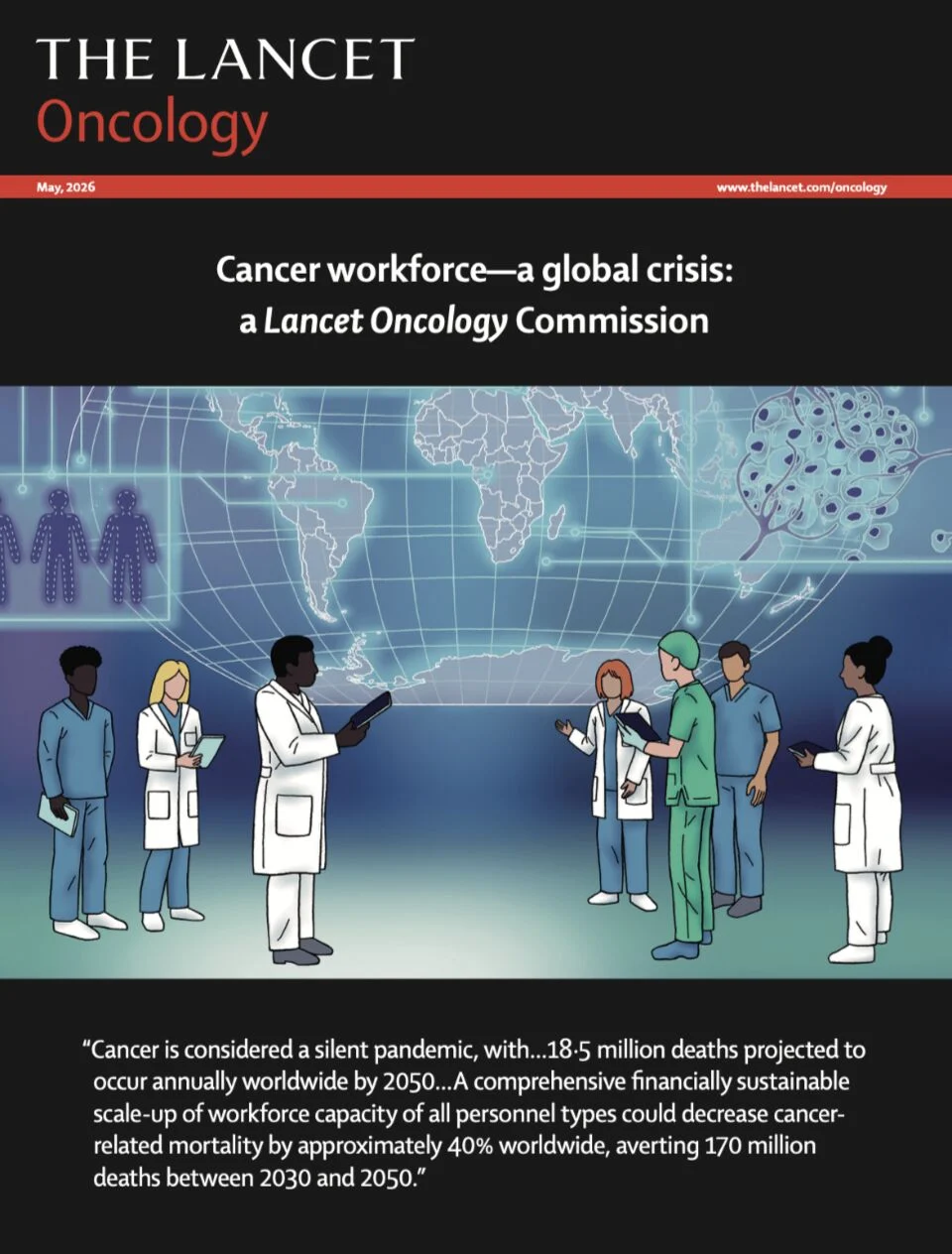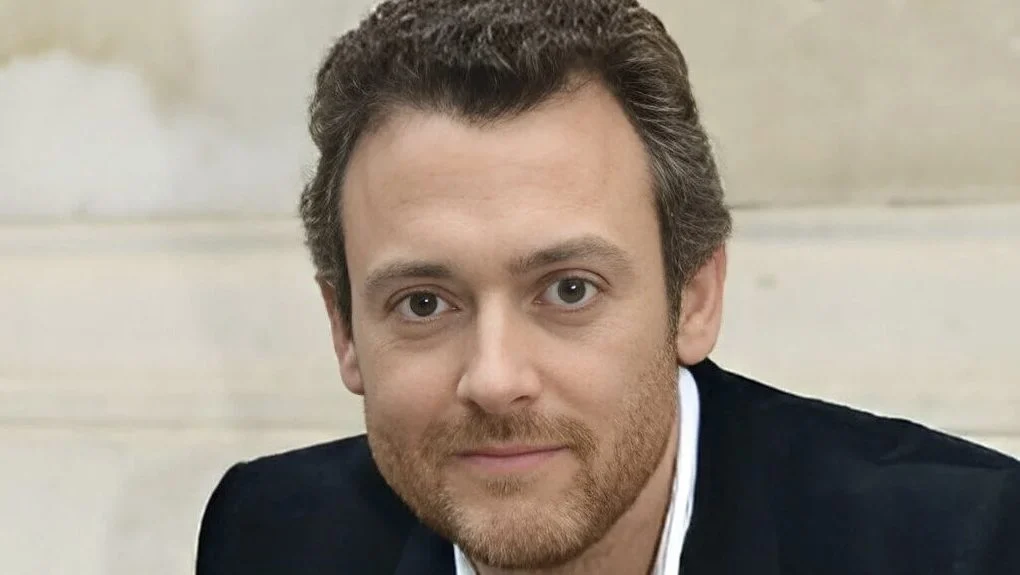
Richard Sullivan, Co-Director of the Centre for Conflict and Health Research, and Professor of Cancer and Global Health at King’s College London, shared a post on LinkedIn about a recent article he and his colleagues co-authored, adding:
“A crisis is a time of intense difficulty and instability. But the root Greek word – krisis – means a ‘turning point’ or ‘decision’ in a predicament. And so this is where we find ourselves today with the world’s cancer workforce. The new Lancet Oncology Commission on the Cancer Workforce, which focuses on Sub-Saharan Africa (SSA) and Latin America, gives some sense of this crisis. I say only ‘some sense’ because, for most countries, the data has had to be modelled. Despite the billions that flow into healthcare, the inability of countries to properly measure the cancer workforce leaves a huge policy gap.
The findings from the Commission mirror much of the contemporary work on the healthcare workforce, e.g., the State of the Healthcare Workforce in Africa. Failure to keep pace with need; uneven access to the specialised workforce; competence is a major bottleneck; training alone will not solve the crisis; the paradox of shortages yet unemployment; migration; absenteeism; and a continual failure by governments to invest in the public-sector workforce.
Oh, and the political barriers. The irony of a workforce Commission launch in the USA, which now has full or partial entry restrictions on 40 countries, is not lost on anyone.
Policy in high-income countries shoulders a fair proportion of the blame for this crisis. As we pointed out in the Commission on the Human Crisis in Cancer, no one ever took the Recife Political Declaration on Human Resources for Health, adopted in 2013, seriously. Cancer workforce planning failures in high-income countries create massive osmotic gradients. But this needs to be balanced by the fact that in many transitioning countries, public sector health salaries are generally appalling. Increasingly, private-sector salaries in these countries reach 5 times or more of public-sector incomes. This is a pure and simple political failure.
Whilst the Commission goes into some length about the ‘promise’ of technology, digital (including AI) and technical solutions will only go so far. Cancer is a prime example of Baumol’s Cost Disease; it is a labour-intensive health service in which technology mostly increases costs without changing productivity. The Commission also tackles the R&D workforce. But with high-income countries withdrawing major funding and with little sign of domestic resource mobilisation, regions like SSA will continue to see stagnation in their outputs.
In its broad focus on labour markets, the World Bank has hit the nail on the head, especially for the health workforce. Individual countries will need to transform their approach to the public-sector cancer system labour market through data-driven policy and financing. And research funding organisations will need to do the same for the research workforce.”
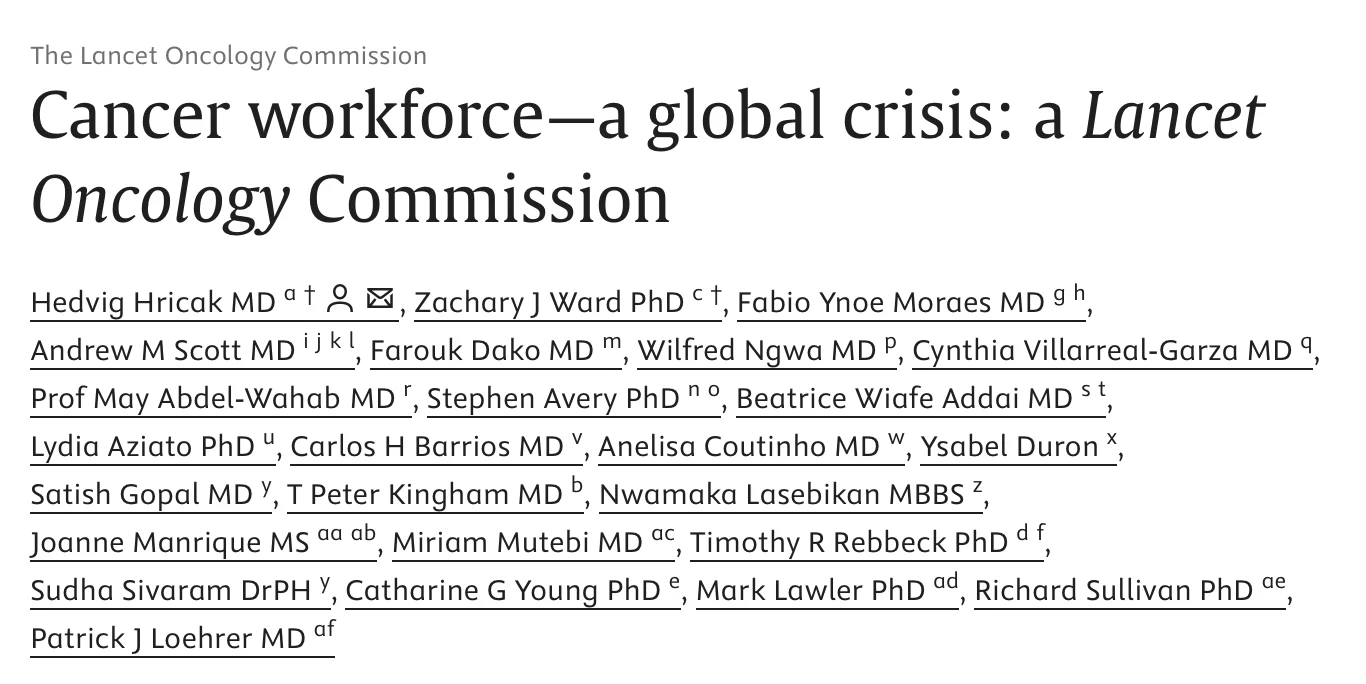
Title: Cancer workforce—a global crisis: a Lancet Oncology Commission
Authors: Hedvig Hricak, Zachary Ward, Fabio Ynoe Moraes, Andrew Scott, Farouk Dako, Wilfred Ngwa, Cynthia Villarreal-Garza, May Abdel-Wahab, Stephen Avery, Beatrice Wiafe Addai, Lydia Aziato, Carlos Barrios, Anelisa Coutinho, Ysabel Duron, Satish Gopal, T. Peter Kingham, Nwamaka Lasebikan, Joanne Manrique, Miriam Mutebi, Timothy Rebbeck, Sudha Sivaram, Catharine Young, Mark Lawler, Richard Sullivan, Patrick Loehrer
Read rhetorical Full Article on The Lancet Oncology
More posts featuring Richard Sullivan.