






Rawia Mohamed, Head of the Anatomical Pathology Department at Burjeel Medical City, shared a post on LinkedIn:
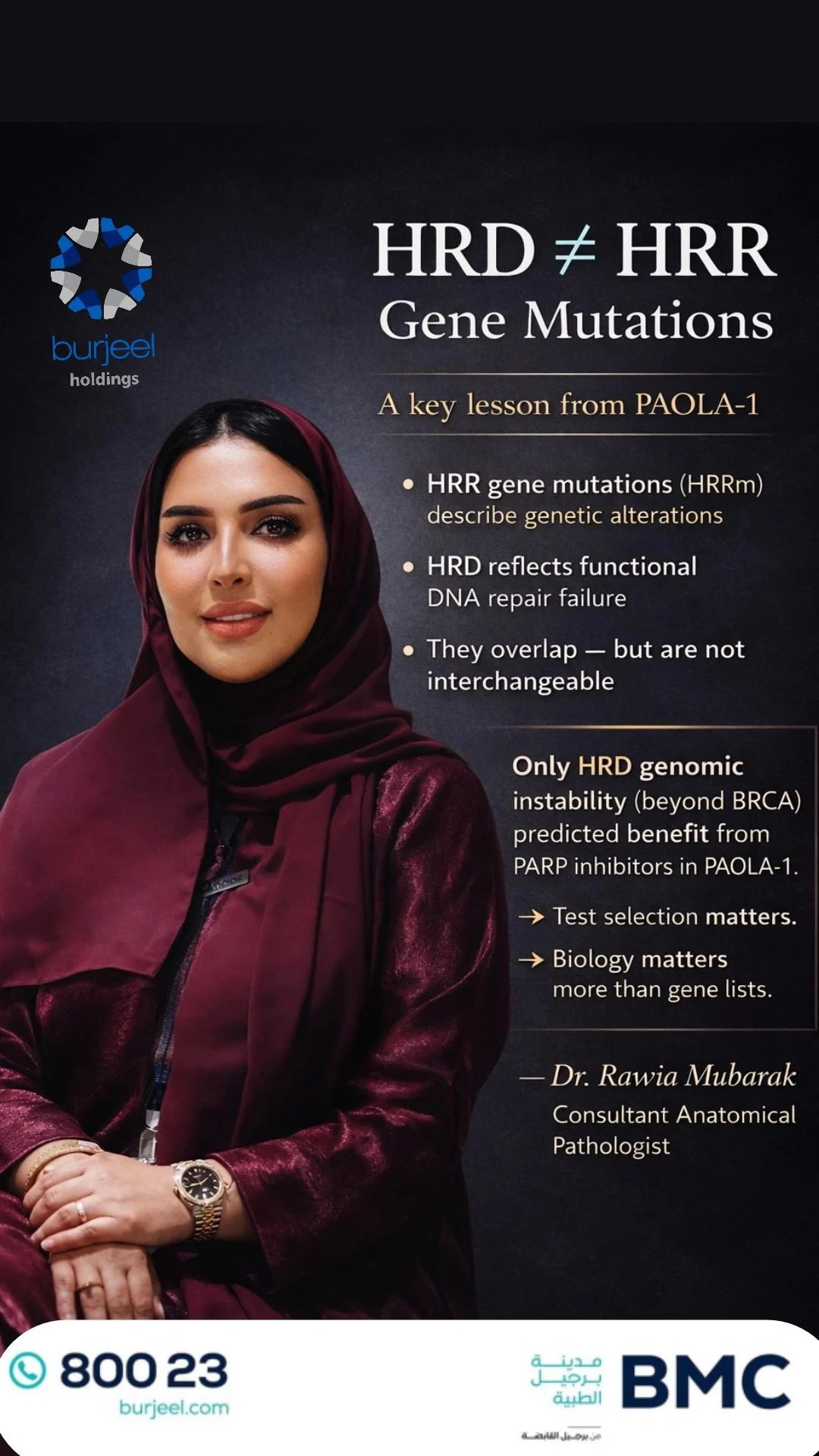
“Understanding the difference between HRD and HRR gene mutations is essential for optimal patient selection for PARP inhibitor therapy.
1. HRRm and HRD are related—but not interchangeable
HRRm refers to mutations in homologous recombination repair genes detected by NGS panels.
HRD reflects the functional consequence of defective DNA repair, measured by genomic instability (“genomic scars”).
A tumor may be HRD-positive without detectable HRR gene mutations, and vice versa.
2. HRD testing captures more clinically relevant biology
Genomic instability assays identify tumors with functional homologous recombination failure, regardless of the underlying mechanism.
Non-BRCA HRD is significantly more frequent than non-BRCA HRRm, highlighting that gene panels alone underestimate true HR deficiency.
3. Predictive value differs between tests
In the PAOLA-1 trial, HRD positivity (excluding BRCA) predicted a clear progression-free survival benefit from olaparib plus bevacizumab.
Non-BRCA HRRm positivity alone did not predict benefit, despite biological plausibility.
Therefore, HRRm gene panels should not be used as a surrogate for HRD testing when making first-line maintenance decisions.
4. Practical clinical implication
HRD genomic instability testing should guide PARP inhibitor use, not HRR gene panels alone.
HRRm panels remain valuable for:
- Identifying BRCA mutations
- Hereditary cancer risk assessment
- Research and molecular profiling
However, they are not sufficient for treatment selection in the first-line maintenance setting.
5. Key takeaway for daily practice
HRD is a functional phenotype; HRRm is a genetic finding. Only HRD has demonstrated predictive value for PARP inhibitor benefit beyond BRCA in PAOLA-1.
Final clinical message
Test choice matters.
Using the wrong biomarker risks undertreating eligible patients or overtreating those unlikely to benefit.
HRD and HRRm answer different questions—and should be interpreted accordingly.”
More posts featuring Rawia Mohamed.