






Ramy Sedhom, Director of Medical Oncology and Palliative Care at Penn Medicine Princeton Health, University of Pennsylvania Health System, shared a post on X about a paper he co-authored with colleagues published in JCO Oncology Practice:
“Efrat Dotan and I in JCO Oncology Practice on pancreatic cancer in older adults.
PDAC needs a systems approach to evaluating fitness for older adults. We make the analogy that Edison’s light bulb is useless without durable filaments, sockets, and electric grids.
In the article that accompanies this editorial, Collineau et al show in a cohort of 142 patients > 70 yo: ->50% were malnourished
>80% had sarcopenia
>50% experienced grade ≥3 adverse events
Importantly, 14% received only one cycle and 12.5% never initiated therapy at all, underscoring how PDAC biology, as opposed to treatment choice, often dictates outcome
The study also highlights the paradox of dose intensity. Nearly 70% started with dose modifications, and most required further reductions; yet, those patients able to remain on therapy achieved mOS in a similar range to PRODIGE.
While this data is predictable, we ask whether we are even asking the right question. By focusing narrowly on who can endure FOLFIRINOX, we risk missing the more relevant point: what is the most tolerable approach to the care of older adults w/ PDAC, and who truly benefits?
In PDAC, the Edison lesson is similar: the discovery of an intense regimen is useless unless it is embedded in a system that makes treatment tolerable and meaningful for patients. That grid is built through geriatric assessment, supportive interventions, and integration of palliative care.
In contemporary oncology, precision is usually equated with genomics. But when caring for OA with PDAC, the most actionable precision tool may be GA
The oncology culture remains anchored in the maximum tolerated dose paradigm. Regulatory frameworks, payer models, and academic incentives still prioritize dose intensity and toxicity tables over tolerability and quality-of-life end points.
Most clinical trials are designed to ask what can be endured, rather than what is minimally effective. As a result, success is often defined by delivering full-dose therapy, not by tailoring treatment to vulnerabilities or preserving patient-defined goals.
For PDAC, we must ensure that the next breakthrough will not come from pseudo-innovations that add weeks of survival at the cost of months of toxicity. Immediate improvements can be attained by the incorporation of available tools to align treatments with the realities of aging and by recognizing that survival is measured not just in months gained but in what is preserved. Until then, we will continue to mistake endurance for benefit – and fail the very patients we most hope to help.”
Title: Prioritizing Benefit Over Tolerance Among Older Adults With Pancreatic Cancer
Authors: Ramy Sedhom, Efrat Dotan
You can read the Full Article in JCO Oncology Practice.

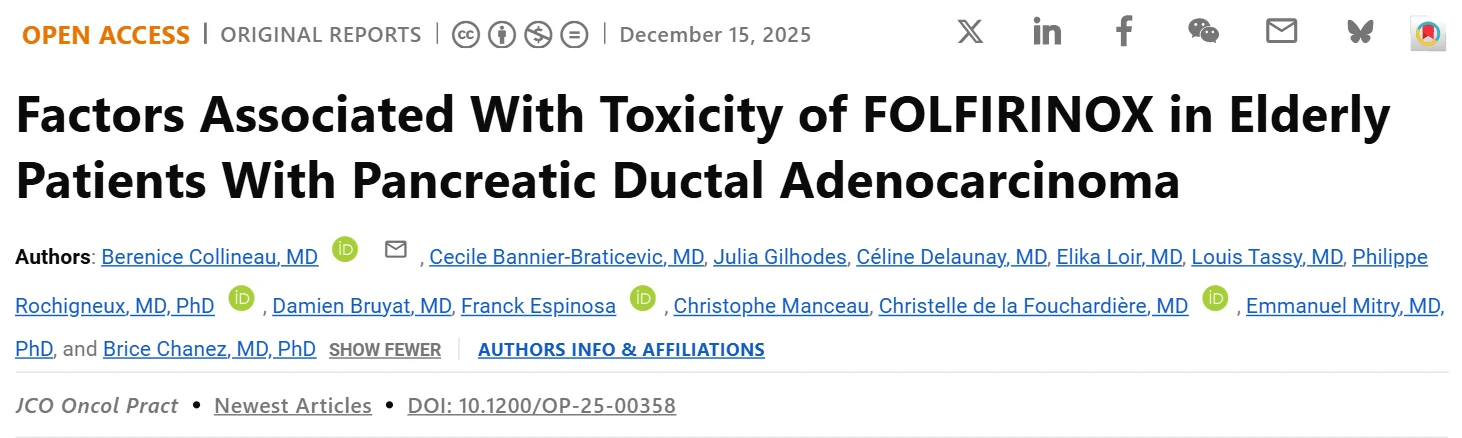
Title: Factors Associated With Toxicity of FOLFIRINOX in Elderly Patients With Pancreatic Ductal Adenocarcinoma
Authors: Berenice Collineau, Cecile Bannier-Braticevic, Julia Gilhodes, Céline Delaunay, Elika Loir, Louis Tassy, Philippe Rochigneux, Damien Bruyat, Franck Espinosa, Christophe Manceau, Christelle de la Fouchardière, Emmanuel Mitry, and Brice Chanez.
You can read the Full Article in JCO Oncology Practice.
More posts featuring Ramy Sedhom.