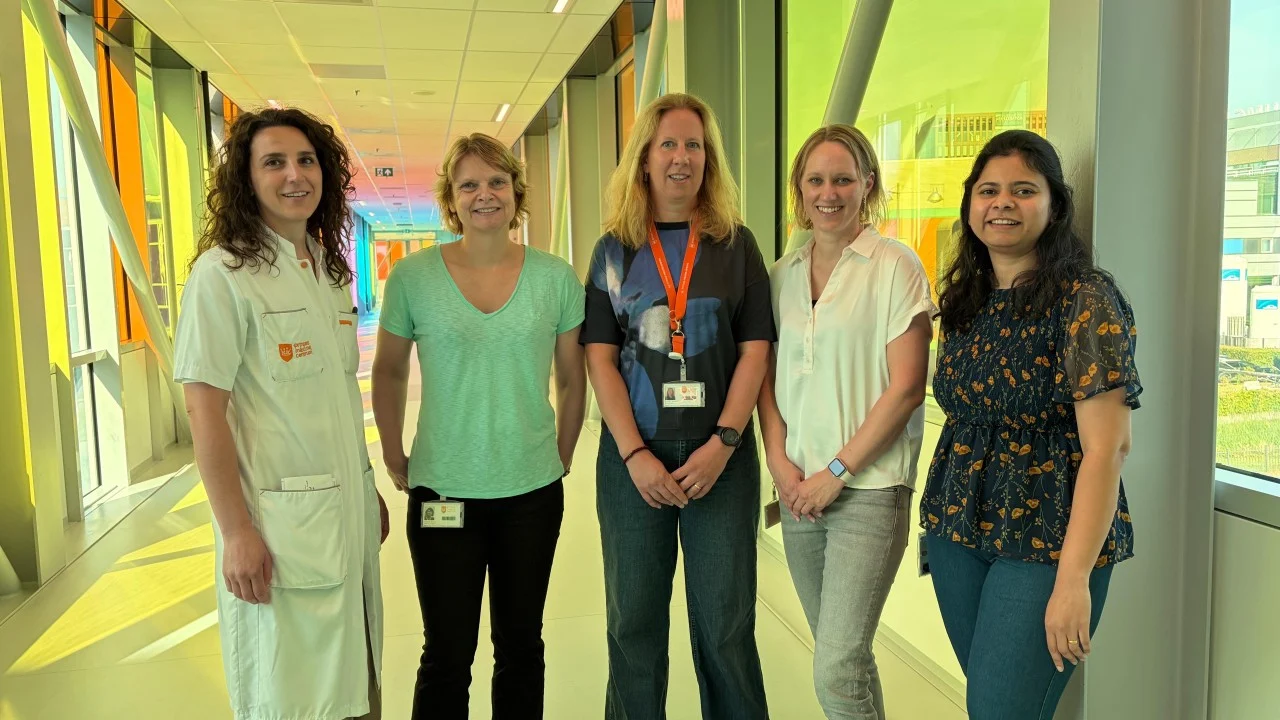
Prinses Máxima Centrum voor kinderoncologie (Princess Máxima Center) shared on LinkedIn:
“The targeted drug inotuzumab ozogamicin has been approved for children with acute lymphoblastic leukemia (ALL).
The decision was made earlier this year by the European Medicines Agency (EMA), which evaluates and approves medicines for use in the European Union. The approval is based in part on impressive results from a clinical trial investigating the drug, led by the Princess Máxima Center: three quarters of children were cancer free.
Results from a high-risk group of patients enrolled in the study were published last month in the leading journal The Lancet Haematology.
Acute lymphoblastic leukemia (ALL) is the most common form of childhood cancer.
In the Netherlands, around 150 children are diagnosed with the disease each year. Many are cured with standard treatment, which consists of chemotherapy and, in some cases, a stem cell transplant or CAR T-cell therapy. But new, alternative therapies are needed for children whose leukemia comes back after treatment.
The targeted drug inotuzumab ozogamicin has been available for adults with ALL since 2018. It is now approved for use in Europe as a standard treatment option for certain children with ALL. This applies to children with a high-risk form of the disease whose leukemia returns after chemotherapy. Before the drug becomes routinely available in the clinic, agreements on reimbursement must first be made with health insurance companies. Negotiations on this are currently ongoing.
Impressive results
The EMA’s approval is based on the impressive results of a clinical trial investigating inotuzumab. The study began at Erasmus MC in 2016, and since the opening of the Princess Máxima Center in 2018, the trial has been conducted by the Máxima Center.
‘It is unique for an academic study to lead to European approval of a medicine for children with cancer,’
says Prof. Dr. Michel Zwaan, who led the study.
‘I am extremely proud that our findings have contributed to the approval of this promising treatment for many more children with ALL, who are in urgent need of new and better therapies.’
Around 130 children with relapsed ALL received inotuzumab as part of the clinical trial. In approximately three-quarters of the children, the drug eliminated all detectable leukemia cells from the bone marrow. This is a very encouraging result for a new medicine, and particularly remarkable because this was an early-phase clinical trial. The primary goal of the study was to determine the safety and appropriate dose of inotuzumab for children.
The results for the group of children with a very high-risk form of ALL were recently published in The Lancet Hematology. The study was funded by Pfizer, the manufacturer of inotuzumab ozogamicin.
First-in-child clinical trial
Inotuzumab ozogamicin is a targeted therapy that binds to the CD22 protein on leukemia cells. The drug had already shown promising results in adults. The first-in-child clinical trial of inotuzumab, ITCC-059, was launched in 2016 under the leadership of Prof. Dr. Zwaan and coordinated by Dr. Erica Brivio, then based at Erasmus MC. The study involved 34 hospitals across 15 countries in Europe and beyond. Following the opening of the Princess Máxima Center in 2018, the Máxima’s Trial and Data Center took over study coordination. Even in this phase I/II study, the drug demonstrated encouraging activity, with around 80% of children responding to treatment.
Academic study leads to drug approval
Together with a similar study conducted in Japan, the results of ITCC-059 provided the evidence supporting EMA approval.
The approval covers the use of inotuzumab in specific groups of children with acute lymphoblastic leukemia (ALL):
- Children whose leukemia comes back after a stem cell transplant;
- Children whose leukemia comes back for a second time or later;
- Children with a very high-risk form of ALL;
- Children whose disease no longer responds adequately to standard treatment.
Inotuzumab continues to be evaluated in studies conducted by the European IntReALL study group for relapsed ALL, as well as in trials for other indications. The drug is also being investigated in the ALLTogether study, which is assessing whether inotuzumab can be introduced earlier in treatment for children with newly diagnosed ALL.
You can also read: The Next Frontier in R/R ALL: CAR-T, Bispecifics, and Emerging Strategies