Pavlos Msaouel, Assistant Professor of Genitourinary Medical Oncology at MD Anderson Cancer Center, shared a post on LinkedIn:
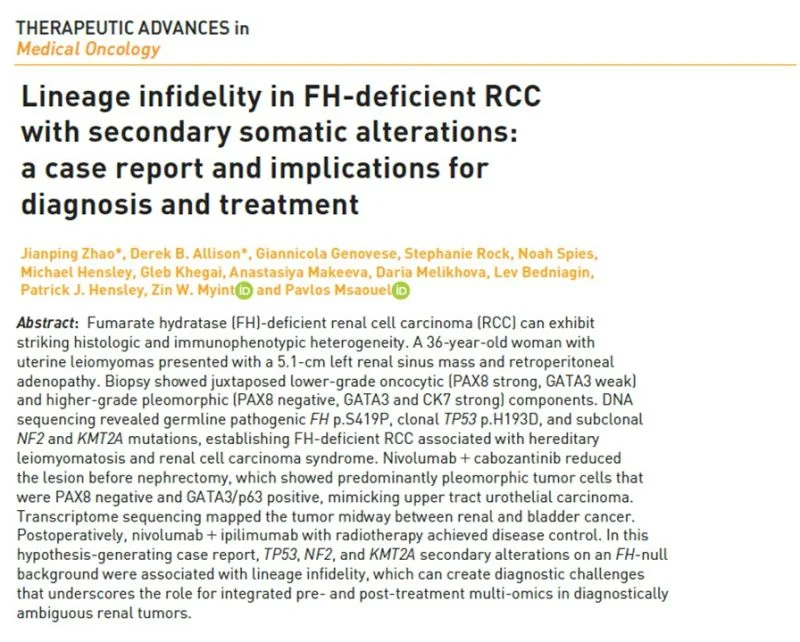
“New open access case report out in Therapeutic Advances in Medical Oncology that I think is a useful teaching case on tumor plasticity and the value of integrated, longitudinal molecular pathology.
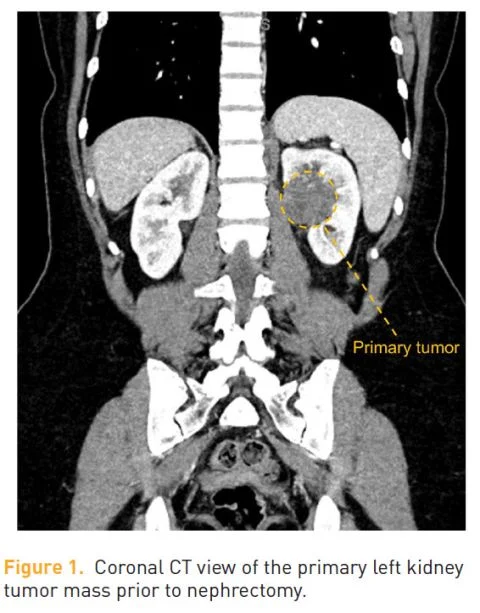
A young patient with HLRCC syndrome (germline FH p.S419P) presented with a renal sinus mass. The tumor showed two intermixed components – a lower-grade oncocytic component (PAX8+, GATA3 weak) and a higher-grade pleomorphic component (PAX8–, GATA3+, CK7+). After nivolumab + cabozantinib and nephrectomy, the resection specimen was dominated by the PAX8-negative, GATA3/p63-positive pleomorphic component with only variably positive 2SC – closely mimicking upper tract urothelial carcinoma.
That resemblance is a genuine diagnostic pitfall, and getting it wrong would have pointed toward urothelial-directed therapy. What resolved it was integrating DNA and RNA profiling across both pre- and post-treatment tissue: Transcriptomics showed lineage infidelity already present at diagnosis, and the post-treatment tumor mapped midway between RCC and bladder cancer – a transcriptional ‘hybrid’ identity.
Critically, the infidelity was partial, not a complete lineage switch: the tumor gained upstream urothelial transcription factors (GATA3/p63) but never engaged the downstream urothelial differentiation program – uroplakins, TROP2, and HER2 were near-absent (HER2 IHC 0). A markedly elevated EMT signature pointed to EMT-driven dedifferentiation as the mechanism.
Biallelic FH loss plus a low tumor mutational burden (3 mut/Mb) confirmed FH-deficient RCC rather than urothelial carcinoma (which typically carries a much higher TMB).
This is a single-patient, hypothesis-generating report and cannot establish causality between the secondary TP53/NF2/KMT2A alterations and the lineage infidelity, nor frequency. The aim is to illustrate how diagnosis-informed, integrated management operates in a genuinely ambiguous setting. Clonal dynamics were informative too: therapy appeared to debulk the PAX8-positive oncocytic clone while a PAX8-negative TP53/KMT2A-mutant clone came to dominate, and a subclonal NF2 variant was lost post-treatment – consistent with treatment-associated clonal selection.
This biology directly shaped management. The molecular profile eliminated the rationale for urothelial agents (no TROP2 – no sacituzumab govitecan; HER2-negative), and cabozantinib resistance made continued VEGFR/MET inhibition unattractive. The patient was treated with nivolumab + ipilimumab integrated with radiotherapy, with marked regression of treated and untreated lesions and no evidence of active disease at the most recent follow-up, 16 months after surgery.”
Title: Lineage infidelity in FH-deficient RCC with secondary somatic alterations: a case report and implications for diagnosis and treatment
Authors: Jianping Zhao, Derek B. Allison, Giannicola Genovese, Stephanie Rock, Noah Spies, Michael Hensley, Gleb Khegai, Anastasiya Makeeva, Daria Melikhova, Lev Bedniagin, Patrick J. Hensley, Zin W. Myint, Pavlos Msaouel
Read the Full Article.
Other articles featuring Pavlos Msaouel on OncoDaily.