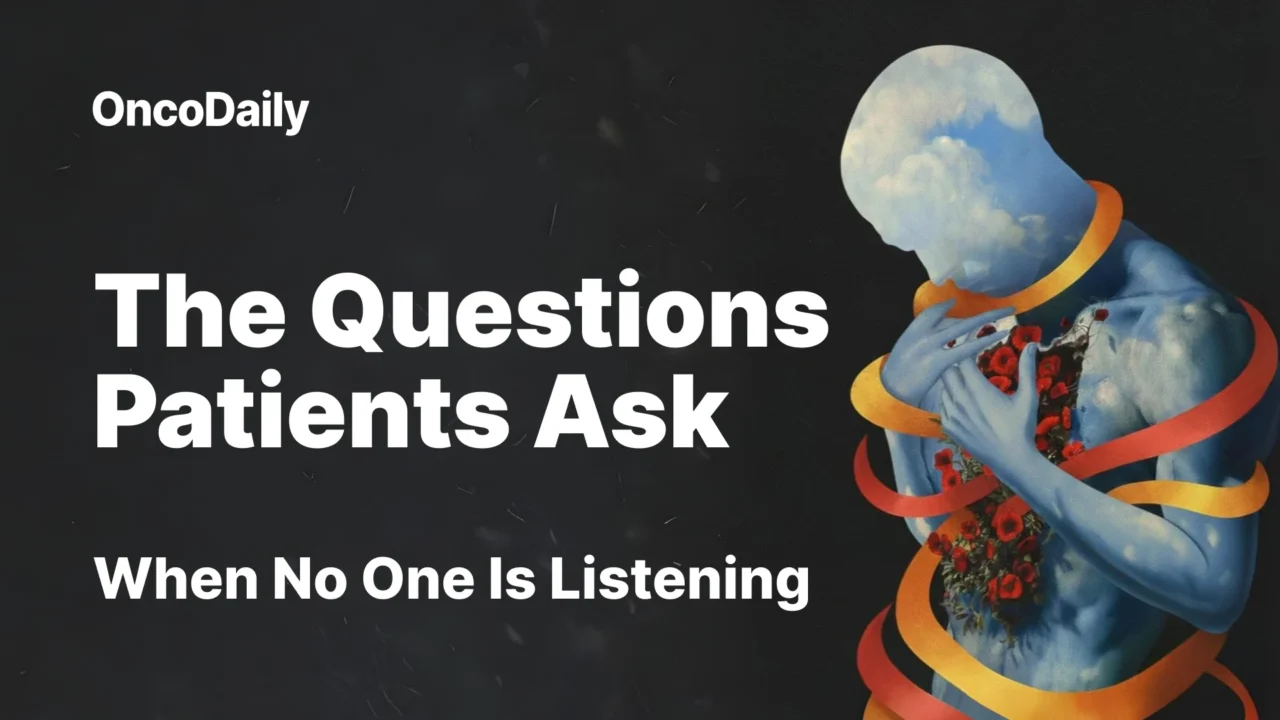
There are questions patients rarely ask out loud. Not because they are unimportant — but because they do not feel permitted. In the clinic, patients learn quickly which questions belong to medicine and which belong to silence. They ask about side effects, schedules, results. They listen carefully. They nod. They thank us.
And then they leave with questions they never voiced.
These questions do not fit neatly into medical language. They are not about protocols or probabilities. They are about identity, fear, and loss — things that are harder to measure and easier to dismiss.
Patients often tell
“I didn’t know if I should ask this.”
What follows is rarely trivial.
They ask themselves:
- Will I ever feel like myself again?
- Will people see me differently now?
- Will my relationships survive this?
- Will I trust my body again?
These are not questions patients bring to the first appointment. They emerge slowly, often after treatment has begun, when the initial shock fades and reality settles in.
By then, patients may feel it is too late to ask.
- They worry about sounding dramatic.
- They worry about wasting time.
- They worry that these questions have no place in a medical conversation.
I have noticed that these questions often surface indirectly. A hesitation. A vague complaint. A sudden change in tone. Patients may talk around what truly concerns them, hoping someone will notice.
- Sometimes they say, “It’s probably nothing.”
- Sometimes they laugh.
- Sometimes they change the subject.
Silence becomes a coping strategy. Patients learn to manage expectations — not only their own, but ours. They sense that medicine prioritizes fixing, solving, progressing. Emotional uncertainty does not always fit this framework. So they postpone asking until they feel “stronger,” “more grateful,” or “less emotional.” But these questions do not disappear. They grow heavier with time.
Fear of recurrence. Fear of dependency. Fear of becoming a burden. Fear of never returning to a life that feels familiar. These fears are rarely irrational. They are grounded in lived experience. Cancer disrupts trust — trust in the body, in the future, in predictability. Even when treatment is effective, uncertainty remains.
Patients often say
“I thought once treatment started, I would feel more secure.”
Instead, many feel exposed.
They are asked to endure, to adapt, to comply — often without space to articulate how destabilizing this feels. The questions patients ask when no one is listening are not demands for reassurance. They are attempts to make sense of change.
- Will I still be independent?
- Will I be able to make plans again?
- Will people expect me to be “over it” before I am?
These questions reflect a struggle to reconcile medical success with personal disruption. As clinicians, we may not hear these questions unless we actively invite them. They rarely arrive fully formed. They require patience and openness.

Sometimes all it takes is asking
“What worries you when you go home?”
This question often opens a door. Patients speak about nights when anxiety feels louder than pain. About moments when they look at themselves and feel unfamiliar. About relationships that have shifted subtly but painfully. These conversations are rarely neat. They do not lead to clear action points. But they matter. Because when patients feel that these questions are allowed, they feel less alone.
Listening does not mean we must have answers. Often, patients know that no one can promise certainty. What they want is acknowledgment. They want to know that these fears are not signs of weakness. That struggling emotionally does not mean treatment is failing. That uncertainty is part of the experience — not a personal flaw. When these questions remain unspoken, patients may internalize them as shame. They may believe they are coping “incorrectly.”
Creating space for these questions is part of care. It does not require specialized language. It requires permission. Permission to speak without being redirected. Permission to feel without being corrected. Permission to exist beyond disease metrics. The questions patients ask when no one is listening shape how they live with cancer. They influence decisions, relationships, and self-perception. When we make room for them, we do not lose control of the clinical encounter. We deepen it. Because sometimes, the most important thing we can do is listen to what patients are afraid to ask — and stay present long enough to hear it.
Written By Eftychia Tataridou, MD