





Paolo Tarantino, Research Fellow Dana-Farber Cancer Institute and Harvard Medical Schoolpost, shared a post on X:
”The ctDNA analysis of DAPHNe was the first project I had the chance to work on when I moved from Italy to Boston in 2021.
Ada Waks had led the clinical study at Dana-Farber’s Breast Oncology Center , showing that approximately half of patients with (mostly) stage II HER2+ breast cancer achieve pCR with THPx12, and that virtually all physicians feel comfortable with omitting further adjuvant chemo if the patient experienced pCR. We had the clinical data and the plasma samples prospectively collected.
We lacked a ctDNA assay to test MRD. Here’s where serendipity took place. Salt Lake City, 2022, cancer conference. A feisty guy approaches me with a bold pitch. ‘We recently developed one of the most sensitive MRD assays out there. We plan to take it to the clinic, and we’d love to partner to make it happen’. Music to my ears.
We eventually established a collaboration with Personalis, Inc. which proved instrumental to successfully conducting the MRD analyses in DAPHNe. Thanks to this partnership, we uncovered several interesting findings:
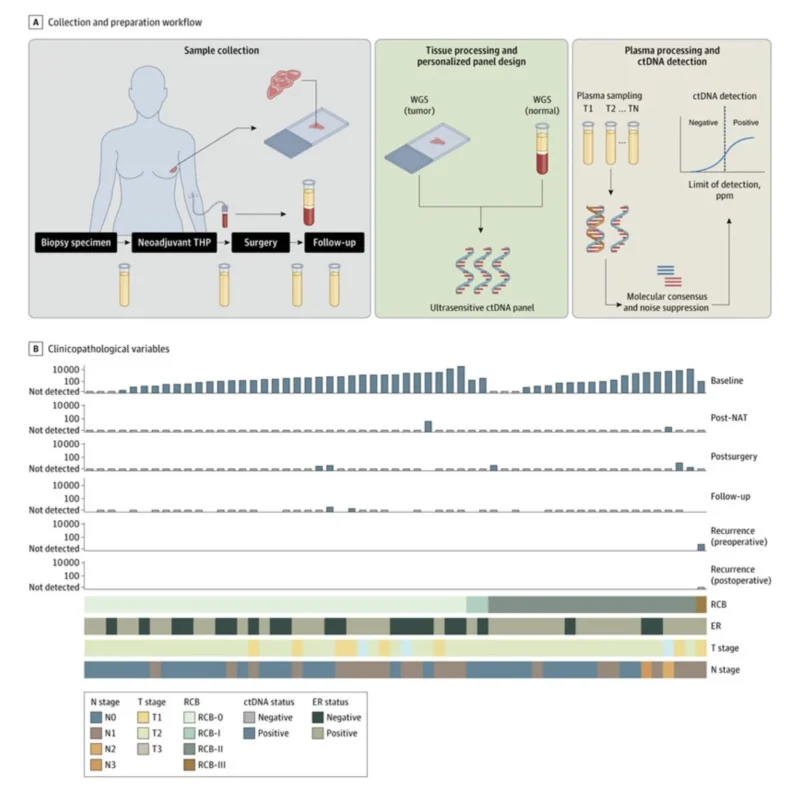
- >90% of patients with mostly stage II HER2+ breast cancer have detectable MRD at baseline if using an ultrasensitive assay – which is higher to what previously reported with less sensitive assays
- virtually all patients clear MRD during neoadjuvant THP treatment
- MRD clearance is not associated with pCR, however…
- the rate of MRD clearance appeared very consistent with long-term outcomes, i.e. no patient developed distant recurrence (despite only half experiencing a pCR)
- at the time of the only local recurrence observed, the patient had detectable MRD, which cleared after resection. Less sensitive assays have historically been suboptimal to detect local recurrences.
This DAPHNe analysis was only a small step in the direction of understanding how to leverage the promise of MRD for tailoring breast cancer treatment. But it did show the promise of ultrasensitive assays, a promise to be validated in dedicated studies. And, to me, it proved the importance of serendipitous connections, reminding me to remain open to spontaneous encounters and to partnerships.
Thanks to all the team at Personalis, Inc. for being great collaborators, and to the Dana-Farber’s Breast Oncology Center translational and statistical teams for all the hard work on the analysis.”
Title: Neoadjuvant Paclitaxel, Trastuzumab, and Pertuzumab for Stage II to III, ERBB2-Positive Breast Cancer
A Secondary Analysis of the DAPHNe Trial
Authors: Paolo Tarantino, Tianyu Li, Esther Ritah Ogayo, Tasnim Rahman, Molly K. DiLullo, Ashka Patel, Sherif El-Refai, Charles Abbott, Bailiang Li, Sean M. Boyle, Richard O. Chen, Neelam V. Desai, Laura M. Spring, Nadine M. Tung, Natalie Sinclair, Meredith Faggen, Michael Constantine, Tari A. King, Ian E. Krop, Nabihah Tayob, Elizabeth A. Mittendorf, Sara M. Tolaney, Eric P. Winer, Heather A. Parsons, Adrienne G. Waks
Other articles about Breast Cancer on OncoDaily.