
Olubukola Ayodele, Co-Convenor (Co-Chair) of London Global Cancer Week, shared on LinkedIn:
“On 16 November, the FDA approved giredestrant + everolimus for ESR1-mutated, ER+/HER2− advanced or metastatic breast cancer following endocrine therapy.
The phase III evERA trial adds another option after CDK4/6 inhibitors, but raises important questions about biomarker selection and sequencing.
Trial design.
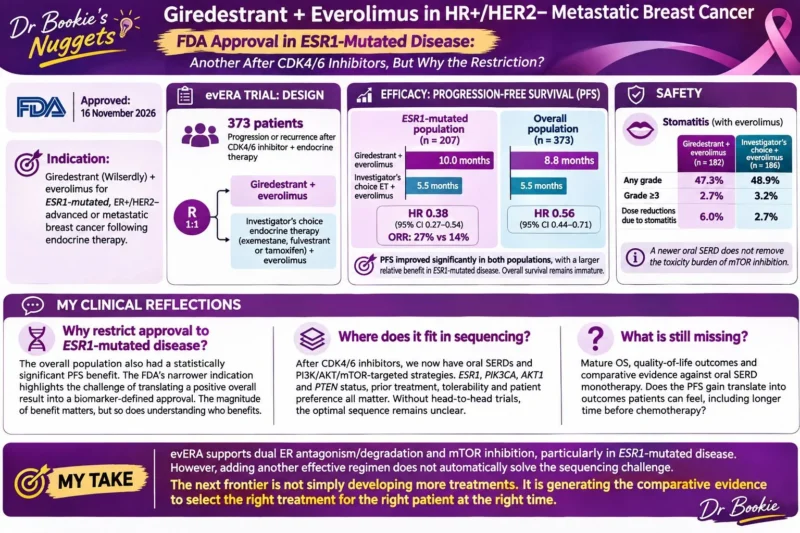
373 patients with progression or recurrence following CDK4/6 inhibitor + endocrine therapy were randomised to giredestrant + everolimus or investigator’s choice endocrine therapy (exemestane, fulvestrant or tamoxifen) + everolimus.
ESR1-mutated population (n=207):
- Median PFS: 10.0 vs 5.5 months
- HR 0.38 (95% CI 0.27–0.54)
- ORR: 27% vs 14%
Overall population (n=373):
- Median PFS: 8.8 vs 5.5 months
- HR 0.56 (95% CI 0.44–0.71)
PFS improved significantly in both populations, with a larger relative benefit in ESR1-mutated disease. Overall survival remains immature.
Safety
Any-grade stomatitis occurred in 47.3% vs 48.9%; grade ≥3 in 2.7% vs 3.2%. Yet stomatitis-related everolimus dose reductions were more frequent with giredestrant (6.0% vs 2.7%).
Because both arms received everolimus, this suggests that a newer oral SERD does not remove the toxicity burden of mTOR inhibition.
My clinical reflections
- Why restrict approval to ESR1-mutated disease?
Despite statistically significant PFS improvement in the overall population, FDA approval was restricted to ESR1-mutated disease, where the relative benefit was substantially greater.
This raises an important question about interpreting biomarker-defined treatment effects when the broader trial population also demonstrates benefit. The magnitude of benefit matters, but so does understanding who benefits.
- Where does it fit in sequencing?
After CDK4/6 inhibitors, we now have oral SERDs and PI3K/AKT/mTOR-targeted strategies. ESR1, PIK3CA, AKT1 and PTEN status, prior treatment, tolerability and patient preference all matter. Without head-to-head trials, the optimal sequence remains unclear.
- What is still missing?
Mature OS, quality-of-life outcomes and comparative evidence against oral SERD monotherapy. Does the PFS gain translate into outcomes patients can feel, including longer time before chemotherapy?
My take
evERA supports dual ER antagonism/degradation and mTOR inhibition, particularly in ESR1-mutated disease. However, adding another effective regimen does not automatically solve the sequencing challenge.
The next frontier is not simply developing more treatments. It is generating the comparative evidence to select the right treatment for the right patient at the right time.”
You can also read: FDA Approves Giredestrant Plus Everolimus: A New Treatment Option for ESR1-Mutated Advanced Breast Cancer