Olubukola Ayodele, Breast Cancer Lead at University Hospitals of Leicester NHS Trust, shared on LinkedIn:
“I have a question.
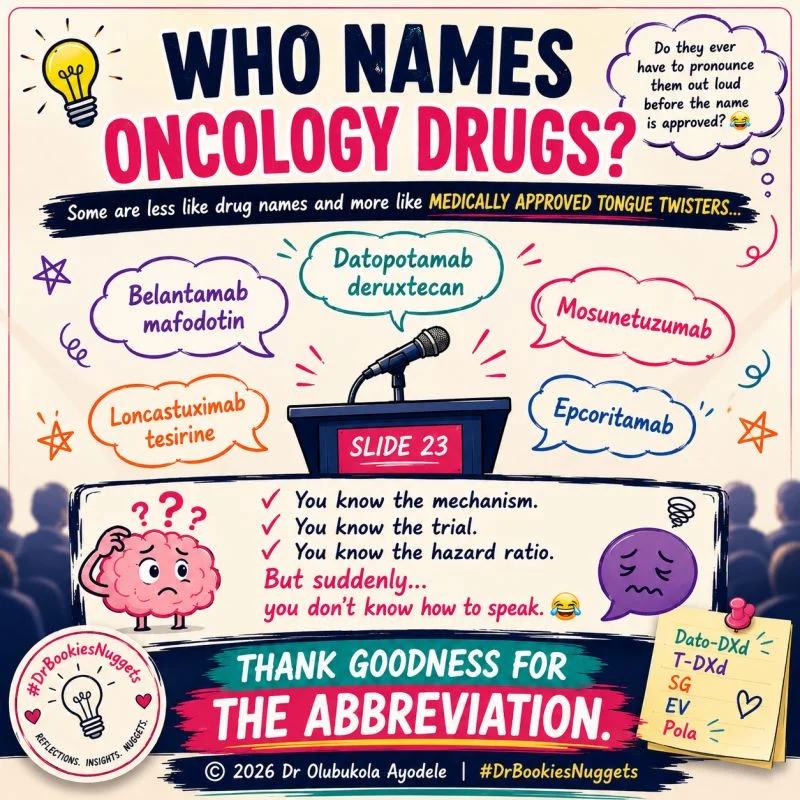
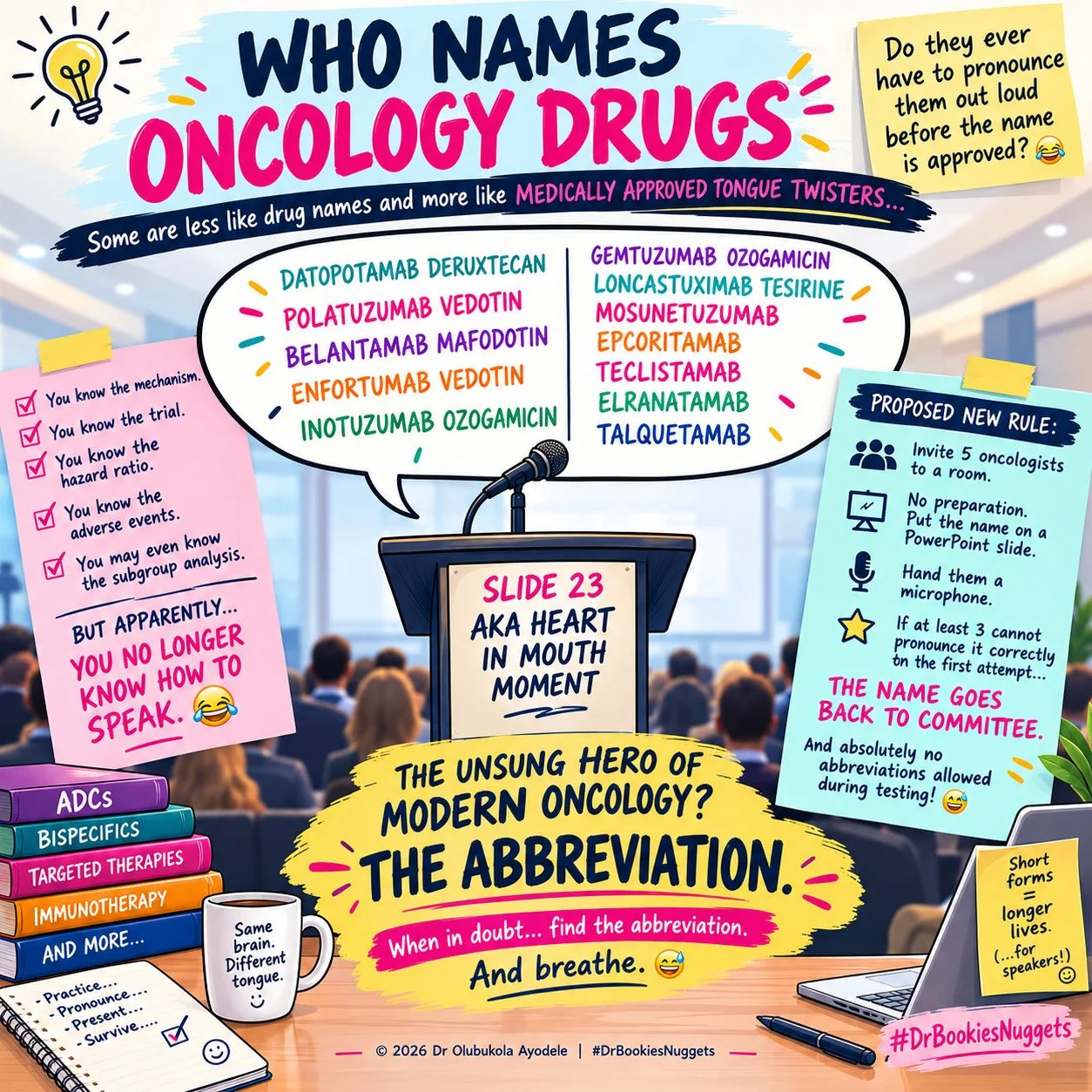
Who exactly names oncology drugs?
And do they ever have to pronounce them out loud before the name is approved?
Because I genuinely think they should. As an oncologist, one of the hidden hazards of being invited to speak at meetings is discovering that slide 23 contains a drug name you have read hundreds of times but have somehow never actually said out loud. Some oncology drug names are less like names and more like medically approved tongue twisters. So you prepare. You practise it in the car. You say it while making breakfast. You listen to someone pronounce it online. You break it into syllables. By the morning of the presentation, you are READY.
Then you get to the podium.
Slide 23 appears.
Datopotamab deruxtecan. And suddenly you are meeting this drug for the first time in your life. Your brain knows exactly what it is. You know the mechanism of action. You know the trial. You know the hazard ratio. You know the adverse events. You may even know the subgroup analysis.
But apparently, you do not know how to speak anymore.
I confess that I sometimes sit at oncology meetings and silently giggle when a colleague gets caught by one of these tongue twisters. Not because I am laughing at them. Quite the opposite. I feel seen.
There is an unspoken solidarity amongst us:
‘Ahhhh. You too.’
And then comes one of the greatest gifts modern oncology has given us.
The abbreviation.
‘Datopotamab deruxtecan… which I will now refer to as Dato-DXd.’
Thank goodness.
- T-DXd.
- SG.
- Pembro.
- Olaparib, thankfully, can stay Olaparib.
There is, of course, actually a science behind drug naming. International naming conventions use particular stems and structures to give information about the type of drug, its target or its class. Very sensible. Very organised. Unfortunately, none of that helps when you are standing in front of 500 people trying to remember where the emphasis goes in a nine-syllable word. And with antibody-drug conjugates, bispecific antibodies, targeted therapies and increasingly sophisticated agents entering oncology, I suspect this problem is only going to get worse.
I have a proposal for an additional stage in the drug-naming process. Before any new oncology drug name is approved, invite five oncologists to a conference room. No preparation. Put the name on a PowerPoint slide. Hand them a microphone. If at least three cannot pronounce it correctly on the first attempt, the name goes back to committee.
And absolutely no abbreviations allowed during testing. So while precision medicine continues to transform oncology, I would personally like to acknowledge another innovation that has quietly saved many conference speakers over the years. The abbreviated form. Long may it continue.
Now tell me, which oncology drug is your ultimate tongue twister?”
You can also read: OTX-2002: Innovative MYC-Targeting mRNA Therapy, Dose, Administration, and Clinical Trials