Key takeaways
- OTX-2002 is an investigational lipid nanoparticle–delivered mRNA therapy designed to suppress MYC gene expression through targeted epigenomic regulation.
- Unlike conventional MYC inhibitors, OTX-2002 was designed to act upstream at the gene-regulation level, before MYC protein is produced.
- The therapy encodes two engineered epigenomic controllers that target regulatory regions associated with MYC and create repressive epigenetic changes.
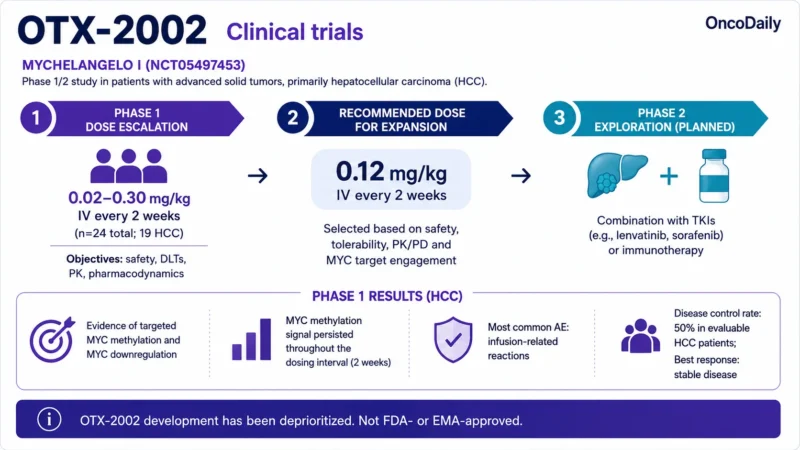
- In the Phase 1 MYCHELANGELO I trial (NCT05497453), doses from 0.02 to 0.30 mg/kg IV every two weeks were evaluated.
- 0.12 mg/kg every two weeks was selected as the recommended expansion dose.
- Phase 1 findings showed evidence of targeted MYC methylation and MYC-expression downregulation, supporting proof of mechanism.
- Among response-evaluable patients with hepatocellular carcinoma, the reported disease-control rate was 50%, with stable disease as the best reported response.
- OTX-2002 remains unapproved and investigational, and the program was subsequently deprioritized.
OTX-2002 is an investigational lipid nanoparticle–delivered mRNA therapy designed to reduce MYC gene expression through targeted epigenomic regulation. It was evaluated mainly in patients with advanced hepatocellular carcinoma in the Phase 1/2 MYCHELANGELO I trial.
Unlike conventional drugs that inhibit an existing protein, OTX-2002 was designed to regulate MYC before the protein is produced. The Phase 1 study established proof of mechanism, but the program was subsequently deprioritized and has not received FDA or EMA approval.
OTX-2002 Key Facts
OTX-2002 is an intravenous, lipid nanoparticle–formulated mRNA epigenomic controller targeting MYC. It was studied every two weeks, with 0.12 mg/kg selected as the recommended expansion dose after Phase 1 testing.
- Drug class: Epigenomic mRNA therapeutic
- Primary target: MYC
- Main cancer studied: Hepatocellular carcinoma
- Administration: Intravenous infusion
- Selected dose: 0.12 mg/kg every two weeks
- Development status: Investigational and deprioritized
- Approval status: Not FDA- or EMA-approved
What Is OTX-2002?
OTX-2002 is a programmable mRNA medicine engineered to reduce MYC transcription through targeted epigenetic modification.
MYC is an oncogenic transcription factor involved in cancer-cell proliferation, metabolism, survival, and treatment resistance. Directly inhibiting MYC with traditional small molecules has been difficult because the protein lacks an easily druggable binding pocket.
OTX-2002 was developed to address this challenge at the gene-regulation level.
The therapy contains a bicistronic mRNA encoding two engineered epigenomic controller elements:
- One element targets a region near the MYC promoter and introduces targeted DNA methylation.
- The second targets an enhancer-associated genomic region and introduces a repressive chromatin signal.
These coordinated changes were designed to alter the MYC insulated genomic domain, reduce enhancer–promoter communication, and suppress MYC transcription before MYC protein is produced.
How Does OTX-2002 Work?
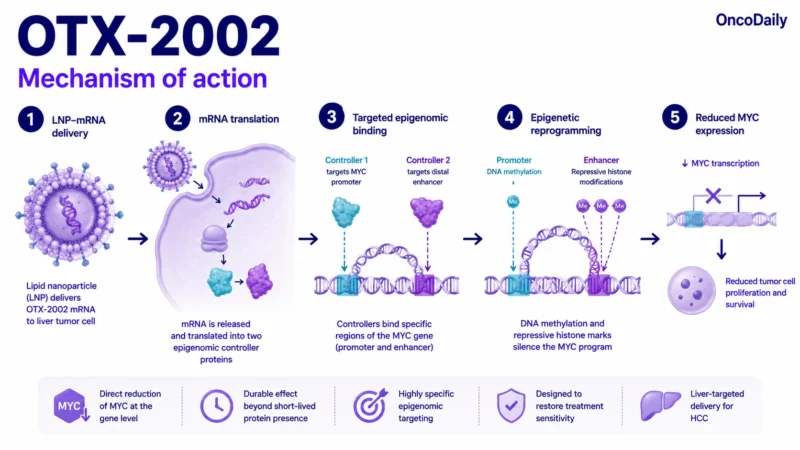
OTX-2002 follows a four-stage process:
- Lipid nanoparticles deliver the mRNA primarily to liver tissue and liver-derived tumor cells.
- Cells translate the mRNA into two short-lived epigenomic controller proteins.
- The controllers bind selected regions of the MYC gene and create repressive epigenetic marks.
- MYC transcription decreases, potentially reducing cancer-cell proliferation and survival.
Preclinical experiments showed that the encoded proteins disappeared relatively quickly, while MYC methylation and transcriptional suppression persisted for substantially longer. MYC mRNA repression was detectable for up to 15 days in laboratory models.
OTX-2002 was therefore designed to produce a durable gene-regulatory effect even though the delivered mRNA and translated proteins were temporary.
Watch more: Learn about current approaches and emerging strategies in liver cancer in OncoDaily’s interview, Transforming Liver Cancer Care: Dr. Gao-Jun Teng on TACE and Combination Therapies On Oncodaily.
What Is the Dose of OTX-2002?
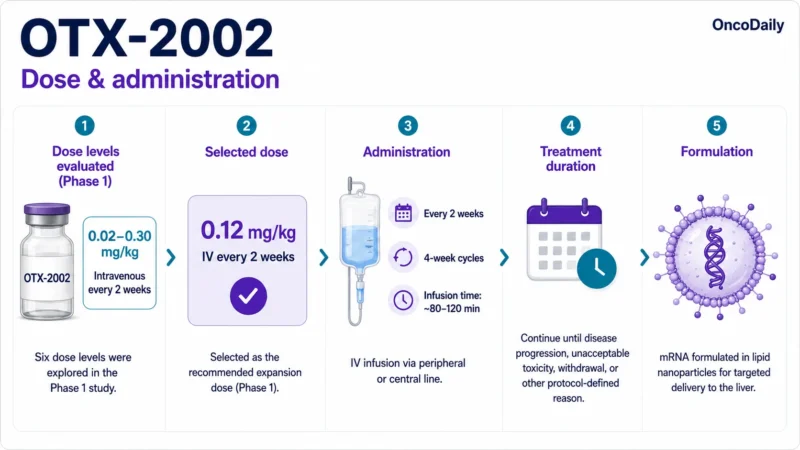
The Phase 1 MYCHELANGELO I trial evaluated six intravenous dose levels:
OTX-2002 0.02–0.30 mg/kg every two weeks.
Following dose escalation, 0.12 mg/kg every two weeks was selected as the recommended dose for expansion.
A total of 24 patients received OTX-2002 during the completed Phase 1 portion, including 19 patients with hepatocellular carcinoma.
These were investigational doses, not approved prescribing recommendations.
How Is OTX-2002 Administered?
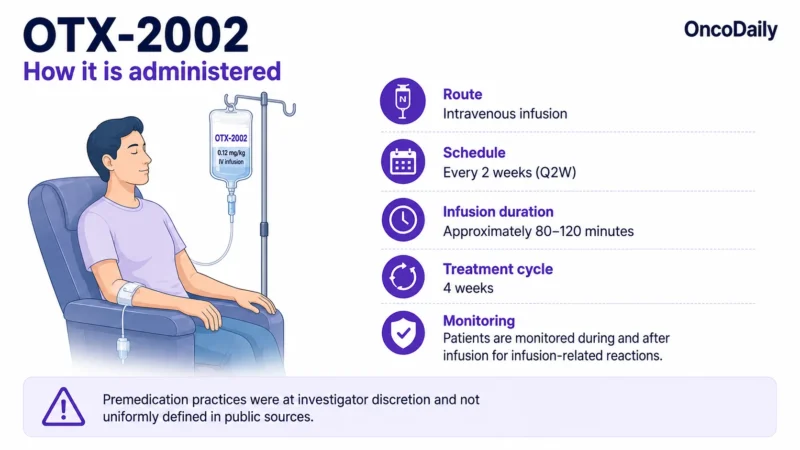
OTX-2002 is administered by intravenous infusion.
The clinical-trial schedule used:
- Intravenous administration
- One dose every two weeks
- Four-week treatment cycles
- An infusion lasting approximately 80–120 minutes
Treatment was intended to continue until disease progression, unacceptable toxicity, withdrawal, or another protocol-defined reason for discontinuation.
OTX-2002 was formulated in liver-targeting lipid nanoparticles to protect the mRNA and support delivery into target cells.
Does OTX-2002 Require an In-Line Filter?
No universal public in-line filter requirement has been established for OTX-2002.
Because OTX-2002 is an investigational lipid nanoparticle formulation, preparation and administration details were controlled through the clinical-trial pharmacy manual. Public sources do not consistently specify:
- Filter type or pore size
- Dilution solution
- Final infusion concentration
- Infusion-bag material
- Prepared-product stability
- Line-flushing instructions
Clinical-trial sites were required to follow the protocol-specific investigational-product instructions.
Is Premedication Required?
Public trial records do not establish one universal premedication regimen. However, infusion-related reactions were the most frequently reported adverse event at the selected 0.12 mg/kg dose.
Study protocols could therefore include measures such as:
- Antihistamines
- Antipyretics
- Corticosteroids when clinically indicated
- Slower infusion rates
- Observation during and after administration
The exact approach depended on the trial protocol and the patient’s previous infusion tolerance.
Are Dose Reductions Used?
Dose modification information remains limited because OTX-2002 did not reach an approved commercial setting.
Clinical-trial toxicity management could involve:
- Temporarily interrupting the infusion
- Reducing the infusion rate
- Delaying the next dose
- Moving to a lower dose level
- Providing supportive medication
- Permanently discontinuing treatment after severe toxicity
The recommended expansion dose of 0.12 mg/kg was selected based on the combined pharmacodynamic, pharmacokinetic, safety, and tolerability findings from dose escalation.
What Is Known About OTX-2002 Pharmacokinetics?
OTX-2002 contains mRNA delivered through lipid nanoparticles rather than a conventional small-molecule drug.
After cellular uptake:
- The mRNA is translated into two epigenomic controller proteins.
- Controller-protein levels rise temporarily.
- The proteins bind predefined MYC genomic regions.
- The mRNA and proteins are subsequently cleared.
- The induced epigenetic changes may remain after the controllers disappear.
In preclinical studies, the encoded proteins reached their highest levels at approximately six hours and were no longer detectable by 48 hours, while MYC suppression persisted considerably longer.
In the Phase 1 trial, increased cell-free DNA methylation at the targeted MYC loci persisted throughout the two-week dosing interval, supporting biological target engagement.
Are Renal or Hepatic Dose Adjustments Required?
No validated renal- or hepatic-impairment dose recommendations were established.
This is especially important because OTX-2002 was mainly studied in patients with hepatocellular carcinoma, who may already have underlying liver disease. Trial eligibility therefore relied on protocol-defined requirements for:
- Liver function
- Kidney function
- Blood-cell counts
- Coagulation parameters
- General performance status
No approved prescribing information is available for patients with severe hepatic or renal impairment.
What Did OTX-2002 Clinical Trials Show?
MYCHELANGELO I Phase 1/2 Trial
The Phase 1/2 MYCHELANGELO I trial, NCT05497453, was designed to evaluate OTX-2002 in relapsed or refractory hepatocellular carcinoma and other MYC-associated solid tumors.
The study assessed:
- Safety and tolerability
- Dose-limiting toxicities
- Pharmacokinetics
- MYC-related pharmacodynamic changes
- Preliminary antitumor activity
- Potential combinations with established treatments
The trial planned monotherapy evaluation followed by combination treatment with tyrosine kinase inhibitors or other standard therapies.
Phase 1 Dose-Escalation Results
Twenty-four patients were enrolled across doses ranging from 0.02 to 0.30 mg/kg, including 19 patients with hepatocellular carcinoma.
The reported findings included:
- Evidence of targeted MYC methylation
- MYC-expression downregulation
- Persistence of the methylation signal throughout the two-week dosing interval
- A recommended expansion dose of 0.12 mg/kg
- Infusion-related reactions as the most common adverse event
Among response-evaluable patients with hepatocellular carcinoma, the reported disease-control rate was 50%. The best overall response was stable disease, meaning no confirmed tumor shrinkage meeting partial-response criteria was reported.
These results demonstrated proof of mechanism but did not establish clinical efficacy.
Preclinical Combination Studies
In laboratory and animal models, OTX-2002 enhanced the activity of:
- Lenvatinib
- Sorafenib
- Anti-PD-1 therapy
- Anti-PD-L1 therapy
The combinations produced stronger tumor-growth inhibition than the individual treatments in selected preclinical HCC models. These findings supported the original plan to explore OTX-2002 combination regimens clinically.
OTX-2002 Development Status
After completing the Phase 1 portion, Omega Therapeutics shifted its strategic priorities toward other epigenomic-controller programs and partnerships. OTX-2002 was among the programs deprioritized, and no approved indication or confirmatory efficacy trial has been established.
What Are the Common OTX-2002 Side Effects?
Publicly available Phase 1 safety details remain limited.
The most clearly reported treatment-related issue was:
- Infusion-related reactions
Other adverse events may reflect:
- The investigational lipid nanoparticle formulation
- Immune or inflammatory responses during infusion
- Advanced liver cancer
- Underlying hepatic dysfunction
- Previous cancer treatments
At the recommended expansion dose of 0.12 mg/kg, the company described the overall safety profile as favorable, but full peer-reviewed clinical safety results have not been published.
Read more: Explore the role of MYC and genomic alterations in hepatocellular carcinoma on OncoDaily.
Mirna Antabian, MD
FAQ
Is OTX-2002 Approved?
No. OTX-2002 is not approved by the FDA, EMA, or another major regulatory authority.
Is OTX-2002 Chemotherapy?
No. OTX-2002 is an investigational mRNA-based epigenomic therapy.
Is OTX-2002 a Gene-Editing Therapy?
Not in the conventional sense. It was designed to regulate MYC expression through targeted epigenetic modification rather than permanently cutting or changing the underlying DNA sequence.
Is OTX-2002 an Infusion or Injection?
OTX-2002 was administered by intravenous infusion.
What Was the OTX-2002 Dose?
The recommended expansion dose was 0.12 mg/kg intravenously every two weeks.
How Long Was the OTX-2002 Infusion?
Clinical-trial records describe an infusion lasting approximately 80–120 minutes.
What Cancer Was OTX-2002 Developed For?
The leading indication was advanced or treatment-resistant hepatocellular carcinoma.
Did OTX-2002 Shrink Tumors?
In the reported Phase 1 data, the best overall response was stable disease. The disease-control rate among evaluable patients with hepatocellular carcinoma was 50%, but no confirmed objective responses were reported.