






Olubukola Ayodele, Breast Cancer Lead at University Hospitals of Leicester NHS Trust, shared a post on LinkedIn:
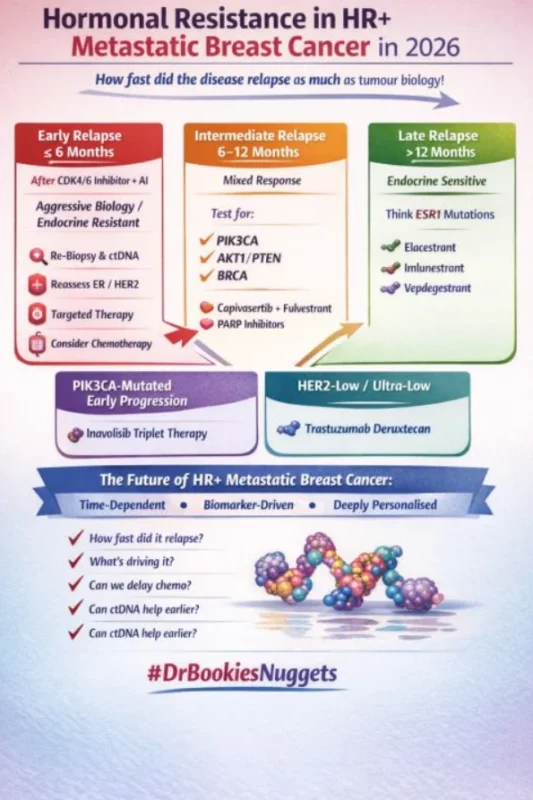
“Hormonal Resistance in HR+ Metastatic Breast Cancer in 2026
As oncologists, who treat Hormone Receptor positive (HR+) metastatic breast cancer, we often tend to ask about tumor mutations. However in the clinic, an increasing relevant question now is “when did the disease relapse?”
Because today: Time to recurrence is as important as tumor biology
Early Relapse (≤ 6 months)
After CDK4/6 inhibitor plus AI
This is true endocrine resistance and often, aggressive biology.
Reusing endocrine therapy alone often leads to low yield.
What to do?
- Re-biopsy + consider ctDNA early
- Reassess ER/HER2 status and emerging mutations
- If actionable mutation, then consider targeted therapy in selected patients
- If rapidly progressive or symptomatic, then consider chemotherapy
*Switching CDK4/6 inhibitor could be considered
*ADCs (e.g. Trastuzumab deruxtecan)
may be considered in selected patients, but are not yet routine first-line in this setting
Intermediate Relapse (>6–12 months)
Mixed biology. Not fully resistant… not fully sensitive.
What to do?
Test for:
- PIK3CA
- AKT1 / PTEN
- BRCA
- Capivasertib + Fulvestrant (CAPItello-291)
* PARP inhibitors if germline mutations
*Where access is limited, everolimus-based therapy still has a role.
It’s about enhancing endocrine therapy via pathway targeting.
Late Relapse (>12 months)
Endocrine-sensitive disease. Especially after prolonged AI exposure
Think ESR1 mutations
Options:
- Elacestrant (EMERALD)
- Imlunestrant (EMBER-3)
- Vepdegestrant (VERITAC-2)
Combination strategies are evolving and may further improve outcomes.
PIK3CA-mutated disease where progression occurs during/within 12 months of adjuvant endocrine therapy
- Triplet with Inavolisib based therapy. (INAVO120)
This space is evolving, with sequencing still being defined
ADCs: Post endocrine therapy
A new therapeutic space
*HER2-low / ultralow disease
- Trastuzumab deruxtecan (DESTINY-Breast04 and 06)
*Sacituzumab Govitecan (TROPiCS – 02 and ASCENT -07)
*Dato-Dxd (TROPION-Breast01)
ADCs are moving earlier, guided not just by HER2 status, but by pace of disease and clinical burden
The real shift is that we are no longer asking: what comes after CDK4/6 inhibitors?
We are now asking:
- How fast did the disease relapse?
- What is driving it biologically?
- Can we delay chemotherapy?
- Can ctDNA help us act earlier?
The future of HR+ metastatic breast cancer is time-dependent, biomarker-driven and deeply personalised.
If you ignore time to recurrence, you are only seeing half the disease.
We are sequencing biology over time.”
Other articles featuring Olubukola Ayodele on OncoDaily.