Nicholas P Restifo, Co-founder, Chief Medical Officer at Medici Therapeutics, shared on LinkedIn:
“Every patient should teach us
I’ll call her Anna.
In the 1990s, Anna came to us with widely metastatic melanoma. She had exhausted available standard treatment options and watched the cancer continue to spread. We removed a tumor, isolated and expanded her tumor-infiltrating lymphocytes, and infused billions of those cells.
Then her tumors began to shrink. Months later, they were gone. Anna went home to her family with something she had not had for a long time: time.
We had the treatment, the scans, and the outcome. But with the technology available then, we could not reconstruct the biology that produced that response.
- Which clonotypes recognized her cancer?
- What antigens did they see?
- Which clonotypes were favored during expansion and dominated the infused population?
- Which of them persisted after infusion, entered the tumors, and contributed to the regression?
I’ll call him Michael.
Years later, Michael underwent surgery for metastatic colorectal cancer. His T cells expanded robustly in the laboratory, reaching billions of cells. The cells met the release criteria then in use.
But after the infusion, his cancer progressed.
Michael had endured surgery, weeks away from home, lymphodepletion, and hospitalization, while carrying the hope that accompanies an experimental treatment. Yet we could not tell him-or ourselves-exactly what had failed.
- Had we expanded the wrong clonotypes?
- Had the right cells been present but lost during culture?
- Did they reach the tumors but fail to function?
- Or had the cancer escaped by altering antigen expression or presentation?
We recorded progressive disease. But it was also a failure to learn fully from what Michael had given us.
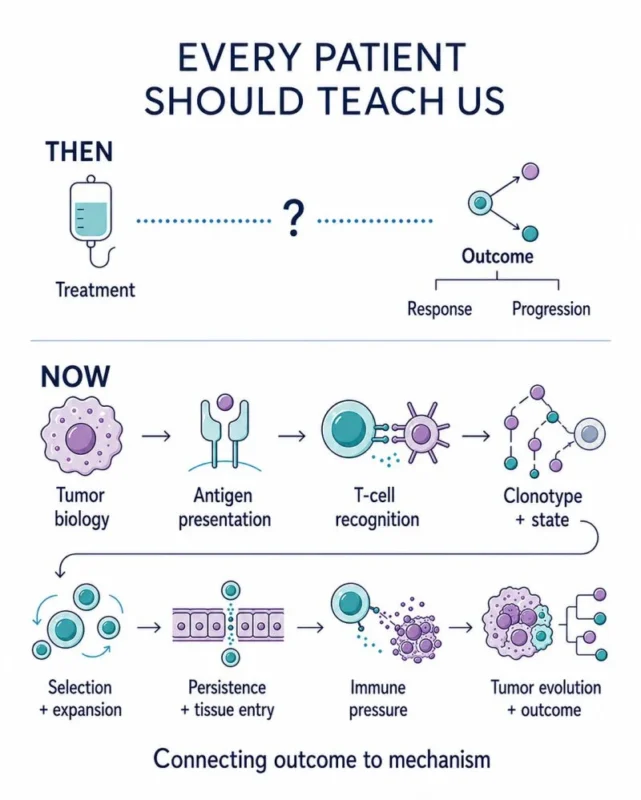
Today, much more of that hidden biology can be measured. Our ability to characterize tumor–immune interactions has exploded.
We can now combine tumor DNA and RNA sequencing, HLA typing, paired single-cell RNA and TCR sequencing, clonotype tracking, serial blood and tissue sampling, circulating tumor DNA analysis, and spatial profiling to link observations that were once made separately:
tumor biology – antigen presentation – T-cell recognition – clonotype–state combinations – selection and expansion – persistence – tissue entry – immune pressure – tumor evolution – clinical outcome.
Yet we still have to design the treatment, sampling, and analysis together so that the observations remain linked. Every patient is more than a response or a progression event. When those observations remain linked, each treatment course can reveal where the immune response succeeded or failed, and whether and how the tumor escaped. The goal is not simply to determine whether a treatment worked.
It is to understand why-so that what we learn from one patient can improve treatment and reduce suffering for the next patient.
These stories are composites drawn from multiple patients. Names are fictional and identifying details have been changed.”
You might be interested in:
Navigating Melanoma: The Cancer Research Institute’s Patient Guide to Immunotherapy