Murali Janakiram, Associate Professor at the Division of Hematological Malignancies, Myeloma, Cellular Immunotherapy and Immune Checkpoints at City of Hope, shared a post on X:
“With Tal-Dara published and concerns about ataxia/balance disorders lets take a deep dive on GPRC5D ataxia syndrome.
- The first report of a cerebellar syndrome from GPRC5D came from MCARH019 reported by Mailankody et al
- 2/17 (12%) Grd 3 cerebellar syndrome
- 6.5 and 8.4 mo’s after infusion -was a DLT at 450*10^6.
Subsequently this was reported in Arlo-cel
- they reported it as OSN-other select neurotoxicity
- 12%, Grd 3 -7%
- time to onset- 30 days
- dose related kinetics observed
- resolved in 4 patients
- however repeated episodes observed, hence need more granularity on resolution/persistence.
Now lets switch to MONUMENTAL – 1 – Talq
- ataxia was not observed as a safety signal in the Ph 1/2 studies
- only 1 patient had Grade 2 ataxia in the final analysis,
- in the EMA information, 12% had dizziness and 8% had Grade 3 dizziness- why is this important.
- Dizziness can be a first symptoms but can also be non specific.
What happens in real world.
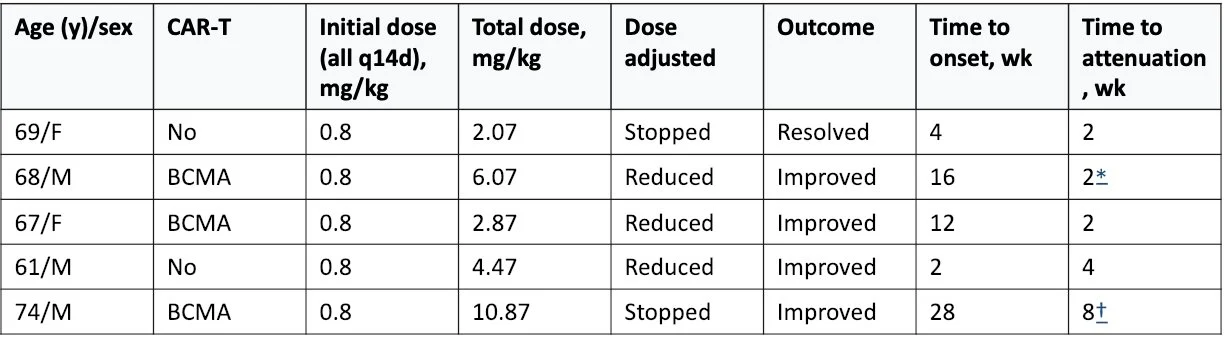
I noticed this in some of my patients treated with talq and put together a case series with our group.
Notice the relatively early onset and reversibility.
Named this as dizziness-ataxia syndrome.
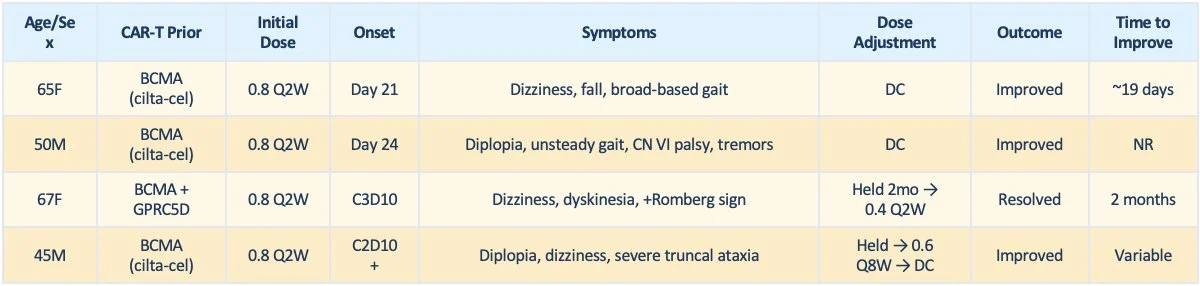
Second report from Harsh Parmar in real-world.
They put together a series of 6 patients and named it vestibular syndrome.
Wide variation in onset but notice improvement and reversibility.
Now lets look at MONUMENTAL–3- Table S19
- captured ataxia and balance disorders
- 12.4 and 14.5%, 2.9 and 2.2% Grade 3
- 8% dose delays/skips
- time to onset- 73 wks -81 wks
- earliest is 3 and 24 days
- quite different/delayed to what we are seeing in RWE
- 10-16% resolution, 68-88% no resolution
- low in cycle 1 (0.4% ), increased during cycles 2-6 (4.7%, 2.6%), and highest from cycle 7 (10.9%. 10.2% ).
Lets consolidate.
- ataxia/balance disorder, dizziness early symptom
- occurs with GPRC5D CART and Bispecific
- increasing incidence over time, hence needs vigilance
What’s not known.
- why the wide variance
- pathophysiology (seperate tweet)
- syndrome
- who is at risk, reversibility
- prevention/treatment.
What should we do in the field.
- Common terminology – we can’t call it ataxia/balance disorder, other selected neurotoxicity (CART), cerebellar syndrome. We need to name it as GPRC5D related ataxia/balance disorder across trials and RWE. This is important so that non specific symptoms like dizziness or balance disorders which has other causes are not attributed wrongly
- Understand the syndrome, its variations, risk factors. In the IMWG we are undertaking a co-ordinated effort to collect the clinical course of these patients. Specifically – onset, CNS signs/symptoms, resolution, imaging. This is a syndrome and should not be considered symptom in isolation. If talq is continued the whole syndrome will develop. Also imperative to stress is reversibility which we have seen in the real world experience
- Uncover the pathophysiology through translational science
- Incorporate this in prospective clinical trials
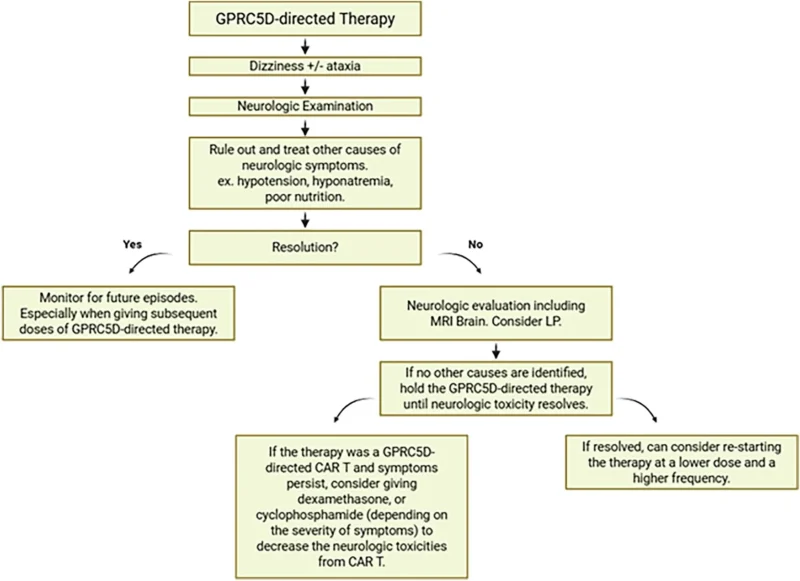
- Develop guidance for clinicians on early identification and prevention, rechallenge
- GPRC5D is an important therapeutic target.”
To which Hamza Hashmi, Myeloma and Cellular Therapy Physician at Memorial Sloan Kettering Cancer Center, added:
“This is a great tweet on rare and unique toxicities of GPRC5d therapies Murali Janakiram. Dizziness and ataxia can be subtle and non-specific symptoms and could be under reported in RWE and over reported in trials.
More data can help generate criteria (timing, symptoms, r/o other etiologies) and criteria should guide management, especially for community providers.”
Other articles featuring Murali Janakiram and Hamza Hashmi on OncoDaily.