Muna Al-Khaifi, GP Oncologist at Mount Sinai Hospital (Toronto), Sinai Health.This article explores the evolving evidence on hormone replacement therapy for gynecologic cancer survivors, challenging the long-standing assumption that hormonal treatment should be universally avoided after cancer. Drawing on contemporary clinical studies and systematic reviews, it examines the safety of hormone therapy across endometrial, ovarian, cervical, vulvar, and vaginal cancers, as well as in women with BRCA and Lynch syndrome following risk-reducing surgery. It also reviews the evidence surrounding testosterone use, recommended hormonal and non-hormonal treatment strategies for menopausal symptoms, and the importance of individualized, evidence-based decision-making to improve quality of life while balancing oncologic safety.
Menopause Management After Gynecologic Cancer: What Does the Evidence Tell Us About Hormone Therapy?
Why This Matters
Menopause, whether it arrives naturally or is initiated abruptly by cancer treatment, can be a defining part of a gynecologic cancer survivor’s life. Surgery to remove the ovaries, pelvic radiation, and certain chemotherapy regimens can all push a woman into menopause years or even decades before it would otherwise occur, and that sudden hormonal drop tends to produce symptoms that are more intense than those of natural menopause. Roughly 40% of women diagnosed with a gynecologic malignancy are still pre or perimenopausal at the time of diagnosis, meaning a large share of survivors will face this transition as a direct consequence of their treatment rather than as a gradual biological process.
Vasomotor symptoms such as hot flashes, flushing, night sweats, and chills affect approximately 80% of menopausal women, and are frequently accompanied by anxiety and disrupted sleep. Sexual health concerns are even more widespread among this specific population, with studies reporting that up to 90% of gynecologic cancer survivors experience some form of sexual dysfunction, whether from vaginal dryness, pain with intercourse, loss of desire, or psychological concerns. Despite how common these issues are, hormone replacement therapy has historically been withheld from cancer survivors out of a blanket fear that any hormonal treatment could fuel a recurrence.
The aim of this article is to lay out, cancer type by cancer type, what the actual evidence says about the safety of hormone therapy in gynecologic cancer survivors, where testosterone fits into that picture, and what a reasonable, individualized approach to treatment looks like.
Women’s Health Initiative and Its Limitations for This Population
Much of the historical hesitancy surrounding hormone therapy can be traced to the Women’s Health Initiative, the largest study of women’s health ever conducted. Between 1993 and 1998, the Women’s Health Initiative enrolled more than 27,000 women between the ages of 50 and 79 across 40 sites in the United States in order to evaluate the effects of hormone therapy on coronary heart disease and breast cancer incidence. Secondary outcomes included endometrial cancer, colorectal cancer, stroke, venous thromboembolism, hip fracture, and overall mortality. Participants received either conjugated equine estrogen alone or conjugated equine estrogen in combination with medroxyprogesterone acetate if they had an intact uterus.
The trial was terminated earlier than planned after investigators observed an increased risk of cardiovascular events and breast cancer among women receiving combined estrogen and progestin therapy. This finding precipitated a sharp, decade long decline in hormone therapy use across the United States.
However, subsequent long term follow up involving 16,608 participants demonstrated that combined estrogen and progestin therapy significantly reduced the risk of endometrial cancer relative to placebo. Additional follow up data published in 2024 further clarified this picture, showing that among women who had previously undergone hysterectomy, estrogen alone significantly increased both the incidence and mortality associated with ovarian cancer, whereas combined estrogen and progestin therapy did not increase ovarian cancer risk among women who retained their uterus.
Several methodological considerations limit the applicability of these findings to gynecologic cancer survivors. The average age of Women’s Health Initiative participants was 63 years, substantially older than the average age of natural menopause in the United States and older than the age at which hormone therapy is typically initiated in cancer survivors. Furthermore, the study was not designed to evaluate gynecologic cancer outcomes specifically, and the hormone doses administered were considerably higher than those available in current low dose formulations.
For these reasons, while the Women’s Health Initiative has meaningfully informed our understanding of hormone therapy risk in the general postmenopausal population, its findings should not be directly extrapolated to guide the management of treatment induced menopause in younger gynecologic cancer survivors.
The Testosterone Question
Testosterone is not currently approved by the FDA for use in women for any indication, including menopausal symptoms or sexual dysfunction, which means any use in this context is off label. Some research has suggested a possible benefit of testosterone for sexual dysfunction during menopause, but that data is limited and inconsistent, and notably, a woman’s endogenous testosterone level does not reliably correlate with how she reports her sexual function. In other words, low testosterone does not clearly predict who will benefit from supplementation, and higher levels do not necessarily protect against sexual dysfunction.
Testosterone has also shown no meaningful benefit for the treatment of vasomotor symptoms like hot flashes and night sweats, so it should not be viewed as an alternative to estrogen for that purpose.
The risk side of the equation is where testosterone becomes particularly concerning. Its use carries a documented risk of adverse effects including clitoromegaly, an enlargement of the clitoris, and hirsutism, meaning excess hair growth in a male pattern distribution. There is also a theoretical risk of malignancy because testosterone can undergo a process called aromatization, in which the body converts androgens into estrogen, potentially exposing hormone sensitive tissue to estrogenic stimulation even when the original intent was to avoid it.
Given the combination of unproven benefit for the outcomes patients actually care about, the lack of FDA approval, and the real potential for physical side effects and theoretical cancer risk, testosterone is not currently recommended for the treatment of menopausal symptoms in gynecologic cancer survivors. Patients interested in addressing sexual dysfunction are generally better served by therapies with clearer evidence and safety profiles, including vaginal estrogen for tissue level symptoms, moisturizers and lubricants, pelvic floor physical therapy, and psychosocial or sex therapy counseling.
Endometrial Cancer
Endometrial cancer is typically diagnosed around age 60, though about 25% of cases occur in premenopausal women, and treatment usually involves hysterectomy with removal of both ovaries, often alongside chemotherapy, immunotherapy, or radiation. Because unopposed estrogen is a well established driver of endometrial cancer in the general population, hormone therapy was historically considered off limits for survivors of this disease. Research over the past two decades has softened that stance considerably for early stage, low grade disease.
A prospective study of more than 1,200 women with stage I or II endometrial cancer compared estrogen therapy against placebo after hysterectomy and bilateral removal of the ovaries. Although the study closed early because of the fallout from the WHI, the results were reassuring. Over a median follow up of 36 months, 2.3% of women who received systemic estrogen experienced a recurrence, compared with 1.9% of women on placebo, a difference that was not considered clinically significant. A meta-analysis and a Cochrane review that incorporated this trial along with several observational studies reached similar conclusions, supporting the idea that hormone therapy is relatively safe for survivors of early stage endometrial cancer.
The picture is different for advanced disease, where safety has not been established and hormone therapy is not recommended, and it is also different depending on tumor subtype. Endometrioid carcinoma, the most common type, is considered hormone dependent, while subtypes such as serous carcinoma, clear cell carcinoma, carcinosarcoma, and sarcoma are considered non hormone dependent. Even so, many of these non hormone dependent tumors still express estrogen and progesterone receptors, so systemic hormone therapy is avoided in patients with advanced hormone independent cancers as well.
Ovarian Cancer
The relationship between hormone therapy and ovarian cancer risk in the general population is genuinely complicated. Several large cohort studies, including the Million Women Study, the Danish Sex Hormone Register Study, and the Nurses’ Health Study, all found an increased risk of ovarian cancer among women using hormone therapy, with the risk appearing greater for estrogen alone than for combined estrogen and progestin, and more strongly linked to endometrioid tumors than to serous or mucinous types. A more recent French cohort study of 75,606 women, however, found no increased ovarian cancer risk associated with estrogen alone, illustrating just how mixed the underlying data remains.
Despite this uncertainty in the general population, the evidence specifically in ovarian cancer survivors has generally been reassuring, and in some cases surprisingly favorable. A Swedish prospective study of 799 women with epithelial ovarian cancer or borderline tumors found no difference in overall survival among women who had used hormone therapy before their diagnosis, and actually suggested improved survival among epithelial ovarian cancer patients who used hormone therapy after diagnosis. A randomized trial of 150 women with epithelial ovarian cancer, followed for a median of 19 years, showed both an overall survival and relapse free survival advantage in the group receiving estrogen therapy.
A meta-analysis combining two randomized trials and four cohort studies similarly found that hormone therapy had a favorable impact on overall survival without increasing recurrence risk. A more recent Korean study following 1,784 women found a significant overall survival advantage among those who received hormone therapy, and a separate meta-analysis of six studies covering 1,521 women found a significant reduction in ovarian cancer related deaths among hormone therapy users.
As with endometrial cancer, subtype matters. Hormone therapy is not recommended for low grade serous or endometrioid ovarian cancers because these tumor types may actually respond to antiestrogen therapy, and caution is also warranted in borderline tumors with features suggesting a risk of progression toward low grade serous carcinoma. For high grade serous ovarian cancer, the most common and aggressive subtype, the evidence suggests estrogen therapy may be not just safe but potentially beneficial, though more high quality randomized trials are still needed before that conclusion can be considered definitive.
Cervical, Vulvar, and Vaginal Cancer
Squamous cell carcinoma, the most common form of cervical cancer, is not driven by hormones, which is why ovarian conservation is already standard practice for premenopausal patients undergoing treatment for this disease. This biology makes it reasonable to expect that hormone therapy would be safe for these survivors, and the available research supports that expectation.
A prospective study of 120 women with early stage cervical cancer treated with either surgery or radiation found no difference in five year recurrence or overall survival between those who received estrogen alone, those who received combined estrogen and progestin, and those who received placebo. A systematic review from 2021 reinforced this, finding no increased risk of squamous cell carcinoma associated with hormone therapy, only a weak signal for increased risk of adenocarcinoma, and an overall improvement in quality of life favoring hormone therapy use.
Adenocarcinoma of the cervix raises somewhat more caution because these tumors can express estrogen receptors, but a small case control study of 58 women with cervical adenocarcinoma did not find a statistically significant difference in outcomes between those who received hormone therapy and those who did not or who had their ovaries preserved. Because vulvar and vaginal cancers are, like most cervical cancers, HPV related squamous cell carcinomas that are not hormonally driven, it is reasonable to extend the same logic to survivors of those cancers, even though direct research in this specific group remains extremely limited. For women with an intact uterus, combined estrogen and progestin therapy is recommended rather than estrogen alone.
BRCA and Lynch Syndrome After Risk-Reducing Surgery
Women with BRCA1 mutations are generally advised to undergo risk reducing removal of the fallopian tubes and ovaries between ages 35 and 40, while those with BRCA2 mutations are advised to do so between ages 40 and 45, and both groups often undergo hysterectomy as well. This surgery induces menopause immediately and, because these women tend to be young, the resulting hormonal drop can be especially disruptive.
Most available research suggests that in women without a personal history of breast cancer, a short course of estrogen therapy can meaningfully ease these symptoms without raising breast cancer risk after the ovaries are removed. A prospective cohort of 872 BRCA carriers without a personal cancer history who underwent risk reducing surgery found no overall increase in breast cancer risk associated with hormone therapy, though the risk appeared higher with combined estrogen and progestin than with estrogen alone. A more recent retrospective study of 306 BRCA carriers, however, found a significantly elevated breast cancer risk among those over age 45 who used hormone therapy, underscoring that age and individual risk factors still matter a great deal.
For women with an intact uterus, progesterone should be added to estrogen, with the decision weighed against the competing risks of endometrial cancer versus breast cancer.
Hormone therapy is not recommended for women with a personal history of hormone sensitive breast cancer due to recurrence risk. Women with Lynch syndrome, particularly those with MLH1, MSH2, or MSH6 mutations, are typically offered risk reducing hysterectomy and removal of the ovaries by their mid-40s, and those who have had a hysterectomy can safely use estrogen alone without increasing colon cancer risk. There is currently no data available to guide hormone therapy use in Lynch syndrome patients who have not undergone hysterectomy.
Recommended Treatment Approach
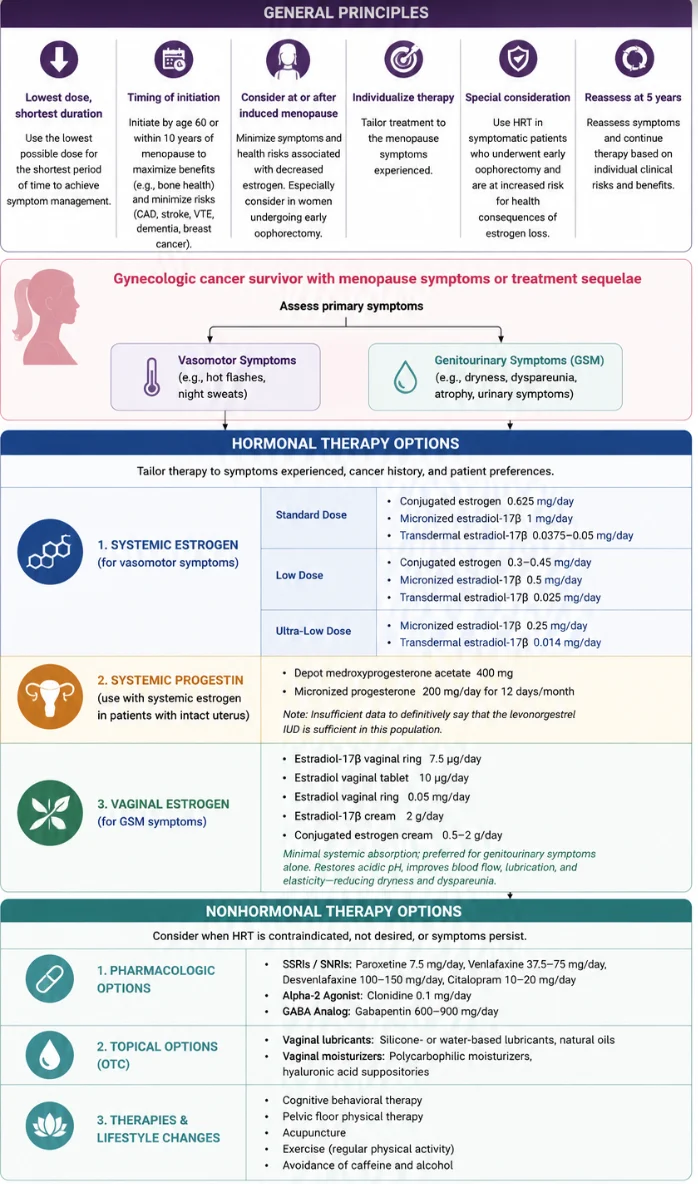
Across every cancer type where hormone therapy is considered appropriate, the same general principle applies, that the lowest effective dose should be used for the shortest duration needed to control symptoms. Treatment is ideally started before age 60 or within ten years of menopause onset in order to capture benefits like improved bone health while minimizing risks such as coronary artery disease, stroke, blood clots, dementia, and breast cancer.
For vasomotor symptoms, options include low dose oral micronized estradiol around 0.5 milligrams daily or transdermal estradiol around 0.025 milligrams daily, and women with an intact uterus should receive a progestin such as depot medroxyprogesterone acetate alongside estrogen to protect the endometrium, since there is not yet enough evidence to confirm that a levonorgestrel IUD provides sufficient protection on its own. Treatment should be reassessed after five years based on the individual’s evolving risks and benefits.
For women whose primary concern is genitourinary symptoms such as vaginal dryness, thinning tissue, or pain with intercourse rather than hot flashes, vaginal estrogen is preferred over systemic therapy because it carries minimal systemic absorption and therefore a lower risk profile. Options include vaginal estradiol at 7.5 micrograms daily, a vaginal estradiol tablet at 10 micrograms daily, or conjugated estrogen cream at 0.5 to 2 grams daily, and a 2008 Cochrane meta-analysis found no association between local vaginal estrogen and endometrial hyperplasia, even though absorption rates can vary. These regimens can generally be continued indefinitely to maintain their effect.
Nonhormonal options remain valuable throughout, including SSRIs and SNRIs for vasomotor symptoms, over the counter vaginal moisturizers, pelvic floor physical therapy, and psychosocial counseling, all of which can meaningfully improve quality of life without the risks associated with hormone exposure. Progestin only therapy, testosterone, and compounded bioidentical hormones are not recommended as first line options given their limited safety data, lack of regulatory oversight in the case of compounded products, and unclear or unfavorable risk to benefit ratios.
Notably, a survey of 61 Italian oncologists found that while most reported discussing hormone therapy with their patients, their willingness to actually prescribe it varied significantly by cancer type, with only 8.2% in favor of prescribing hormone therapy for endometrial cancer survivors specifically. This gap between what the evidence supports and what actually happens in clinical practice highlights a persistent need for clearer, more consistent guidelines so that physicians feel confident offering treatment that could substantially improve their patients’ quality of life.
The Bottom Line
Hormone replacement therapy is not the universal danger it was once believed to be for gynecologic cancer survivors, but it is also not a one size fits all solution. Women with early stage, low grade endometrial cancer, epithelial and germ cell ovarian cancers, early stage squamous cell cervical, vulvar, and vaginal cancers, and those who have undergone risk reducing surgery for BRCA or Lynch syndrome mutations can generally use hormone therapy safely, ideally starting before age 60 or within ten years of menopause, with the decision always individualized around personal risk factors, cancer subtype, and symptom severity.
Vaginal estrogen remains the safest and most effective option for genitourinary symptoms, while low dose systemic estrogen, combined with progesterone for women with an intact uterus, addresses vasomotor symptoms most effectively.
Testosterone, despite consumer interest, currently lacks FDA approval for use in women, has not demonstrated benefit for hot flashes, has only weak and inconsistent evidence for sexual dysfunction, and carries real risks including clitoromegaly, hirsutism, and a theoretical cancer risk through aromatization, so it is not recommended as part of standard care.
Nonhormonal therapies such as SSRIs, SNRIs, vaginal moisturizers, pelvic floor physical therapy, and psychosocial counseling remain effective, evidence backed alternatives that should be offered alongside or instead of hormones depending on patient preference and risk profile. The overarching message from the evidence is one of individualized, informed decision making rather than blanket avoidance, and closing the gap between what research supports and what is actually offered in clinical practice stands to meaningfully improve the lives of gynecologic cancer survivors.
Despite the limited availability of high-quality evidence, hormone replacement therapy is considered safe and appropriate for many gynecologic cancer survivors. For patients in whom hormonal therapy is contraindicated, a variety of pharmacologic and non-pharmacologic interventions are available to effectively alleviate the symptoms associated with treatment-induced menopause.
References (Selected)
Luzarraga Aznar, A., Elyashiv, O., Dababou, S., Palasz, N. A., Canturk, M. M., Montero-Macias, R., Pavone, M., Jayraj, A. S., Hsu, H. C., & Ramirez, P. T. (2026). Hormone replacement therapy in gynecologic cancer: oncologic safety and alternative therapies. International journal of gynecological cancer : official journal of the International Gynecological Cancer Society, 36(2), 102809.
Laila S. Agrawal et al. Enhancing Sexual Health for Cancer Survivors. Am Soc Clin Oncol Educ Book 45, e472856(2025). DOI:10.1200/EDBK-25-472856
Gorman, M., & Shih, K. (2025). Updates in Hormone Replacement Therapy for Survivors of Gynecologic Cancers. Current treatment options in oncology, 26(3), 179–186.
Mihulka, O., Curran, M., Narasimhan, R. M., Moore, J. F., & Rojas, K. E. (2026). Strategies for treating sexual health concerns after breast and gynecologic cancer. Journal of Minimally Invasive Gynecology, 33(7), 1001–1013.
Table 1. Evidence-Based Hormonal and Non-Hormonal Treatment Options for the Management of Menopausal Symptoms and Treatment-Related Sequelae in Gynecologic Cancer Survivors
| Treatment Category | Subtype | Therapy | Recommended Dose / Use |
| Hormonal Therapy | Systemic Estrogen (Standard Dose) | Conjugated estrogen | 0.625 mg/day |
| Micronized estradiol-17β | 1 mg/day | ||
| Transdermal estradiol-17β | 0.0375–0.05 mg/day | ||
| Systemic Estrogen (Low Dose) | Conjugated estrogen | 0.3–0.45 mg/day | |
| Micronized estradiol-17β | 0.5 mg/day | ||
| Transdermal estradiol-17β | 0.025 mg/day | ||
| Systemic Estrogen (Ultra-Low Dose) | Micronized estradiol-17β | 0.25 mg/day | |
| Transdermal estradiol-17β | 0.014 mg/day | ||
| Systemic Progestin* | Depot medroxyprogesterone acetate | 400 mg | |
| Micronized progesterone | 200 mg/day for 12 days/month | ||
| Vaginal Estrogen | Estradiol-17β vaginal ring | 7.5 μg/day | |
| Estradiol vaginal tablet | 10 μg/day | ||
| Estradiol vaginal ring | 0.05 mg/day | ||
| Estradiol-17β cream | 2 g/day | ||
| Conjugated estrogen cream | 0.5–2 g/day | ||
| Non-Hormonal Therapy | SSRIs/SNRIs | Paroxetine | 7.5 mg/day |
| Venlafaxine | 37.5–75 mg/day | ||
| Desvenlafaxine | 100–150 mg/day | ||
| Citalopram | 10–20 mg/day | ||
| Alpha-2 Agonist | Clonidine | 0.1 mg/day | |
| GABA Analog | Gabapentin | 600–900 mg/day | |
| Vaginal Lubricants & Moisturizers | Silicone-based lubricants | As needed | |
| Water-based lubricants | As needed | ||
| Natural oils | As needed | ||
| Polycarbophil-based vaginal moisturizers | Regular use | ||
| Hyaluronic acid vaginal suppositories | Regular use | ||
| Therapies & Lifestyle Interventions | Cognitive behavioral therapy | Individualized | |
| Pelvic floor physical therapy | Individualized | ||
| Acupuncture | Individualized | ||
| Exercise | Regular physical activity | ||
| Avoidance of caffeine and alcohol | Lifestyle modification |
Figure 1. Evidence-Based Management of Menopausal Symptoms in Gynecologic Cancer Survivors
You can also read: Muna Al-Khaifi: Why Cancer Survivorship Must Begin at Diagnosis