Mukul Roy, Governance Committee Member at Young SIOG, Consultant Clinical and Radiation Oncologist at Jaslok Hospital and Research Centre, shared on LinkedIn:
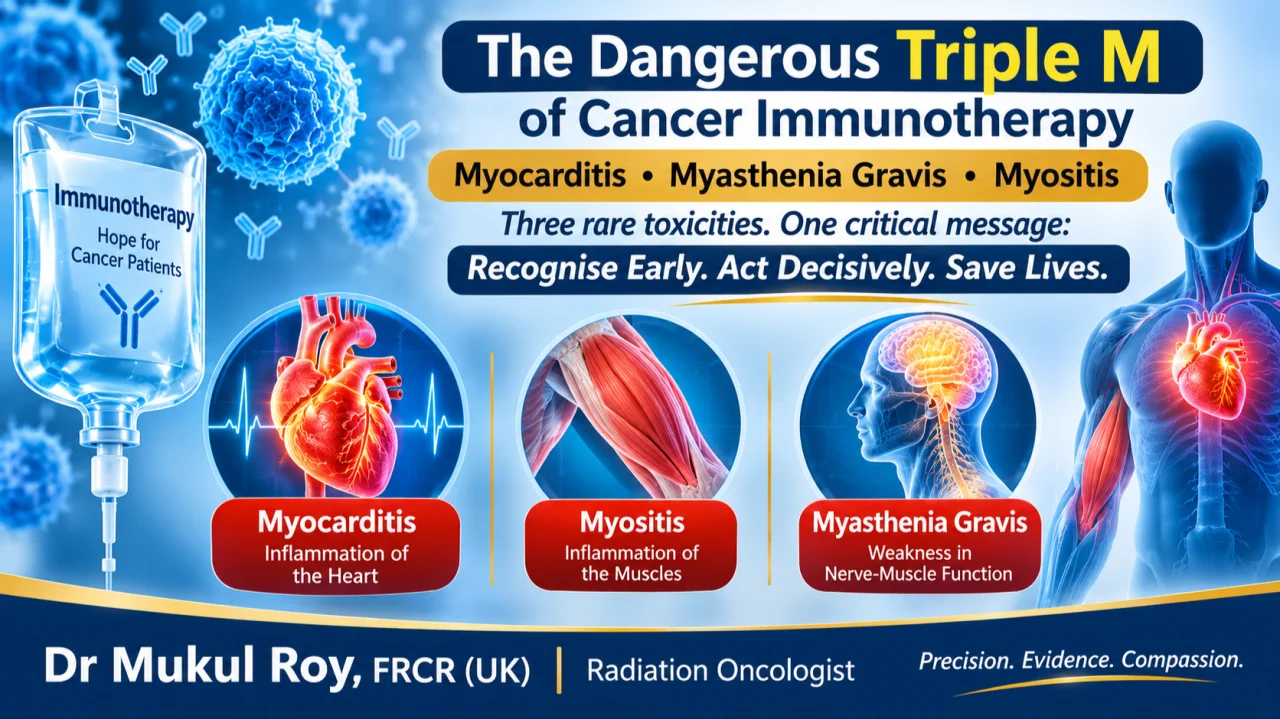
“Myocarditis • Myasthenia Gravis • Myositis
Three rare toxicities. One critical message: Recognise early. Act decisively. Save lives.
Cancer immunotherapy has changed the landscape of modern oncology. Drugs that help the immune system recognise and attack cancer have offered new hope to patients with lung cancer, melanoma, kidney cancer and several other malignancies.
But every breakthrough comes with responsibility.
Among the most concerning complications of immune checkpoint inhibitors is a potentially life-threatening combination known as the Triple M:
- Myocarditis – inflammation of the heart muscle.
- Myositis – inflammation of the muscles.
- Myasthenia Gravis – a condition in which the immune system interferes with communication between nerves and muscles.
Individually, these conditions can be serious. When they occur together, the consequences can be devastating.
MYOCARDITIS: When immunotherapy affects the heart
Myocarditis means inflammation of the heart muscle. In some patients receiving immunotherapy, the immune system mistakenly attacks the heart.
The danger is that this may interfere with the heart’s ability to pump blood and maintain a normal rhythm.
Warning signs include:
- Unexplained tiredness or weakness.
- Chest pain or discomfort.
- Breathlessness.
- Palpitations or an unusually fast heartbeat.
- Dizziness or fainting.
- In severe cases, myocarditis can cause dangerous heart rhythms, heart block or heart failure.
An important point: a patient may develop myocarditis even without dramatic symptoms initially.
An ECG and blood tests such as troponin can help identify possible heart injury. Further assessment may include an echocardiogram and cardiac MRI.
The lesson: New cardiac symptoms during immunotherapy must never be dismissed as routine treatment-related fatigue.
MYOSITIS: When muscles become inflamed
Myositis is inflammation of the muscles caused by an abnormal immune response.
Patients may experience:
- Muscle pain or tenderness.
- Weakness in the arms and legs.
- Difficulty climbing stairs.
- Difficulty getting up from a chair.
- Difficulty lifting the arms or holding the head upright.
It can sometimes be mistaken for general cancer-related weakness, ageing or simple fatigue.
However, there is a critical distinction: immune-related muscle inflammation can progress rapidly and may affect the muscles responsible for swallowing and breathing.
Blood tests, including creatine kinase (CK), can help detect muscle injury. A normal-looking patient should not automatically be assumed to be free of serious toxicity if symptoms are concerning.
The lesson: New muscle weakness during immunotherapy deserves prompt investigation, not reassurance alone.
MYASTHENIA GRAVIS: When nerves and muscles stop communicating properly
Myasthenia gravis affects the connection between nerves and muscles.
Patients may develop:
- Drooping of one or both eyelids.
- Double vision.
- Difficulty chewing or swallowing.
- Slurred speech.
- Weakness that becomes worse with activity.
- Difficulty breathing in severe cases.
The most dangerous complication is weakness of the breathing muscles, which can lead to respiratory failure and require intensive care.
Unlike ordinary tiredness, this weakness may fluctuate and worsen as the day progresses or with repeated activity.
The lesson: Drooping eyelids, double vision, swallowing difficulty or new breathing problems in a patient receiving immunotherapy require urgent assessment.
WHY THE COMBINATION IS SO DANGEROUS
The real concern is that these three conditions can overlap.
A patient may develop muscle inflammation, nerve-muscle dysfunction and heart inflammation at the same time.
A 2024 systematic review of 50 published cases of Triple M overlap reported an in-hospital mortality of 38%. The median time from starting immunotherapy to presentation was just 21 days.
These figures relate to a small, selected collection of reported overlap cases, not the overall risk among immunotherapy recipients. Nevertheless, they underline the seriousness of this complication.
WHAT SHOULD ONCOLOGISTS DO?
This is where clinical judgement and multidisciplinary teamwork become essential.
- Recognise early: Do not attribute new weakness, breathlessness or fatigue automatically to cancer or treatment-related tiredness.
- Investigate promptly: Depending on the presentation, assessment may include ECG, troponin, CK, cardiac imaging and neurological evaluation.
- Think beyond one organ: If myositis or myasthenia is suspected, actively consider associated myocarditis.
- Act as a team: Oncology, cardiology, neurology, intensive care and other specialists may need to work together.
- Do not delay escalation: Suspected serious toxicity requires urgent hospital assessment, interruption of immunotherapy while evaluated, and prompt specialist-led management.
A MESSAGE FOR INDIAN ONCOLOGY
As immunotherapy becomes increasingly accessible in India, our focus must move beyond simply prescribing these drugs.
We need stronger toxicity-monitoring systems, patient education, rapid referral pathways and multidisciplinary expertise.
Every patient starting immunotherapy should know which symptoms require immediate medical attention and whom to contact.
The success of immunotherapy should not be measured only by tumour response. It must also be measured by how safely we deliver treatment and how effectively we recognise and manage complications.
MY FINAL MESSAGE
Immunotherapy is a remarkable scientific achievement, but it is not a treatment that can be prescribed and forgotten.
The best oncologist is not simply the one who knows when to start immunotherapy, but also the one who knows when to suspect toxicity, when to stop, and how to act.
Precision in cancer care means treating the tumour while protecting the patient.
Recognise early. Collaborate widely. Treat decisively.
Because sometimes, saving a patient’s life means recognising what the treatment itself may be doing.
Dr Mukul Roy, FRCR (UK) Radiation Oncologist | Clinical Oncology Advancing Precision, Evidence-Based and Patient-Centred Cancer Care.”
You can also read: Navigating Immunotherapy Side Effects: Understanding Immune-Related Adverse Events