
Immune-related adverse events (irAEs) represent one of the defining clinical challenges of modern oncology. Unlike the predictable toxicities of conventional chemotherapy, irAEs result from excessive immune activation and can affect virtually any organ system, ranging from mild skin reactions to rapidly fatal myocarditis. As immunotherapy continues to expand across cancer types and treatment settings, recognizing and managing these unique toxicities has become an essential component of delivering safe and effective cancer care.
Immune checkpoint inhibitors (ICIs) have transformed the treatment of many advanced malignancies, offering durable responses and improved survival across an expanding range of cancers. By targeting immune checkpoints such as CTLA-4, PD-1, and PD-L1, these monoclonal antibodies restore the body’s natural antitumor immune response, allowing T cells to recognize and destroy cancer cells more effectively.
However, the same mechanism responsible for these remarkable clinical outcomes also underlies one of immunotherapy’s greatest challenges. Unlike conventional chemotherapy, which primarily targets rapidly dividing cells, ICIs amplify immune activity by blocking inhibitory immune checkpoints that normally maintain peripheral immune tolerance. While this restores antitumor immunity, it can also activate autoreactive T cells, increase pro-inflammatory cytokine production, promote autoantibody formation, and trigger immune-mediated inflammation in healthy tissues.
In some patients, this immune activation extends beyond the tumor and attacks healthy organs, giving rise to immune-related adverse events. These toxicities are unique to immunotherapy and can affect virtually every organ system, making early recognition and prompt intervention essential for successful patient care.
Immunotherapy vs Chemotherapy: Success Rates, Side Effects, Costs Compared
Not All Patients Experience irAEs the Same Way
The likelihood of developing immune-related adverse events depends on several factors, including the checkpoint inhibitor being used, treatment dose, and individual patient characteristics. Combination immunotherapy—particularly regimens combining anti-CTLA-4 with anti-PD-1 agents—consistently produces higher rates of toxicity than monotherapy and is associated with both earlier onset and greater severity of adverse events.
According to the pharmacovigilance analysis “Fatal Toxic Effects Associated With Immune Checkpoint Inhibitors”by Wang et al., fatal immune-related toxicities have been reported in approximately 0.3% to 1.3% of treated patients, with combination regimens demonstrating a median onset of serious events of around 14.5 days after treatment initiation. The same study reported that cardiac and neurologic toxicities accounted for 43% of immune-related deaths among 3,545 treated patients across seven academic centers.
The review “Diagnosis, Monitoring, and Management of Adverse Events From Immune Checkpoint Inhibitor Therapy” by Postow et al. also highlights that immune-related adverse events often develop in a predictable sequence, although delayed toxicities may occur months after therapy has been discontinued. Cutaneous manifestations usually appear first, most commonly within two to four weeks of starting treatment. Gastrointestinal complications generally emerge between four and eight weeks, while hepatic and endocrine toxicities tend to develop later. Understanding these characteristic patterns—and remaining alert for delayed events—helps clinicians maintain an appropriate level of suspicion throughout treatment and long-term follow-up.
A Disease That Can Affect Nearly Any Organ
One of the defining features of immune-related adverse events is their ability to involve almost any organ system, often presenting with symptoms that resemble autoimmune diseases. The frequency and severity of these toxicities vary considerably by organ.
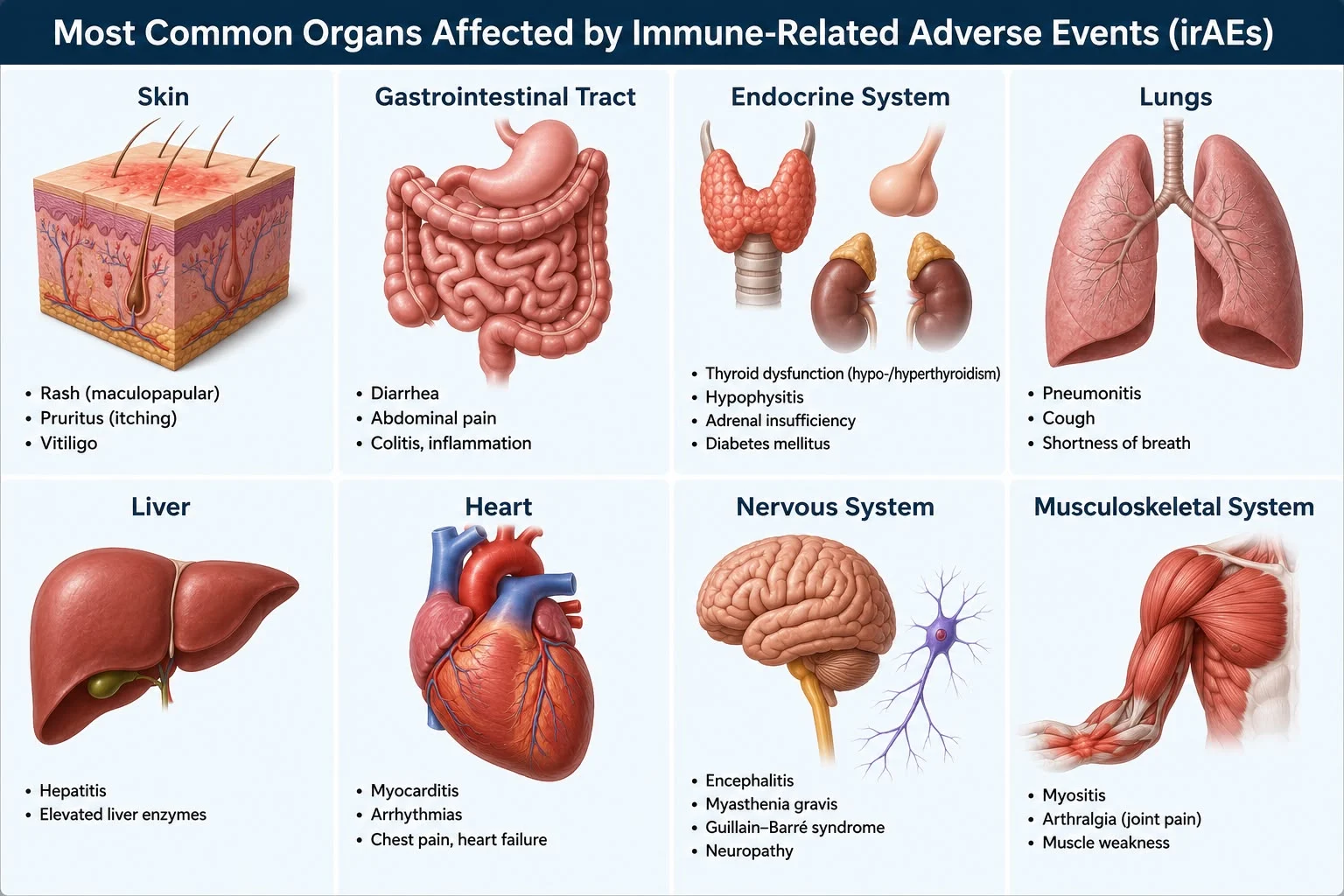
According to the review article “Diagnosis, Monitoring, and Management of Adverse Events From Immune Checkpoint Inhibitor Therapy” by Postow et al., the skin is the most frequently affected organ system, with cutaneous toxicities occurring in approximately one-third to one-half of patients. Maculopapular rash, pruritus, and vitiligo are among the earliest and most commonly observed manifestations.
The gastrointestinal tract and endocrine system are also commonly involved. Immune-mediated colitis typically presents with diarrhea and abdominal pain and remains one of the most serious complications associated with checkpoint inhibition. As highlighted by Postow et al., colitis continues to represent the leading cause of treatment-related mortality among patients receiving anti-CTLA-4 therapy. The same review describes endocrine toxicities, including thyroid dysfunction, hypophysitis, and adrenal insufficiency—as frequent complications. Unlike many other irAEs that resolve with immunosuppressive therapy, endocrine toxicities often result in permanent hormonal deficiencies requiring lifelong hormone replacement.
According to the systematic review and meta-analysis “Incidence of Programmed Cell Death 1 Inhibitor–Related Pneumonitis in Patients With Advanced Cancer” by Nishino et al., pulmonary toxicity, particularly pneumonitis, occurs in approximately 2.7% of patients receiving PD-1 inhibitor monotherapy, with the incidence increasing to 6.6% during combination immunotherapy. Among patients with non-small cell lung cancer, the reported incidence reaches 4.1%. Pneumonitis remains one of the leading causes of fatal immune-related adverse events associated with anti-PD-1/PD-L1 therapy.
Cardiac toxicity is rare but carries a disproportionately high mortality. The pharmacovigilance analysis “Fatal Toxic Effects Associated With Immune Checkpoint Inhibitors” by Wang et al. reported a case-fatality rate of 39.7% among 131 patients with immune checkpoint inhibitor-associated myocarditis. Similarly, the systematic review and meta-analysis “Immune Checkpoint Inhibitor-Associated Myocarditis: A Systematic Review and Meta-analysis” reported an overall mortality rate of 37.7% among 220 patients with ICI-associated myocarditis. Myocarditis frequently coexists with immune-mediated myositis and myasthenia gravis, forming the so-called “overlap syndrome,” one of the most life-threatening immune-related complications.
Neurological toxicities are uncommon but highly heterogeneous, affecting both the central and peripheral nervous systems. Patients may develop serious conditions including encephalitis, myasthenia gravis, or Guillain–Barré syndrome, highlighting the broad spectrum of immune-mediated complications clinicians may encounter. Any new neurological symptom arising during or after immunotherapy should be considered a potential immune-related adverse event until proven otherwise.
Recognizing Toxicity Before It Becomes Severe
Prompt diagnosis is one of the most important determinants of patient outcomes. Because the initial clinical presentation of immune-related adverse events is often nonspecific—or even asymptomatic—radiological imaging has become an essential component of their evaluation.
According to the review article “Imaging Features of Toxicities Associated With Immune Checkpoint Inhibitors” by Tirumani et al., computed tomography (CT), magnetic resonance imaging (MRI), and ultrasonography play a central role in identifying inflammatory changes across multiple organ systems and, in some cases, detecting toxicity before overt clinical manifestations develop.
The same review highlights that chest CT is the preferred imaging modality for evaluating immune-related pneumonitis, while CT enterography is recommended for assessing severe immune-mediated colitis. Cardiac MRI remains the imaging gold standard for suspected myocarditis, whereas brain MRI is essential for evaluating neurological complications such as encephalitis. Ultrasonography is particularly useful for assessing thyroiditis and other endocrine toxicities.
Early recognition through clinical assessment and appropriate imaging allows clinicians to initiate treatment before inflammation progresses to irreversible organ damage, emphasizing the importance of maintaining a high level of suspicion throughout immunotherapy.
Managing Immune-Related Adverse Events
Management of immune-related adverse events is guided primarily by toxicity severity and is generally based on the Common Terminology Criteria for Adverse Events (CTCAE). Depending on the grade of toxicity, immunotherapy may be continued with close monitoring, temporarily withheld, or permanently discontinued.
Current recommendations from the ASCO, ESMO, and SITC clinical practice guidelines emphasize that systemic corticosteroids including prednisone and methylprednisolone remain the cornerstone of treatment for most clinically significant irAEs.
For patients with steroid-refractory toxicity, additional immunosuppressive therapy may be required. The ASCO Clinical Practice Guideline on the Management of Immune-Related Adverse Events recommends infliximab, a tumor necrosis factor-alpha inhibitor, for steroid-refractory immune-mediated colitis, while tocilizumab, an interleukin-6 receptor antagonist, has emerged as an effective option for selected refractory rheumatologic and inflammatory toxicities.
Because irAEs can affect virtually any organ system, successful management relies on close multidisciplinary collaboration involving oncologists, radiologists, gastroenterologists, pulmonologists, endocrinologists, cardiologists, neurologists, dermatologists, and other specialists.
Current international guidelines recommend that immunotherapy may be cautiously resumed in selected patients once toxicity has resolved to Grade 1 or lower and corticosteroids have been appropriately tapered. However, permanent discontinuation is generally advised following severe Grade 3–4 toxicities involving the heart, lungs, or nervous system because of the substantial risk of recurrent or life-threatening complications.
Looking Ahead
Immune checkpoint inhibitors have fundamentally transformed the treatment landscape across multiple cancer types, but their clinical success is inseparable from the unique spectrum of immune-related toxicities they can produce. As immunotherapy continues to expand into earlier-stage disease, perioperative treatment, and novel combination strategies, recognizing and managing irAEs has become an essential component of modern oncology practice.
Early recognition of the characteristic timing, clinical presentation, laboratory abnormalities, and imaging features of immune-related adverse events, combined with prompt multidisciplinary management remains critical for maximizing the benefits of immunotherapy while minimizing potentially life-threatening complications.
Looking ahead, ongoing research is focused on identifying predictive biomarkers capable of distinguishing patients at greatest risk for severe irAEs before treatment begins. A deeper understanding of the mechanisms underlying immune toxicity, together with advances in precision medicine and personalized monitoring strategies, may enable clinicians to tailor surveillance, intervene earlier, and further improve the safety of immune checkpoint inhibitor therapy without compromising its remarkable antitumor efficacy.
ONCOFFEE: Ugur Uslu — From Carl June’s Lab to Launching His Own
Written by Manushak Ghukasyan, MD