






Mohammad Sabry Alkady, Professor of Medical and Radiation Oncology at Faculty of Medicine at Ain Shams University, Egypt, shared a post on Facebook:
“When ‘low-dose, long-term’ makes a long-lasting difference
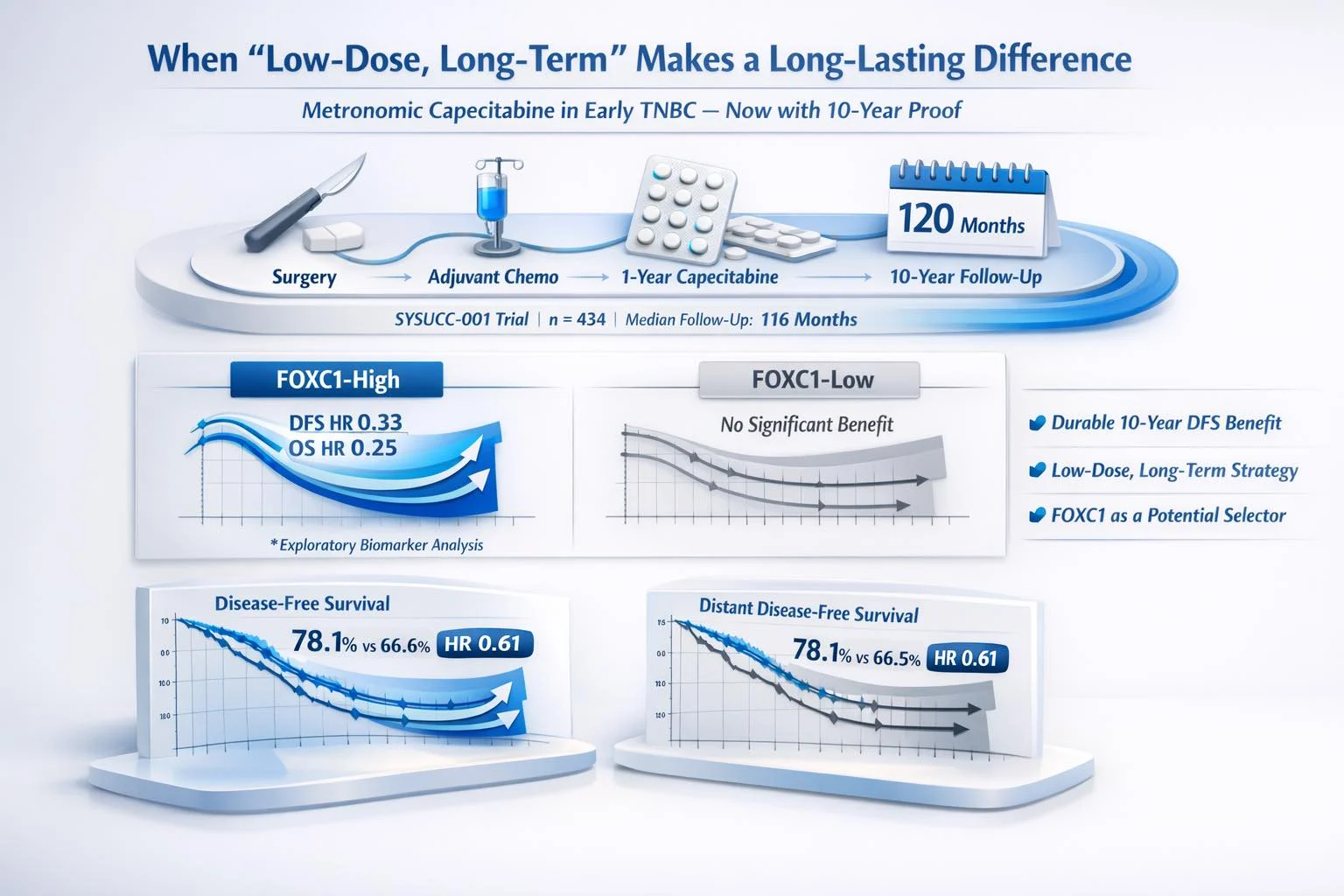
Metronomic capecitabine in early TNBC — now with 10-year proof
The 10-year update of the Chinese phase III SYSUCC-001 trial, reported in The Lancet Oncology, delivers a rare message in triple-negative breast cancer (TNBC):
A simple oral strategy can translate into durable survival.
If you miss Pembrolizumab Pre operatively…….. you can use this way
Trial snapshot (SYSUCC-001)
- Population: Early TNBC after surgery + standard adjuvant therapy
- Intervention: Metronomic capecitabine 650 mg/m² BID × 1 year
- Comparator: Observation
- Follow-up: Median 116 months (≈10 years)
10-year outcomes that matter
Disease-free survival: 78.1% vs 66.6% → HR 0.61, P = 0.007
Distant DFS: 78.1% vs 66.5% → HR 0.61, P = 0.0075
Locoregional RFS: 81.6% vs 69.9% → HR 0.60, P = 0.011
Overall survival: numerically better (82.4% vs 73.7%), trend toward significance.
Biomarker insight: FOXC1 matters
FOXC1-high tumors
- DFS HR 0.33
- OS HR 0.25
Clear survival advantage
FOXC1-low tumors
- No significant benefit
A step toward biologically driven de-escalation vs intensification.
A real patient story — now echoed by trial data
Four years ago, a woman in her early 40s underwent surgery and standard adjuvant chemotherapy for early TNBC.
Given her high-risk features and excellent tolerance, she continued on metronomic capecitabine beyond the classic timeframe — low dose, continuous, with close monitoring.
Over 4 years, she maintained:
- Stable quality of life
- Minimal toxicity
- Complete disease control
Today, she remains disease-free — a real-world experience that once felt ‘anecdotal’…
Now, SYSUCC-001 shows this strategy can stand on level-I evidence.
Sometimes, clinical intuition arrives years before publication.
Clinical take-home messages
- Metronomic capecitabine is not just a 5-year DFS story — it’s a 10-year survival story
- FOXC1 may help identify who truly benefits
- Low-dose, continuous therapy can be powerful, practical, and patient-friendly
- This approach deserves discussion in high-risk early TNBC, especially where immunotherapy access is limited
The bigger lesson
Precision oncology is not only about new drugs, sometimes it’s about using old drugs, differently, for the right patient.”
More posts about breast cancer.