





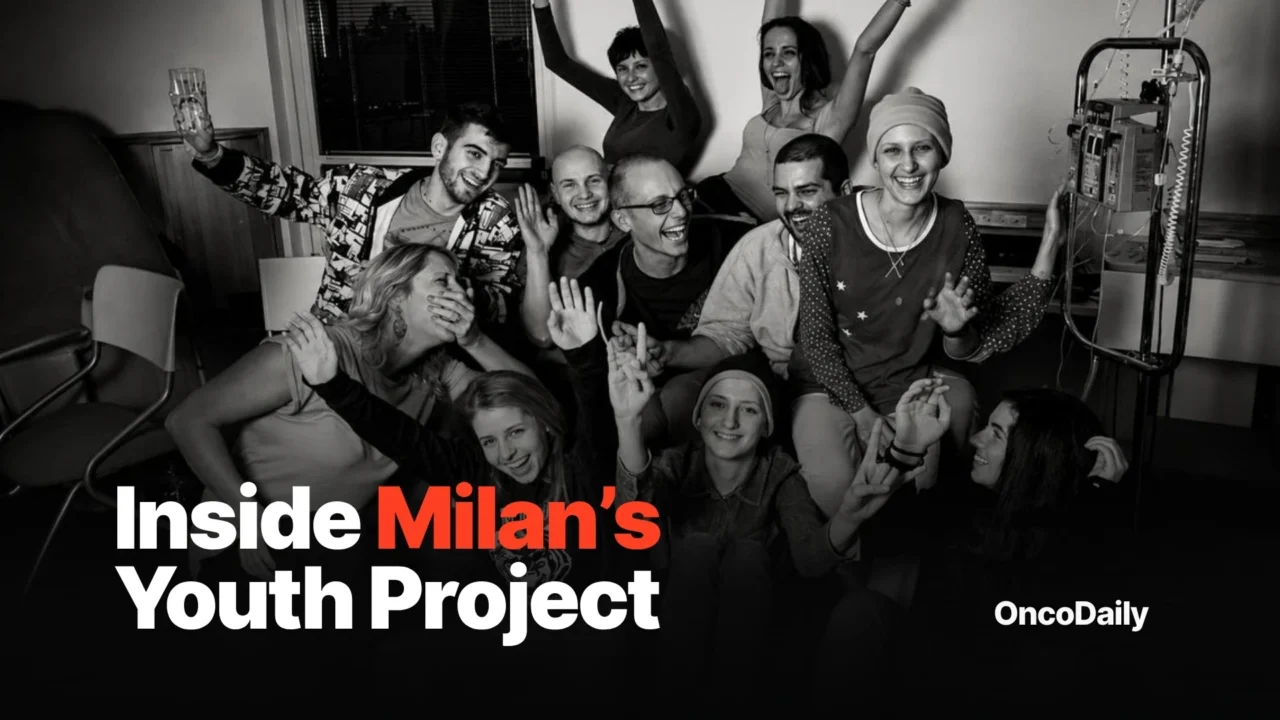
Cancer during adolescence or young adulthood is never only a medical diagnosis. It arrives at a time when identity is still forming, independence is beginning, relationships are changing, and the future is expected to feel open and limitless.
For young patients, a cancer diagnosis can suddenly reduce that future to the date of the next chemotherapy cycle, the next hospital admission, or the next scan.
At the Istituto Nazionale dei Tumori di Milano, the Youth Project was created to respond to this reality. Presented by pediatric oncologist Andrea Ferrari, the initiative offers a clinical and organizational model specifically designed for adolescents and young adults with cancer.
Its purpose extends beyond delivering effective treatment. It seeks to understand the lives, fears, relationships, ambitions, and emotional needs of young patients, while giving them the space to remain teenagers and young adults throughout their cancer journey.
Why Young Patients Need a Different Model of Care
Adolescents and young adults with cancer occupy a unique position between pediatric and adult oncology.
The epidemiology of cancer in this age group includes both pediatric and adult tumor types. Caring for these patients therefore requires collaboration between pediatric oncologists, adult medical oncologists, and specialists from multiple disciplines.
Young patients have also historically had limited participation in clinical research and clinical trials. This has contributed to slower improvements in survival compared with other age groups. For some cancers, adolescents and young adults may experience poorer outcomes than children with the same disease.
The challenges are not limited to tumor biology or access to treatment.
Cancer can affect physical development, sexuality, identity, education, employment, relationships, privacy, independence, and plans for the future. Communication may become more complex, while treatment adherence, shared decision-making, and risk-taking behaviors require an age-appropriate approach.
These realities make one principle essential: healthcare professionals should not assume that they already understand what young patients need.
The patients themselves must be given the opportunity to explain.
Treating the Person, Not Only the Cancer
Young patients need access to the best possible treatment. However, they also need physicians who recognize that treating an adolescent with cancer is different from treating cancer that happens to occur during adolescence.
Each young person is more than a diagnosis. Their life also includes family, friendships, education, love, ambitions, passions, fears, and plans.
They may need to express anger while also finding reasons to smile. They may need to protect their privacy, reclaim confidence after major surgery, play football with friends, return to a bicycle after an amputation, or imagine a professional future beyond treatment.
One young patient involved in the project, Rebecca, spoke about her dream of becoming a doctor. She later graduated with a degree in medicine.
Stories such as hers reflect one of the project’s central beliefs: young people must be supported not only in surviving cancer, but also in continuing to imagine and build a future.
A Truly Multidisciplinary Approach
An effective adolescent and young adult oncology program must combine elements of pediatric and adult cancer care while addressing the wider needs of the patient.
This requires an integrated multidisciplinary team that may include pediatric and adult medical oncologists, age-specific psychologists, nurses, social workers, palliative care specialists, physiotherapists, occupational therapists, nutritionists, and professionals with expertise in fertility and sexuality.
Specialized training and continuing professional education are also essential for everyone involved.
Additional pillars of care include access to clinical trials, clear referral pathways, age-appropriate psychological support, genetic and genomic testing, fertility preservation, survivorship services, palliative care, patient advocacy, dedicated spaces, flexible age boundaries, defined metrics, and sustainable funding.
Yet even the strongest framework cannot succeed without the human element.
Professionals working with young people must be willing to sit down, listen, and spend time with them.
When Clinical Time Is Not Enough
There are moments when medical expertise alone cannot meet the needs of a young patient.
Behind appointments, laboratory results, imaging reports, and treatment plans are silences, hidden tears, brief smiles, unanswered messages, nervous glances, private fears, small lies, and thoughts that may be difficult to express.
At those moments, doctors and other healthcare professionals must bring their humanity into the room alongside their clinical knowledge.
They must be prepared to stand beside a young person during one of the most difficult periods of life, not only as specialists, but also as adults capable of listening, understanding, and sharing vulnerability.
This philosophy became the foundation of the Youth Project.
The Birth of the Youth Project
The Youth Project was launched in 2011 within the Pediatric Oncology Unit at the Istituto Nazionale dei Tumori di Milano.
It was designed for adolescents older than 15 years and young adults up to the age of 25 with solid tumors. Patients are managed by the pediatric oncology team while receiving access to services specifically developed for their age group.
The initiative began as an extension of existing clinical activities, without requiring major changes to the hospital’s organization or significant new demands on its administration.
Its goal was to create both a new organizational model and a new culture of care.
On one side, the project aims to improve and standardize the quality of care for young patients. This includes access to clinical trials, psychological support, fertility preservation, and structured follow-up after treatment.
On the other, it aims to improve quality of life during treatment.
Making the Hospital a Place for Young People
Hospital environments designed for children or older adults may not reflect the needs of adolescents and young adults.
The Youth Project therefore created dedicated spaces, including a multifunctional room, a study room, a music room, and a gym.
These areas allow young patients to meet peers, maintain social connections, study, exercise, create, and spend time away from the formal clinical environment.
The model also recognizes the importance of flexible visiting arrangements, easy access to the hospital, opportunities for social interaction, and respect for physical and emotional privacy.
The goal is not to disguise the seriousness of treatment. It is to make the hospital a place where young people can continue to experience parts of ordinary life.
Creativity as a Form of Care
One of the most distinctive elements of the Youth Project is its use of creative and artistic activities.
Patients have participated in music, photography, fashion, graphic novels, video production, podcasts, comedy, and other forms of storytelling. These activities offer young people new ways to express their emotions while allowing doctors, psychologists, and nurses to better understand their inner experiences.
They also give patients the opportunity to spend time together.
Those receiving active treatment meet young people who have already completed therapy. For patients still undergoing treatment, survivors can offer a visible example of life beyond cancer. For those who have finished therapy, participation can serve as a bridge between life during treatment and life afterward.
The projects also create moments of normality and lightness. They remind participants that before being patients, they are young people.
Working with professional musicians, photographers, artists, and writers can help restore confidence at a time when self-esteem may have been damaged by illness and treatment.
Long-term creative projects also encourage participants to plan months ahead. This can be especially meaningful when cancer has narrowed their sense of time to the next hospital discharge or treatment cycle.
Giving Fear a Voice
Creative work gives young patients the freedom to describe their hopes, fears, anger, uncertainty, and ambitions in their own words.
Speaking about illness can become part of processing the trauma of diagnosis and searching for an answer to the question, “Why me?”
For clinicians, these projects provide a valuable window into the emotional world of their patients. They complement traditional psychological assessment by revealing experiences that may never emerge during a routine clinical conversation.
Camilla, a 22-year-old patient with osteosarcoma, described the experience simply: the art project gave her the opportunity to “make a friend” of her fears.
The initiative’s creative work has therefore been described as more than recreation. It represents what the project calls a “science of the soul.”
From Creative Expression to Scientific Work
The Youth Project has developed a defined methodology intended to place adolescents and young adults, together with their needs and voices, at the center of care.
Its creative projects have also contributed to scientific publications and international discussion about adolescent and young adult oncology.
Among its early initiatives was a fashion project focused on creating beauty through the senses. This was followed by the music project Clouds of Oxygen, published in the Journal of Clinical Oncology.
The graphic novel Loop: There Is No Going Back allowed patients to create superheroes with individual powers. Another project, Searching for Happiness, asked young people to use photography to explain what happiness meant to them during treatment and what gave them the strength to continue.
The song Christmas Balls became widely known in Italy, generating millions of online views and being performed in schools during the Christmas period.
Other projects explored the future, personal dreams, social isolation, survival strategies, travel, and hospital life.
Songs, Stories and Survival Guides
The photography project What Shall I Do When I Grow Up? focused on the future and the ambitions of young patients.
Music projects included Summer in Your Eyes and Reverse Rain Dance. In one reflection, Martina described travelling through the night with the promise that there would eventually be sunshine.
The Tumorial project took more than a year to complete. Patients created a series of video tutorials intended as a survival handbook for other young people with cancer, sharing practical advice and personal strategies for getting through treatment.
The fashion project Condominium, later described in The Lancet Oncology, explored social isolation and the experience of feeling alone even when surrounded by people offering affection.
A podcast project, Based on a True Story, examined the idea of a journey, both as a real adventure and as a metaphor for cancer.
In one contribution, Giorgia described emptying her suitcase of clothes for dancing and replacing them with strength, hope, patience, courage, determination, and many pairs of pajamas.
Using Humor Without Minimizing Cancer
The project also explored magic through personalized playing cards created by patients. Kings received chemotherapy, queens wore bandanas, jacks were dressed as nurses, and doctors appeared as jokers.
The song I Was Only 16 was written in English to reach an international audience. It was performed with established artists, including Tony Hadley, the former lead singer of Spandau Ballet.
More recently, patients created two seasons of the sitcom Operation Crab. Acting as writers, performers, and directors, they used irony and black humor to describe hospital life.
The intention was not to laugh at cancer, but to laugh from within the experience of cancer. Through comedy, patients challenged language shaped by pity, excessive sentimentality, and fear.
A Model That Must Reflect Local Realities
Adolescent and young adult oncology programs have been developed in different parts of the world with the involvement of healthcare professionals, academic societies, organizations, and governments.
These programs share important principles but also differ according to local healthcare systems, cultures, resources, and institutional structures.
A dedicated program should therefore not be built only around an ideal model. It must also respond to the realities of the community in which it operates.
This diversity can be valuable. Successes and failures from different settings can be shared, allowing centers to learn from one another and develop models suited to their own patients.
Measuring What Matters
The long-term sustainability of adolescent and young adult oncology programs depends on demonstrating their value.
This requires agreement on the outcomes that matter and on how those outcomes should be measured.
Clinical results remain essential, but the value of a program may also be reflected in quality of life, treatment participation, psychological wellbeing, social connection, fertility support, survivorship care, patient engagement, and the ability to restore a sense of the future.
Clear evidence will be necessary for these initiatives to become accepted as a standard of care at institutional, community, and governmental levels.
A Safe Haven, a Home and a Future
When patients were asked what the Youth Project meant to them, their answers reflected the range of needs the program seeks to meet.
They described it as a safe haven, teamwork, home, happiness, communication, friendship, relief, hope, love, support, family, and a return to normality.
One called it a rainbow. Another said it had saved their life.
These words capture the purpose of the Youth Project more clearly than any organizational framework could.
Young patients need excellent cancer treatment. They also need space to speak, create, laugh, become angry, fall in love, protect their privacy, make friends, pursue ambitions, and imagine a life beyond the hospital.
For adolescents and young adults with cancer, hope is not an abstract idea. It is the awareness of having a future and the possibility of becoming its author.
Written by Nare Hovhannisyan, MD
Stay informed with more articles like this on OncoDaily