



Miguel Bronchud, Medical Oncologist at GenesisCare Corachán in Barcelona, shared on LinkedIn:
“Is there an urgent need to review cancer research investment priorities?
The recent annual investment on cancer research (except for pharmaceutical and biotech companies) decreased globally each year, apart from a rise in 2021.
Network analysis in The Lancet revealed that grant and publication collaborations between the Commonwealth, the USA, and the EU are facilitated by linkages through a core group of Commonwealth countries, including the UK, Australia, and Canada.
There are inequities in research investment and low funding for treatment modalities for many cancers.
These inequities also manifest in the central positioning of high-income countries in research collaborations, but also point to opportunities for high-income Commonwealth countries to facilitate linkages with low-income countries and support active cancer research in the USA and the EU.
Global public and philanthropic cancer research funding comes primarily from government agencies, which supply the vast majority of non-industry support.
Global Public and Philanthropic Breakdown (By Region / Contribution)
- United States: Provides 57% to 57.3% of global public and philanthropic cancer research funding (largely driven by the National Institutes of Health [NIH] and National Cancer Institute [NCI]).
- Commonwealth Countries: Account for 17% of global funding (led by the UK, Australia, and Canada).
- European Union: Provides roughly one-sixth (about 16.7%) of global public and philanthropic cancer research funding.
- High-Income Countries Overall: Fund 97.1% of total public and philanthropic cancer research globally, while low-income countries receive less than 0.1%.
Global Research Type Breakdown (Where the Money Goes)
- Pre-clinical (Laboratory Science) Research: 76% of total global funding.
- Breast Cancer Research: 10% to 10.3% of total funding (the highest-funded single cancer type).
- Blood Cancer (Haematological) Research: 9% to 9.4%.
- Clinical Trials: 7%. (Without the Pharmaceutical sponsorship)…
- Radiotherapy Research: 2.8% to 3.1%.
- Cancer Surgery Research: 1.4% to 1.7%
(Note: Pharmaceutical and biotech companies also invest heavily in private oncology R and D, though industry figures are tracked separately from public and philanthropic data.)
With some big AI companies soon to go public on the stock market, the ranks of ultra-rich philanthropists in the United States look set to grow?
Compared to government funding agencies, ultra-wealthy research investors tend to support projects that are higher risk and more personally relevant, with fewer strings attached.
But according to Nature Communications there’s less oversight of philanthropic programmes, it’s difficult to assess their success and many are geared towards encouraging the use of the same technology the philanthropists profited from developing.”
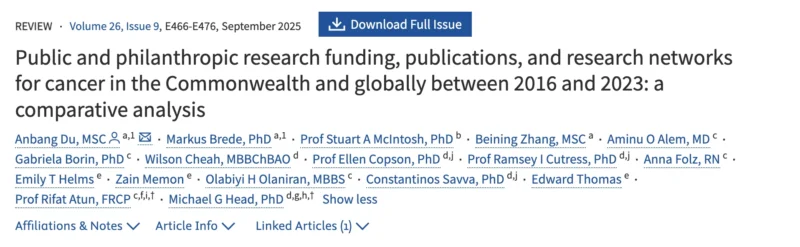
Title: Public and philanthropic research funding, publications, and research networks for cancer in the Commonwealth and globally between 2016 and 2023: a comparative analysis
Authors: Anbang Du, Markus Brede, Stuart A McIntosh, Beining Zhang, Aminu O Alem, Gabriela Borin, Wilson Cheah, Ellen Copson, Ramsey I Cutress, Anna Folz, Emily T Helms, Zain Memon, Olabiyi H Olaniran, Constantinos Savva, Edward Thomas, Rifat Atun, Michael G Head.
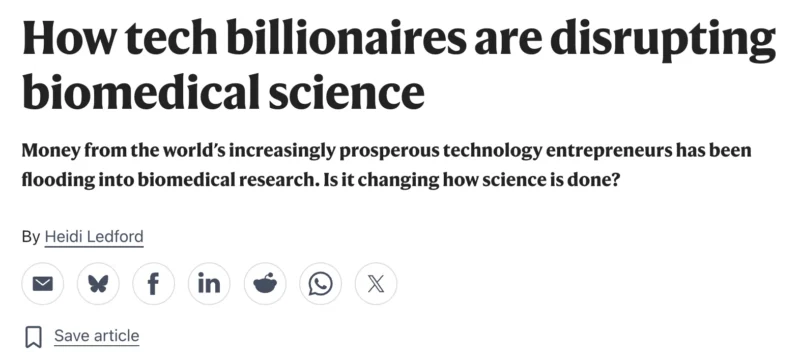
Title: How tech billionaires are disrupting biomedical science
Authors: Heidi Ledford
Other articles featuring Miguel Bronchud on OncoDaily.