






Miguel Bronchud, Co-Founder and Advisory Board at Regenerative Medicine Solutions, shared a post on LinkedIn about a recent article by Jennifer N. Brudno et al. published in JAMA:
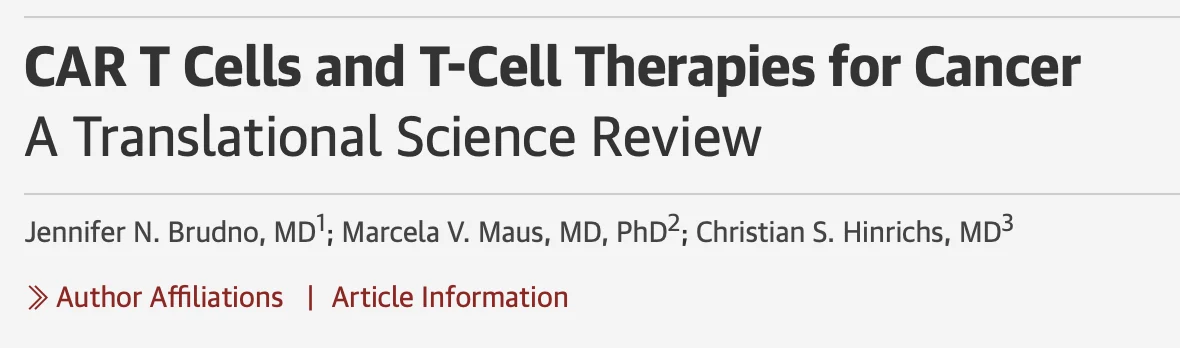
“Nice and reasonably comprehensive review in JAMA on CAR T Cells and T-Cell Therapies for Cancer- a ‘Translational Science Review'(2025)
Congratulations to: Jennifer N. Brudno, Marcela V. Maus, Christian S. Hinrichs,
This review I find particularly relevant and useful because on this subject we have recently witnessed a transition from ‘in house’ local production of personalized autologous ‘chimeric antigen receptor (CAR) T cells’ to more industrial large scale versions’ produced by big pharma or biotech; and any hype is better avoided.
CAR T cells are T lymphocytes that are genetically engineered to express a synthetic receptor that recognizes a tumor cell surface antigen and causes the T cell to kill the tumor cell.
CAR T treatments at present mainly improve overall survival for patients with large B-cell lymphoma and progression-free survival for patients with multiple myeloma. Promising early results in some severe autoimmune diseases like SLE, and improving in other hematological disorders and (with many unsolved problems) also in some solid tumors and aggressive cancers.
Six CAR T-cell products are approved by the US Food and Drug Administration (FDA) for 6 hematologic malignancies: B-cell acute lymphoblastic leukemia, large B-cell lymphoma, follicular lymphoma, mantle cell lymphoma, chronic lymphocytic leukemia, and multiple myeloma.
Compared with standard chemotherapy followed by stem cell transplant, CAR T cells improved 4-year overall survival in patients with large B-cell lymphoma (54.6% vs 46.0%).
Patients with pediatric acute lymphoblastic leukemia achieved durable remission after CAR T-cell therapy. At 3-year follow-up, 48% of patients were alive and relapse free.
In people with multiple myeloma treated previously with 1 to 4 types of non–CAR T-cell therapy, CAR T-cell therapy prolonged treatment-free remissions compared with standard treatments (in 1 trial, CAR T-cell therapy was associated with progression-free survival of 13.3 months compared with 4.4 months with standard therapy).
CAR T-cell therapy is associated with reversible acute toxicities, such as cytokine release syndrome in approximately 40% to 95% of patients, and neurologic disorders in approximately 15% to 65%.
Other CAR-T-related toxicities occur later after CAR-T cell infusion and include B-cell aplasia, hypogammaglobulinemia, infections, and cytopenias.”
Title: CAR T Cells and T-Cell Therapies for CancerA Translational Science Review
Authors: Jennifer N. Brudno, Marcela V. Maus, Christian S. Hinrichs,
Read the Full Article on JAMA
More posts featuring Miguel Bronchud