





The Institute of Cancer and Crisis (ICC) shared a post on LinkedIn about a paper by Habtamu Mellie Bizuayehu et al. published in JAMA Network Open:
“Cancer is no longer just a medical challenge – it is a global crisis of inequality.
A large population-based study published in JAMA Network Open (2025) projects a sharp rise in global cancer cases and deaths by 2050 – with the heaviest burden falling on low- and middle-income countries.
The findings make one thing clear:
cancer outcomes are increasingly shaped not by biology alone, but by where people live and what care they can access.
What the study shows:
- Cancer incidence and mortality are rising fastest in resource-limited regions
- Late diagnosis and delayed treatment drive preventable deaths
- Disparities in screening, treatment availability, and continuity of care persist
- Health system capacity is a decisive factor in survival
In high-income countries, advances in prevention and treatment continue to improve outcomes.
Elsewhere, those same advances remain out of reach.
Why this matters:
Without urgent action to strengthen cancer prevention, early detection, and equitable access to care, global cancer disparities will widen – turning a growing disease burden into a long-term humanitarian and health systems crisis.
Cancer care should not depend on geography or income.
Closing the gap is not optional – it is a global responsibility.
Source: JAMA Network Open.”
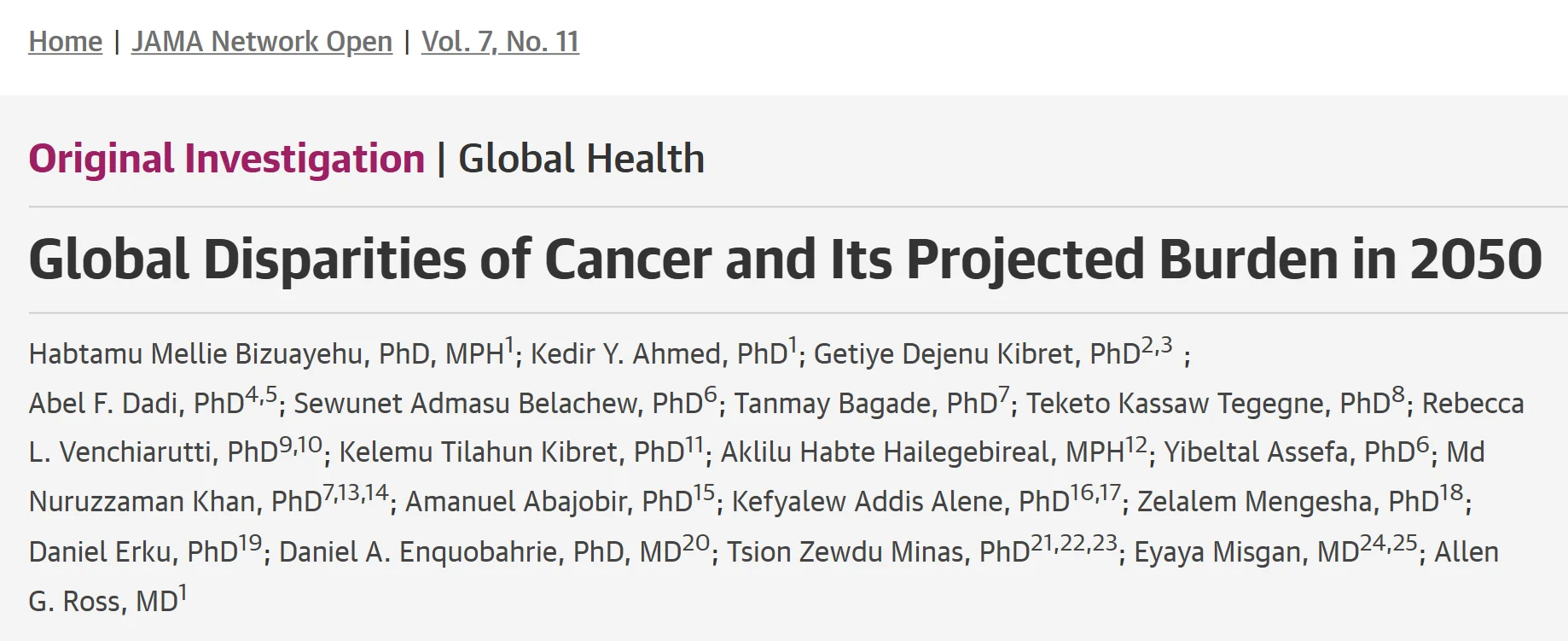
Title: Global Disparities of Cancer and Its Projected Burden in 2050
Authors: Habtamu Mellie Bizuayehu, Kedir Y. Ahmed, Getiye Dejenu Kibret, Abel F. Dadi, Sewunet Admasu Belachew, Tanmay Bagade, Teketo Kassaw Tegegne, Rebecca L. Venchiarutti, Kelemu Tilahun Kibret, Aklilu Habte Hailegebireal, Yibeltal Assefa, Md Nuruzzaman Khan, Amanuel Abajobir, Kefyalew Addis Alene, Zelalem Mengesha, Daniel Erku, Daniel A. Enquobahrie, Tsion Zewdu Minas, Eyaya Misgan, and Allen G. Ross.
You can read the Full Article in JAMA Network Open.
More posts featuring The Institute of Cancer and Crisis.