






Maximilian Merz, Associate Attending Physician at Memorial Sloan Kettering Cancer Center, shared a post on LinkedIn about a recent article he and his colleagues co-authored, adding:
“Medical data are heterogeneous, messy and unstructured.
When I met Maximilian Ferle for the first time, he promised me he would build an algorithm that could detect any survival signal, in any type of source data, in any kind of cancer – provided there is one.
I remember thinking: this sounds a bit overmotivated. But great!
Only two years later, he presented exactly that algorithm — now published in Nature Portfolio NPJ Digital Medicine.
The idea is as bold as it is elegant:
An unsupervised, explainable AI approach that can identify prognostically distinct patient groups across completely different cancer types and data modalities.
In this work, the model predicted survival based on routine lab values in myeloma and CT images in NSCLC. It does not get much more diverse than that.
What I find especially impressive.
The model did not need predefined risk groups, established staging systems, tumor annotations, or handcrafted radiomics features. It learned survival-relevant patterns directly from the data and then made them interpretable.
So proud of you, Maximilian — and excited to see where this goes next.
Thanks to the collaborators.”
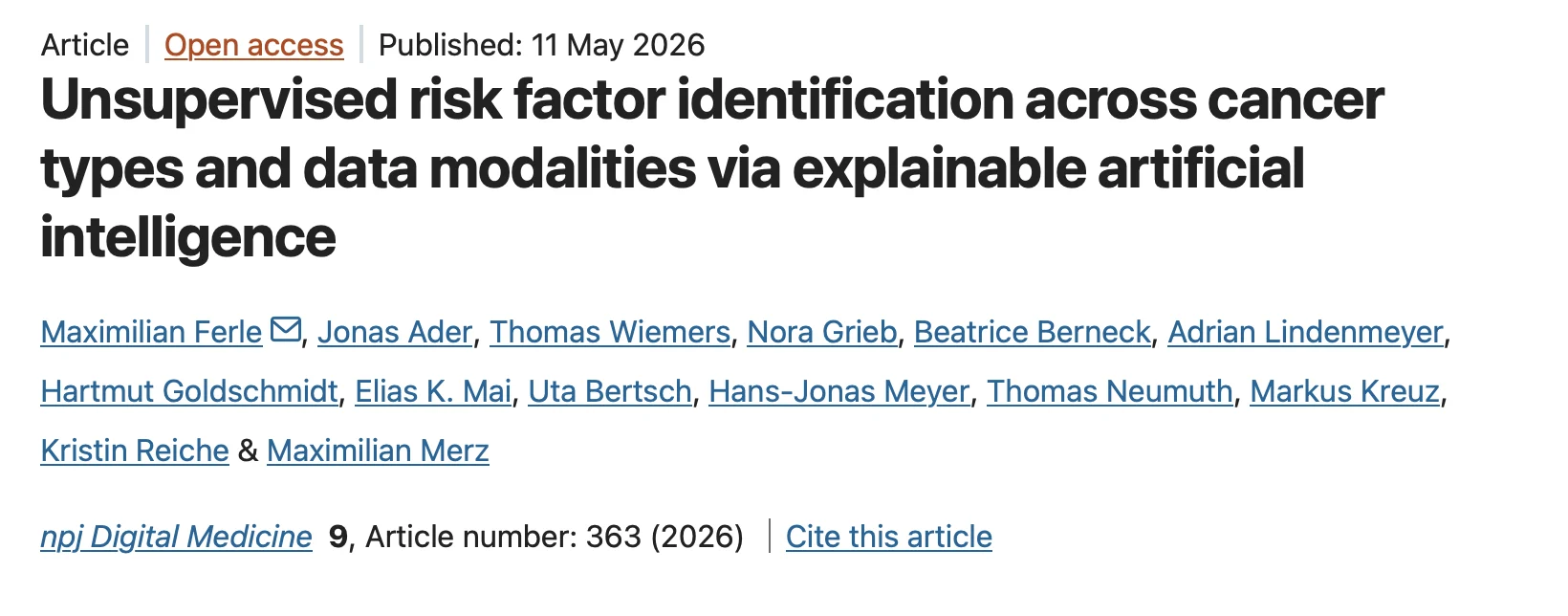
Title: Unsupervised risk factor identification across cancer types and data modalities via explainable artificial intelligence
Authors: Maximilian Ferle, Jonas Ader, Thomas Wiemers, Nora Grieb, Beatrice Berneck, Adrian Lindenmeyer, Hartmut Goldschmidt, Elias K. Mai, Uta Bertsch, Hans-Jonas Meyer, Thomas Neumuth, Markus Kreuz, Kristin Reiche, Maximilian Merz
Read the Full Article on npj Digital Medicine
More posts featuring Maximilian Merz