






Mashukur Rahman, Resident Doctor at Bangladesh Medical University, Medical Officer at Directorate General of Health Services, shared a post on LinkedIn:
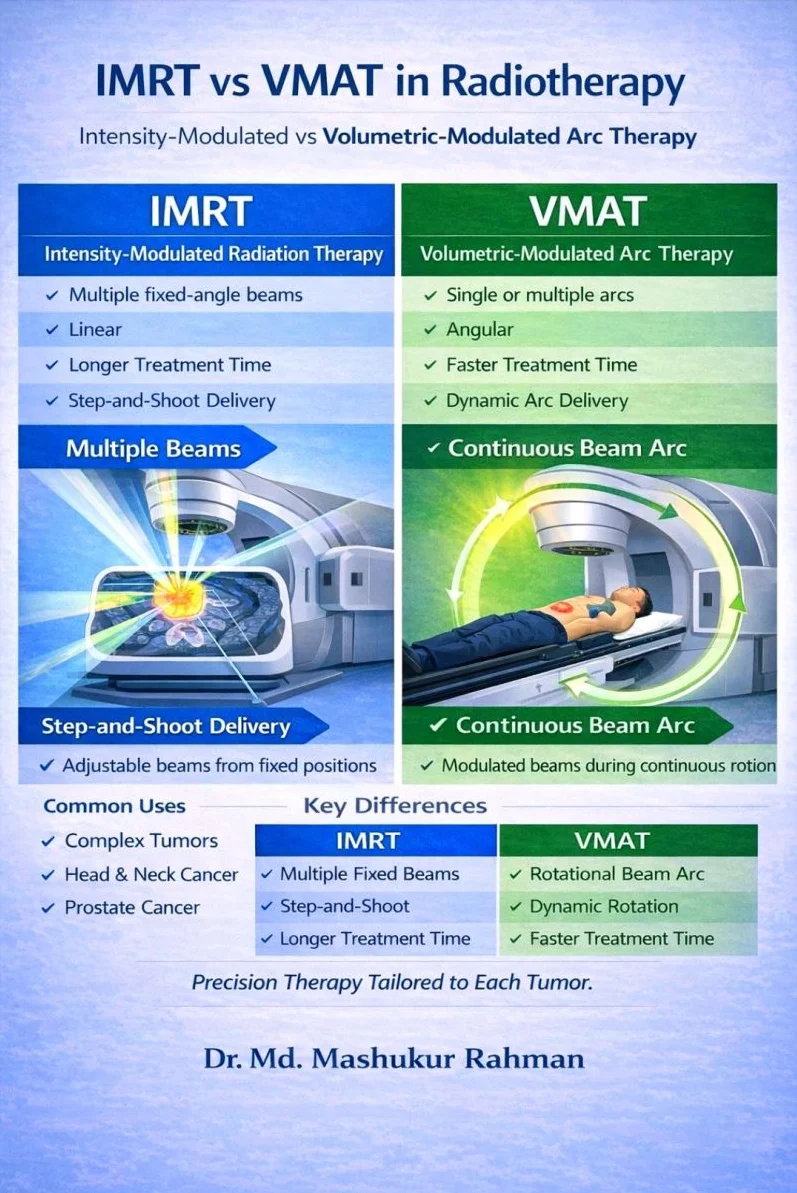
“IMRT and VMAT are often discussed as if one has clearly replaced the other.
In daily radiation oncology practice, the choice is rarely that simple.
Both techniques aim to improve dose conformity and organ-at-risk sparing. But the real difference shows up when we move from planning software to the treatment room.
Plan quality, treatment time, patient comfort, and machine availability all start to matter as much as dosimetric indices.
What we see in practice:
VMAT can reduce treatment time, which helps with patient compliance and intrafraction motion
IMRT may still offer advantages in select cases where control over beam angles and modulation is critical
The “better” technique often depends more on case selection, planning expertise, and departmental workflow than on the label itself
In MDT discussions, technology comparisons often dominate. Less often do we discuss whether the chosen technique truly fits the patient, the disease site, and the system we are working in.
Advanced technology is a tool, not an endpoint.
How does your department decide between IMRT and VMAT for routine and complex cases?”
More posts featuring Mashukur Rahman.