






Maria Maddalena Laterza, Medical Oncologist at Ospedale Santa Maria delle Grazie, shared a post on LinkedIn:
“Immunotherapy in Hepatobiliary Cancers: A True Paradigm Shift
For years, hepatobiliary tumors were considered “immunologically resistant.”
That narrative no longer holds.
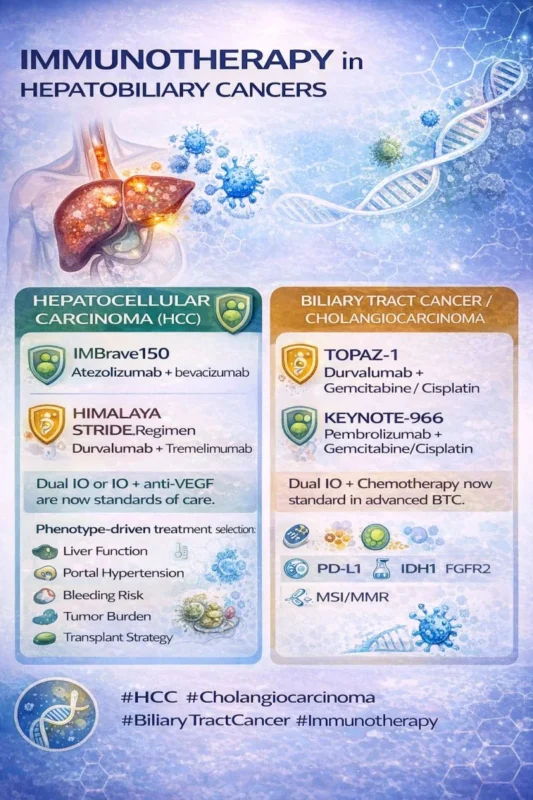
Hepatocellular Carcinoma (HCC)
Immunotherapy is now the backbone of first-line treatment.
Two pivotal strategies:
- IMbrave150 – Atezolizumab + bevacizumab
- HIMALAYA (STRIDE) – Durvalumab + tremelimumab
Dual IO or IO + anti-VEGF are now standards of care.
Treatment selection is phenotype-driven:
- Liver function
- Portal hypertension
- Bleeding risk
- Tumor burden
- Transplant strategy
HCC management has moved into the precision era.
Biliary Tract Cancer (BTC) / Cholangiocarcinoma
Two phase III trials changed frontline therapy:
TOPAZ-1
Durvalumab + gemcitabine/cisplatin
– Improved overall survival
KEYNOTE-966
Pembrolizumab + gemcitabine/cisplatin
– Statistically significant OS benefit
For the first time, chemo-immunotherapy is a frontline standard in advanced BTC.
However:
- Benefit is modest in absolute terms
- PD-L1 is not a reliable biomarker
- MSI-high remains rare
- Molecular profiling (IDH1, FGFR2, BRAF, HER2) remains crucial
What Have We Learned?
- The liver is not immune-resistant
- Combination strategies matter
- Biomarkers lag behind clinical practice
- Molecular + immune stratification is the future
The Real Question
In BTC and HCC, are we maximizing biology —
or simply layering combinations?
The next step is not adding more drugs.
It’s refining patient selection.”
Other articles about Immunotherapy.