Maria Hafez, Assistant Professor at St. Luke’s University Health Network, shared on LinkedIn:
“Proud to represent St. Luke’s University Health Network ESMO – European Society for Medical Oncology ESMO2026 in Madrid.
As a breast medical oncologist, I direct the Breast Cancer Program and Oncology Clinical Trials and Research at St. Luke’s. Global oncology is also a big part of who I am. Through the Syrian American Medical Society (SAMS) – Oncology Committee, I work in oncology leadership and medical education. I’ve joined medical missions to conflict-affected areas, which let me see cancer care from two very different worlds: advanced US health systems and resource-limited settings like Syria.
Each perspective keeps teaching me something about the other.
We are living through an exciting era in breast cancer care with antibody-drug conjugates, targeted therapies, immunotherapy and increasingly personalized treatment. But we also have to ask: Who actually has access to them?
Our studies at ESMO help answer that question:
- Oncology education (3406eP)
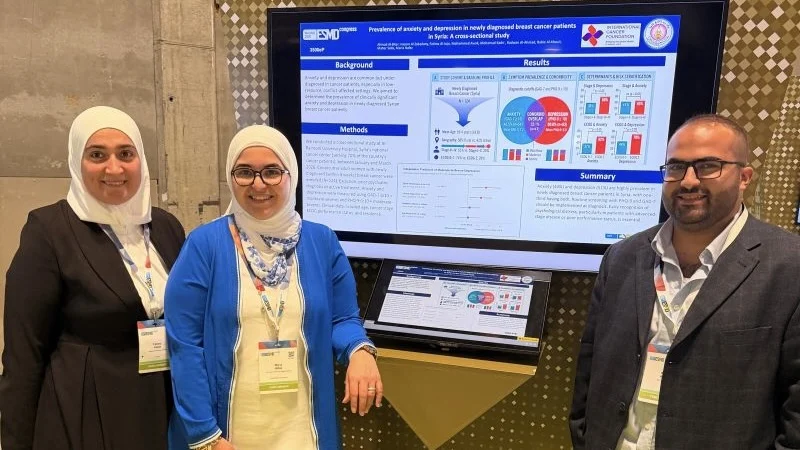
Among 1,097 recent Syrian medical graduates, 87% want oncology in the core curriculum. Yet only 11% are considering an oncology career, and over half reported low confidence in managing cancer emergencies and end-of-life care. - Mental health at diagnosis (3500eP)
- About 51% of newly diagnosed breast cancer patients had clinically significant depression and 44% had anxiety. One-third had both. Treating cancer means treating the whole person, not just the tumor.
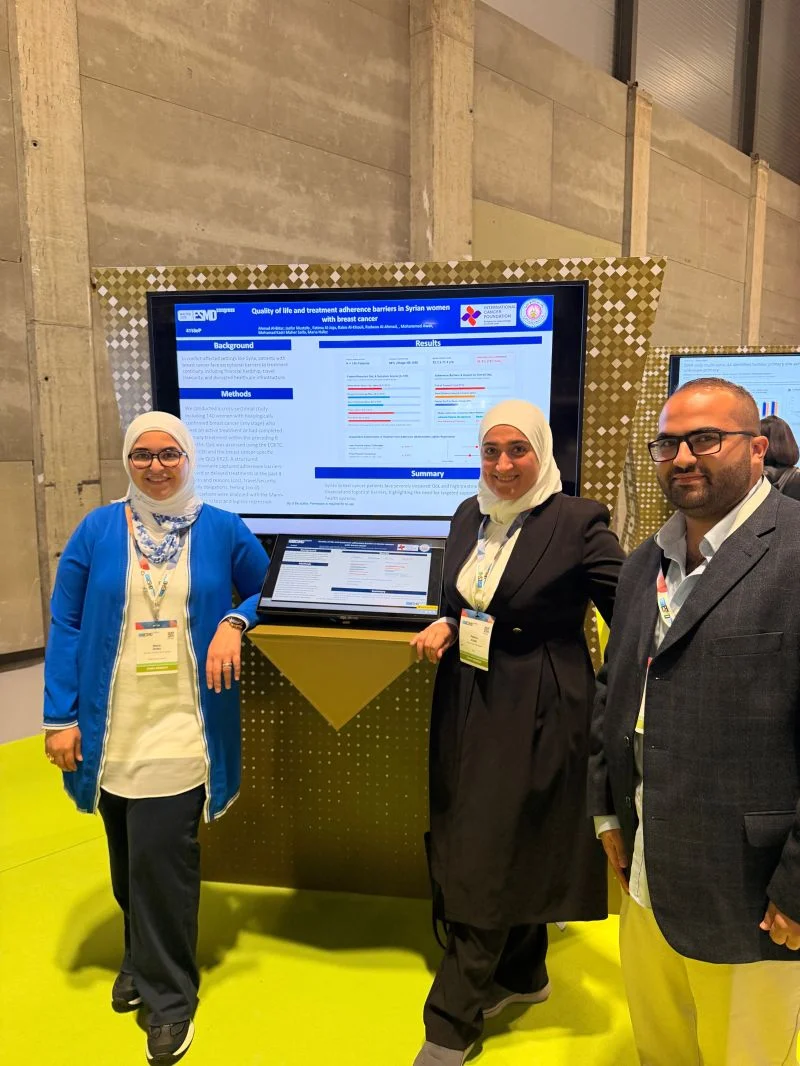
Quality of life and adherence (4118eP)
More than half of Syrian women with breast cancer missed or delayed treatment. Financial hardship, transport costs and security concerns were the main barriers.
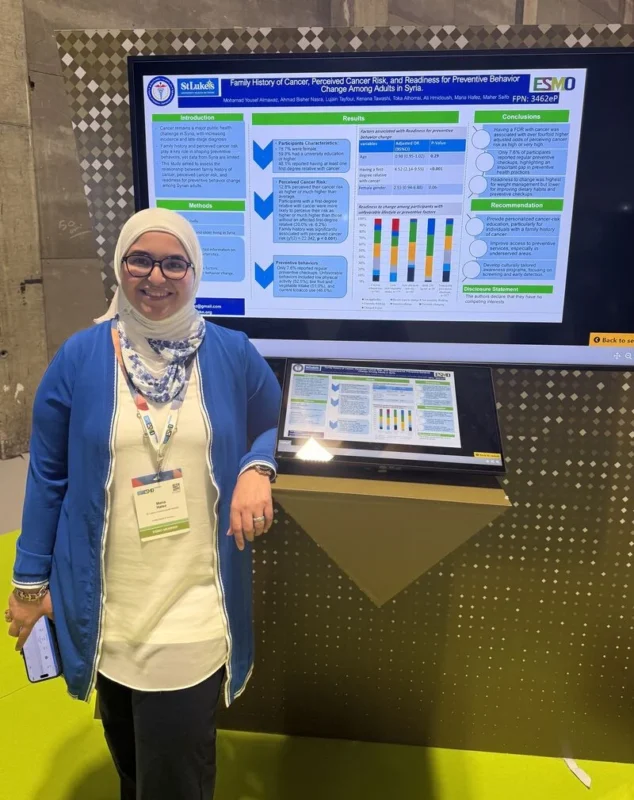
Risk awareness and prevention (3462eP)
Only 7.6% of adults get regular preventive checkups. This shows a major opportunity for screening, education and early detection.
Together, these studies tell one story: cancer care is not just about having the right medications. It also requires education, psychological support, access to treatment, and a functioning health system.
International collaboration must go beyond short-term missions. We need to invest in local professionals, mentorship, education, clinical research and infrastructure. Most of the first authors on these posters are Syrian medical students and young physicians, and they did this work under extraordinary conditions.
A heartfelt thank you to all my co-authors and collaborators in Syria and beyond. This work is yours.
My message from ESMO is simple: the future of oncology should not only be about more precise medicine.
It should also be about more equitable medicine.
Our greatest achievement will be measured not only by the treatments we discover, but by how many patients around the world can actually benefit from them.”
Other articles featuring Maria Hafez on OncoDaily.