





Maria Hafez, Assistant Professor at St. Luke’s University Health Network, shared a post on LinkedIn:
“Breast Cancer Food for Thought Monday
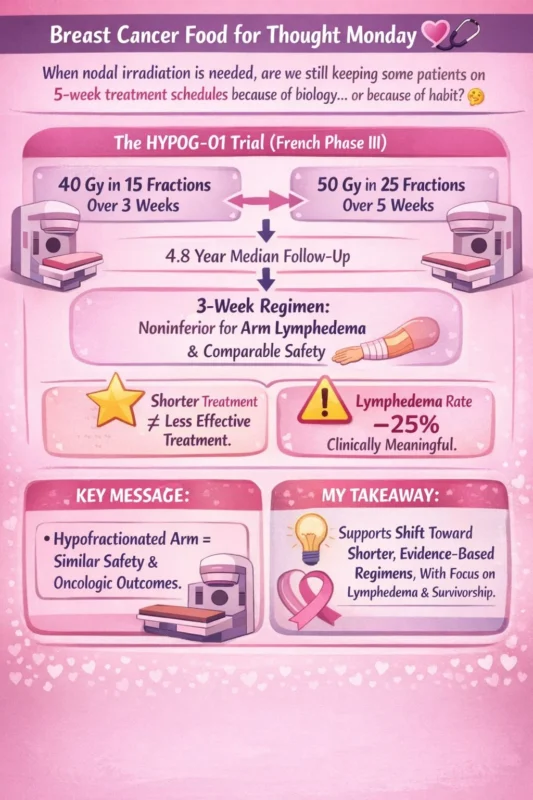
When nodal irradiation is needed, are we still keeping some patients on 5-week treatment schedules because of biology… or because of habit?
The 5-year HypoG-01 data make that question harder to ignore. In this French phase III randomized trial, patients requiring locoregional breast radiotherapy with nodal irradiation were assigned to either:
- 40 Gy in 15 fractions over 3 weeks
or
- 50 Gy in 25 fractions over 5 weeks
After a median follow-up of 4.8 years, the 3-week regimen was noninferior for arm lymphedema, with comparable safety.
What stands out to me is this:
Shorter treatment did not appear to mean less effective treatment.
At the same time, one finding deserves special attention:
Lymphedema remained clinically meaningful, with an overall rate of around 25%.
This reminds us that lymphedema is not just a fractionation issue. The total burden of axillary surgery + nodal treatment still matters.
For the PMRT discussion, this was not a PMRT-only trial, but it remains highly relevant because many patients underwent mastectomy and most received nodal radiation.
Key practical message:
The hypofractionated arm showed similar safety and at least comparable oncologic outcomes, giving more confidence in offering 3-week regimens for appropriately selected patients needing PMRT and/or nodal RT.
My takeaway:
This study supports a continued shift toward shorter, evidence-based breast radiation regimens, while keeping lymphedema counseling, surveillance, and survivorship front and center. Convert the text to figure with text.”
Other posts featuring Maria Hafez on OncoDaily.