Maria Hafez, Assistant Professor at St. Luke’s University Health Network, shared a post on LinkedIn:
“Food for thought (weekend read): I came across an excellent international expert consensus and wanted to share a few practical takeaways on this new, rapidly evolving, and still challenging topic in breast cancer care.
HER2 is no longer “positive vs negative.” It’s a spectrum, and our reports need to reflect that.
The two figures I’m posting summarize key points that can help align clinic + lab workflows (oncologists + pathologists).
Why this matters
The clinical impact of trastuzumab deruxtecan (T-DXd) has changed the game: patients once labeled “HER2-negative” may be eligible for ADC therapy based on very low HER2 protein expression (without gene amplification).
Key takeaways to operationalize now:
1. Use clear categories (don’t stop at “HER2-negative”)
- HER2-positive: IHC 3+ or 2+/ISH+
- HER2-low: IHC 1+ or 2+/ISH–
- HER2-ultralow: IHC 0+ (faint/incomplete staining in >0%–10%)
- HER2-null: IHC 0 (no membrane staining)
2. Report the 5 IHC strata
- 0, 0+, 1+, 2+, 3+ + reflex ISH for 2+
- This reduces ambiguity when treatment hinges on borderline staining.
3. The danger zone = “0 vs 0+ vs 1+”
This is where interobserver variability lives—and where eligibility can be lost if we’re not standardized.
4. Pre-analytics matter (especially for ultralow)
- Minimize cold ischemia time
- Fixation within recommended windows
- Prefer freshly cut sections + most recent FFPE block
- These details can be the difference between “null” and “ultralow.”
5. QA is the new companion-diagnostic mindset
- Validated assays / locked protocols (when applicable)
- Controls spanning 0/1+/2+/3+
- EQA + internal audits
- Double-read borderline cases
- Structured reporting (e.g., CAP synoptic templates)
6. Specimen selection & retesting = real clinical leverage
- Consider additional blocks or a newer specimen when decisions depend on it
- Heterogeneity and temporal change are real
- Avoid compromised samples (e.g., decalcified bone) when feasible for low/ultralow calls
- Practical message
- For oncologists: ask for the exact IHC score (0 vs 0+ vs 1+)—don’t accept “HER2-negative” as the final answer when ADC therapy is on the table.
- For pathologists: standardization + controls + consistent language are now treatment-defining, not just reporting preferences.
- Quick poll for the community
- Are you routinely reporting 0 vs 0+ yet?
- Do you have a workflow for borderline (0+/1+) cases and retesting? “
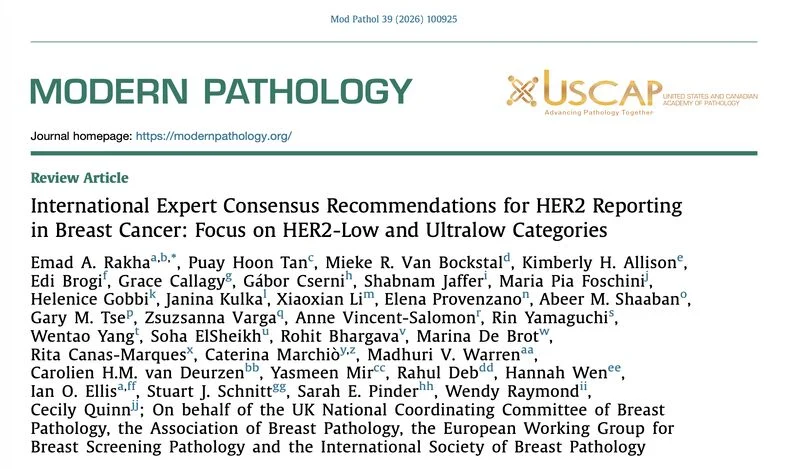
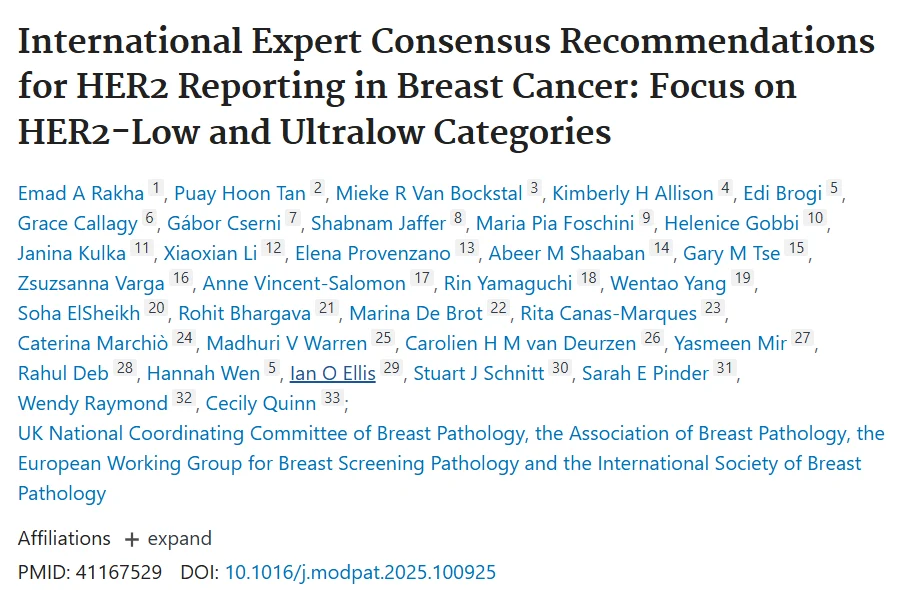
Title: International Expert Consensus Recommendations for HER2 Reporting in Breast Cancer: Focus on HER2-Low and Ultralow Categories
Authors: Emad A Rakha, Puay Hoon Tan, Mieke R Van Bockstal, Kimberly H Allison, Edi Brogi, Grace Callagy, Gábor Cserni, Shabnam Jaffer, Maria Pia Foschini, Helenice Gobbi, Janina Kulka, Xiaoxian Li, Elena Provenzano, Abeer M Shaaban, Gary M Tse, Zsuzsanna Varga, Anne Vincent-Salomon, Rin Yamaguchi, Wentao Yang, Soha ElSheikh, Rohit Bhargava, Marina De Brot, Rita Canas-Marques, Caterina Marchiò, Madhuri V Warren, Carolien H M van Deurzen, Yasmeen Mir, Rahul Deb, Hannah Wen, Ian O Ellis, Stuart J Schnitt, Sarah E Pinder, Wendy Raymond, Cecily Quinn
More posts featuring Maria Hafez.