Maria Babak, Head of The Babak Lab and Assistant Professor at City University of Hong Kong, shared a post on LinkedIn by The Babak Lab, adding:
“A good reminder that drug innovation is not only about discovering new targets, but also about finding entirely new ways to reach them.”
Quoting The Babak Lab’s post:
“Clinical Mondays.
What did 2025 bring to the drug development landscape?
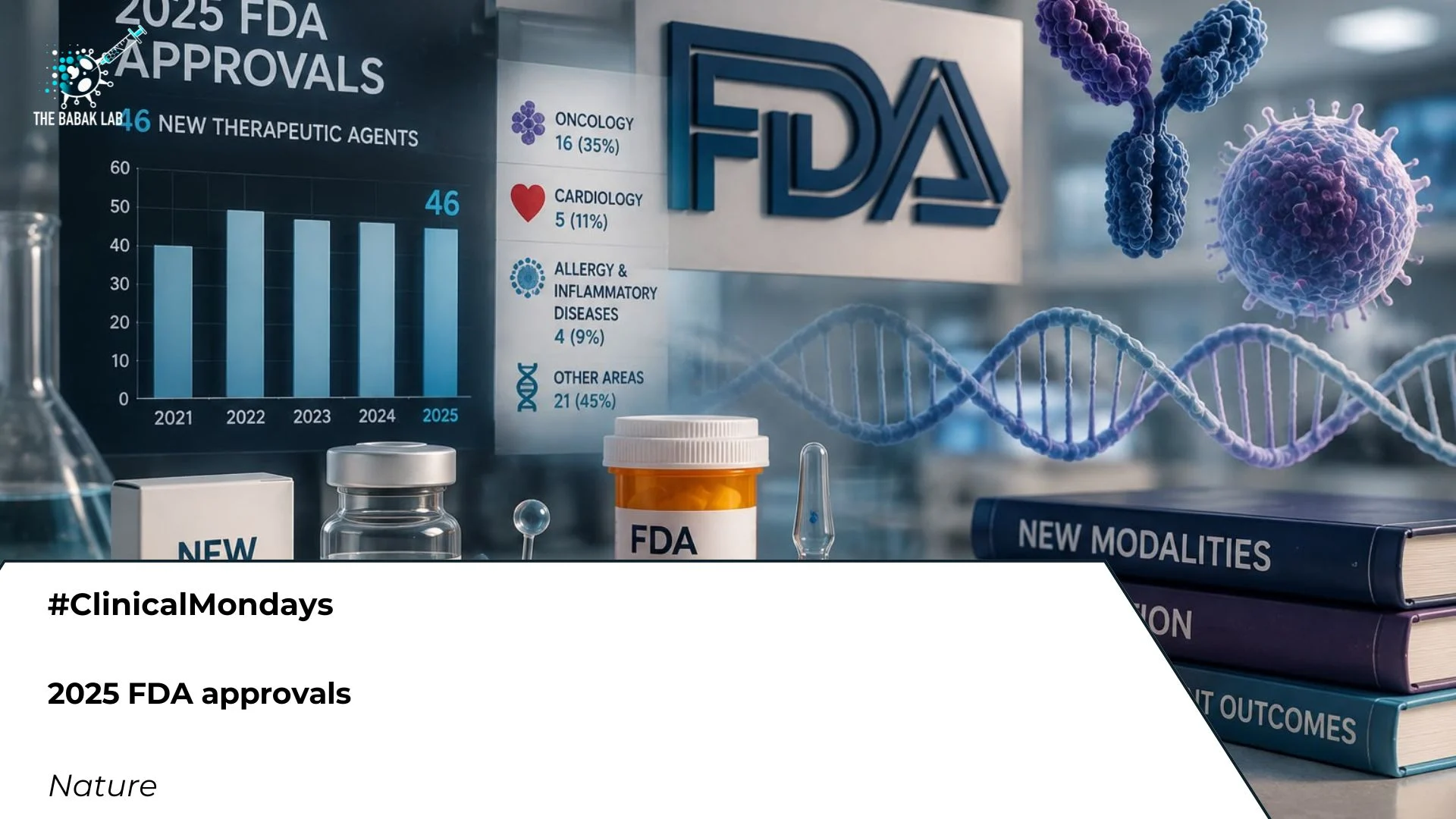
Despite a turbulent year at the FDA, 46 new therapeutic agents received CDER approval in 2025 – keeping the annual number well above the historical average of 36 approvals per year since 1993. Oncology once again led the field, accounting for 16 approvals (35%).
Key Insights
- Kinase inhibitors had their biggest year yet, representing around one-third of newly approved small molecules. Remibrutinib became the 100th FDA-approved kinase inhibitor.
- New modalities continued to reach the market, including the first adnectin-based therapy, PCSK9-targeting lerodalcibep.
- Several first-in-class therapies addressed major unmet needs, including the DPP1 inhibitor brensocatib for bronchiectasis and the NaV1.8 inhibitor suzetrigine as a non-opioid option for acute pain.
- CBER approved 8 notable new products, including a milestone for gene therapy: the first FDA-approved gene therapy from a non-profit organization.
- The year also brought major regulatory changes, including a pilot pathway aiming to shorten selected FDA reviews from the usual 10-12 months to 2 months.
Conclusion
The 2025 approvals show how much the drug landscape is expanding beyond established therapeutic approaches. New mechanisms reached patients across oncology, pain, inflammatory diseases, rare disorders and gene therapy, while established drug classes continued to find new applications. With several new modalities now reaching the market, the next question is how well these therapies perform as they move into broader clinical use.”
Read the full article here.
Title: 2025 FDA approvals
Author: Asher Mullard
Other articles featuring Maria Babak on OncoDaily.