






Mamtha Balla, Transplant Oncology-ID fellow at MD Anderson Cancer Center and Hematology oncology Fellow at The University of Toledo, shared a post on X:
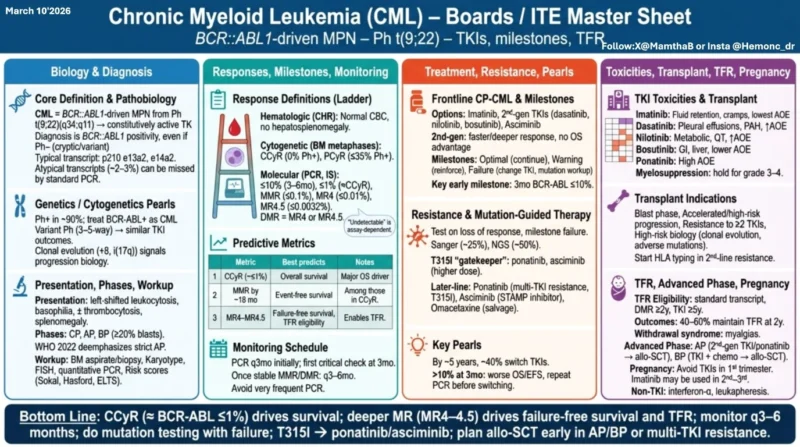
“Chronic Myeloid Leukemia (CML)
ITE/Board review only Memory mnemonic
- Dasatinib Diaphragm (Dripping Lungs): Avoid in patients with Pleural Effusions or CHF
- Nilotinib Narrowing (Nasty Vessels): Avoid in patients with Arterial Disease (PAD/Stroke) or Diabetes
- Bosutinib Bowels (Bathroom): Avoid in patients with IBD or severe GI issues (causes massive Diarrhea)
- Ponatinib Pipe-Plugger (Potent): Used for the T315I “Gatekeeper” mutation, but causes Vascular Plugs (Thrombosis)
Pathobiology and Genetics
- CML is a myeloproliferative neoplasm characterized by the Philadelphia (Ph) chromosome, a (9;22)(q34;q11) translocation.
- The Fusion: Fuses BCR (Chr 22) with ABL1 (Chr 9) .
- The Result: A constitutively active tyrosine kinase that drives myeloid proliferation .
- Common Transcripts: Most express p210 (e13a2 or e14a2).
- Note: e14a2 is the most common and linked to better molecular responses .
- Atypical Transcripts (~2–3%): Standard PCR might miss these! If Ph+ but PCR negative, suspect an atypical transcript and use FISH .
Diagnostic Workup and Staging
Peripheral blood PCR is great, but bone marrow aspirate/biopsy is still the ‘gold standard’ for diagnosis.
Baseline Evaluation
Morphology: Check blast % and basophils to find the disease phase .
Cytogenetics (Karyotype): Essential to find the Ph chromosome and Additional Cytogenetic Abnormalities (ACAs) like trisomy 8 (+8).
PCR (RT-qPCR): Establish the baseline level for future tracking . isk Scoring: Use Sokal or ELTS to pick your frontline TKI .
Disease Phases
PhaseDefinition (WHO/ICC)Chronic (CP) <10% Blasts; most common.Accelerated (AP) 10–19% Blasts, $\ge$ 20% basophils, or clonal evolution.Blast (BP) $\ge$ 20% Blasts (Medical Emergency! ).
Treatment Strategy: The TKI Era
Tyrosine Kinase Inhibitors (TKIs) have made CML a manageable chronic disease.
Frontline Options (Chronic Phase)
1st Gen: Imatinib (The ‘OG’ ).
2nd Gen: Dasatinib, Nilotinib, Bosutinib (Faster/Deeper responses ). STAMP: Asciminib (The newcomer ). Board Pearl: 2nd-gen TKIs hit deeper responses faster, but they haven’t proven an Overall Survival (OS) win over Imatinib in trials .
TKI Selection and Comorbidities ’10 – 1 – 0.1′ rule!
NilotinibHeart disease, PAD, or Diabetes (Vascular risk! ). Dasatinib: pleural effusions or Lung disease (Fluid risk! ). BosutinibGI disease or IBD (Diarrhea risk! ).
Response Milestones and Monitoring PCR (IS scale) is checked every 3 months.
Remember the ’10 – 1 – 0.1′ rule!
Resistance and Advanced Disease If milestones are missed, check for ABL Kinase Domain Mutations . T315I Mutation: The ‘Gatekeeper’.
Resistant to almost everything!
Treatment: Requires Ponatinib (Vascular risk! ) or Asciminib. Blast Phase: Requires TKI + Induction Chemo (e.g., ‘7+3’ or Hyper-CVAD) Stem Cell Transplant .
Treatment-Free Remission (TFR) TFR is the goal of stopping therapy without the cancer coming back. Criteria: Must be in CP, on TKI $\ge$ 3 years, with Deep Molecular Response (DMR) for $\ge$ 2 years . Outcome: ~50% stay off drugs. If MMR is lost, restart TKI immediately! .
- High-Yield Board Summary Table 1. Hallmark$t(9;22)$ BCR-ABL1 (Ph Chromosome)
- DiagnosisBone marrow + Cytogenetics + PCR
- Best Survival PredictorAchieving Complete
- Cytogenetic Response (CCyR)
- Key 3rd Line DrugsPonatinib (Watch for clots!),
- Asciminib .PregnancyStop TKIs (Teratogenic! );
- Use Interferon-α if needed.TransplantReserved for AP/BP or failing multiple TKIs .”
Other articles featuring Mamtha Balla on OncoDaily.