






Mali Barbi, Medical Oncologist at Northwell Health, shared a post on X:
“GLP-1 data is compelling but incomplete. McDonald et al. (Abstract 10506): OR 0.70 for breast cancer incidence. Arya et al. (Abstract 5543): HR 0.45 for endometrial cancer mortality, a large effect for retrospective data.
Before this shapes practice, three things need resolution.
First, the signal conflicts with trial-level evidence. A meta-analysis of 48 RCTs (94,245 patients) found no real effect of GLP-1RAs on obesity-related cancer risk, OR 0.95. That gap is what you’d expect if healthier, better-insured patients are the ones getting prescribed these drugs. Propensity matching narrows that gap, it doesn’t close it.
Second, we should be honest about why this is appealing. Is oncology reaching for a pharmacological fix because the healthcare system fails to support the nutritional interventions that would address the same biology? That’s a health policy question wearing a pharmacology costume.
Third, the mechanism is still assumed, not shown. Orland et al. (Abstract 3143) found tumor GLP-1R expression correlates with survival, a genomic association, not evidence of direct tissue effect. Correlation is not mechanism. Retrospective signal is not guideline-ready.”
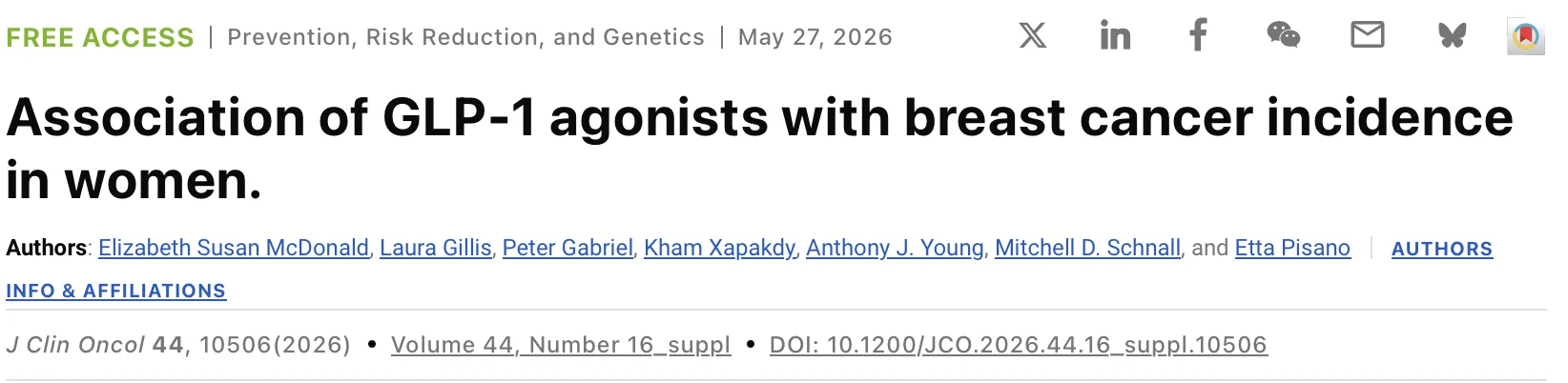
Title: Association of GLP-1 agonists with breast cancer incidence in women.
Authors: Elizabeth Susan McDonald, Laura Gillis, Peter Gabriel, Kham Xapakdy, Anthony J. Young, Mitchell D. Schnall, Etta Pisano
Read the Full Article on Journal of Clinical Oncology
Other articles featuring Mali Barbi on OncoDaily.