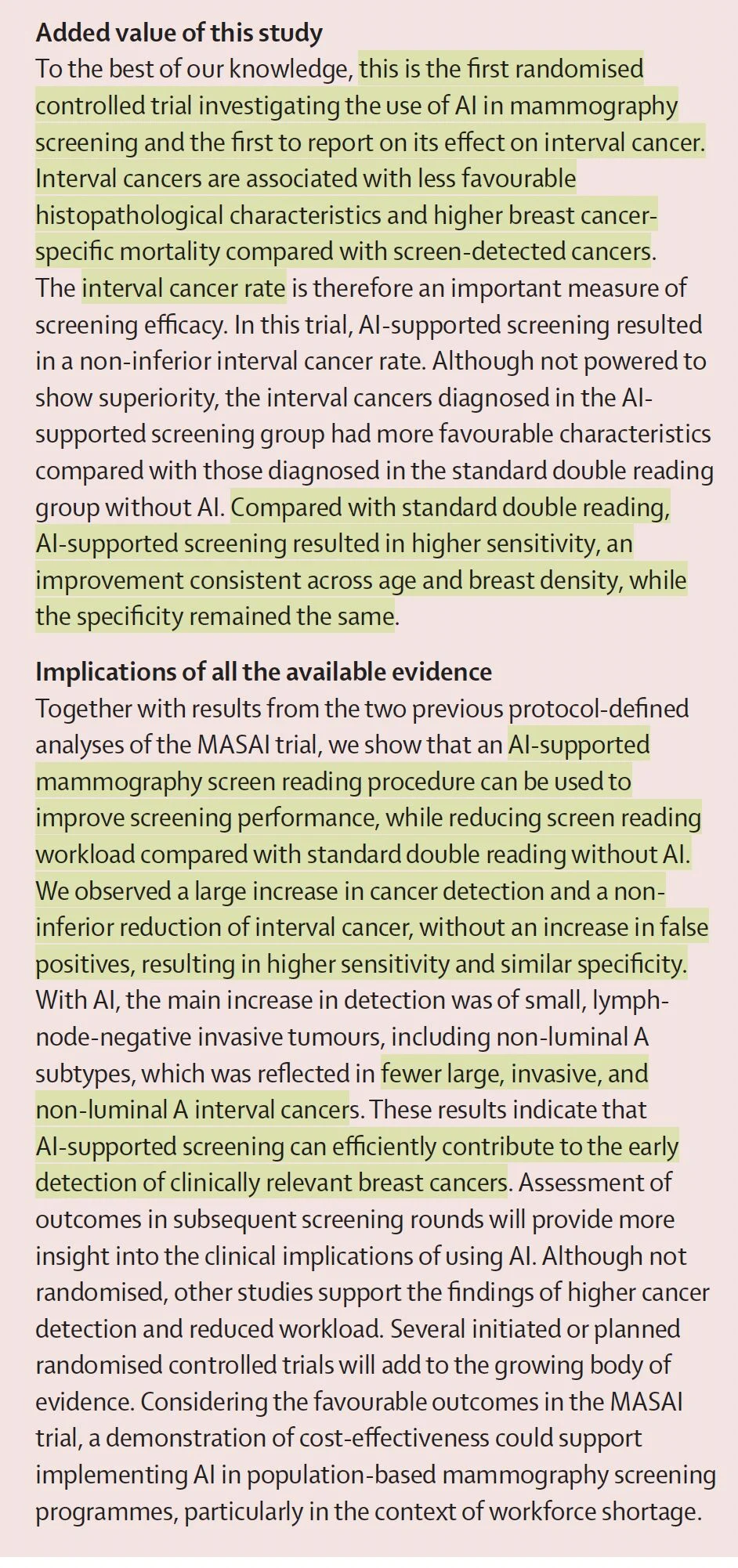
Liam (Alireza) Ghiam, Clinical Associate in the UCI Health, Integrative and Functional Medicine Fellow at the Susan Samueli Integrative Health Institute, shared a post by Eric Topol, Founder and Director of Scripps Research Translational Institute at The Scripps Research Institute, on LinkedIn, adding:
“Congratulations to the authors on this outstanding study. To my knowledge, this is the largest randomized trial of AI in medicine, and it shows what clinically meaningful AI in practice looks like.
This is not an “AI can replace doctors” study. It is a workflow and performance optimization study.
AI-supported mammography screening can reduce screen-reading workload, improve sensitivity, and maintain specificity, without worsening clinical outcomes.
In other words, AI-supported screening can at least be as safe as standard double reading, while being more efficient.
This is especially powerful in today’s practice, with a radiologist shortage combined with rising imaging volumes driven by technological advances.
Radiologists are under increasing pressure to read more studies, faster. AI can enable safe de-escalation of double reading while preserving cancer detection quality, freeing radiologist time without sacrificing outcomes.
The implications for Health Equity are high-impact. In underserved or resource-limited regions, double reading is often not feasible, and screening quality can suffer due to staffing shortages. AI-augmented radiology can help narrow this gap.
Efficiency, access, and equity built on clinically validated AI.”
Quoting Eric Topol‘s post:
“The largest randomized trial of medical AI.
- Over 100,000 women in Sweden
- Radiologist + AI vs 2 radiologists, in follow-up
- AI added led to 29% more cancer detected, 44% reduced workload, and
- Less cancer dx in subsequent 2 years, and, when found, less aggressive.”
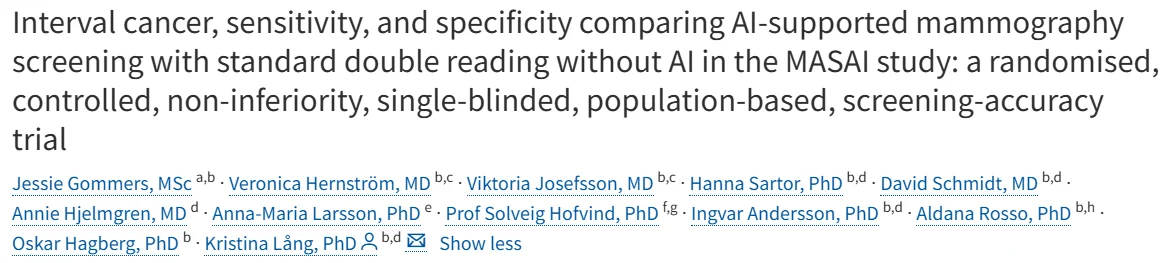
Title: Interval cancer, sensitivity, and specificity comparing AI-supported mammography screening with standard double reading without AI in the MASAI study: a randomised, controlled, non-inferiority, single-blinded, population-based, screening-accuracy trial
Authors: Jessie Gommers, Veronica Hernström, Viktoria Josefsson, Hanna Sartor, David Schmidt, Annie Hjelmgren, Anna-Maria Larsson, Solveig Hofvind, Ingvar Andersson, Aldana Rosso, Oskar Hagberg, Kristina Lång
Read The Full Article on The Lancet
More posts featuring Liam (Alireza) Ghiam and Eric Topol on OncoDaily.