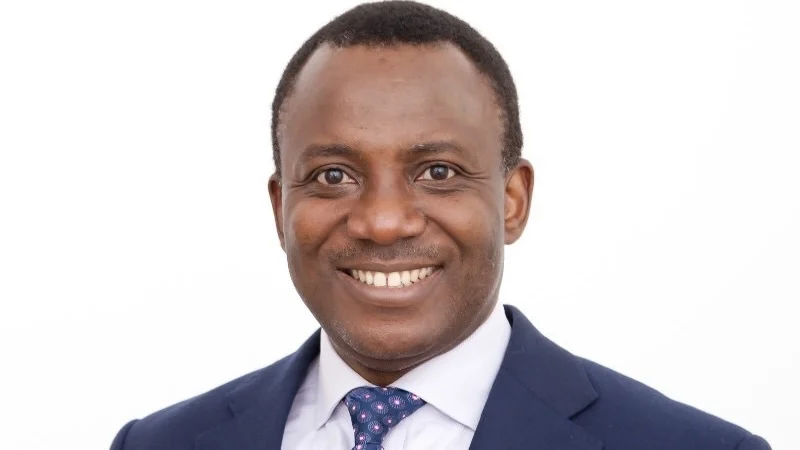
Kenneth Amaeshi, Professor of Sustainable Finance and Chair in Transnational Governance (Global South) at European University Institute, shared a post on LinkedIn:
“I had always wanted to be an academic. Right from my undergraduate days in Nigeria, I saw the acquisition of new knowledge as a true joy to the soul in the Aristotelian sense. I saw academia as a perfect space for knowledge exploration and acquisition. Hence, I pursued a postgraduate degree in Nigeria in the 1990s.
Unfortunately, it was the military era, and Nigerian universities at the time were struggling with frequent strikes and inadequate support. I pivoted to management consulting, which felt closest to a knowledge-based profession. But the attraction to academia remained strong. I published papers in academic journals and presented at academic conferences.
Beyond the love of knowledge, another attraction of academia is the freedom it offers. Unlike management consultancy, which is excessively tied to immediate commercial profits, academia offers the freedom to experiment with remote ideas that are far from the clutches of market logic. Notwithstanding, I have, over the years, found a middle ground between theory and application. The consulting industry experience had its benefits for as long as it lasted. I don’t take that for granted.
When I had the opportunity to leave Nigeria in 2002 to do an MSc in Economics of Public Policy in the UK through the Chevening Scholarship, I grabbed it with both hands. Although it was a master’s degree, I had one mission in mind: to complete a PhD and secure an academic position in the West. I was fascinated by the West, though I didn’t fully understand how it treated outsiders.
I went through a series of routes and completed a PhD in International Business and Political Economy at Warwick Business School in 2007. I started my first academic position in January 2008 at the School of Management, Cranfield University, UK. I was hired as a lecturer. Two years after that, in 2010, I moved to the University of Edinburgh as a senior lecturer. I became a full professor at the University of Edinburgh in 2016 – that’s 8 years after completing my PhD. Although it looks like a relatively quick move, I know someone who became a full professor at a UK university 4 years after their PhD.
When I compare my career progression in the UK with what it would have been in Nigeria, there are many positive aspects of the UK system. It is competitive and subject to market forces. It allows for career mobility. If your university can no longer afford you, or if you think you can be better valued elsewhere, you move, and no one blames you. Unlike in Nigeria, where you are expected to spend a minimum number of years in one position before moving on (it takes not less than 15 years to move from a lectureship position to a full professor), the number of years doesn’t count in the UK system. What counts is your productivity. In the typical sense, it lets the market reap.
The UK system supports and rewards research and teaching excellence. Notwithstanding the current pressures on many UK universities, which many see as temporary pressures, the UK higher education system is very resilient. It has stood the test of time over centuries. The University of Oxford is almost 930 years old, while the University of Edinburgh is 433 years old. The UK system is by no means perfect. It also has some drawbacks, especially in the way it treats minorities.
Available records show that in 2016, when I was promoted to a personal chair and full professorship at the University of Edinburgh, I was probably the first black African professor at the university in its 434-year history. The same can be said of my appointment at the European University Institute, Florence, Italy, in 2021. Although it seems I was the first full-time black African professor in the university’s history, I am currently the only one. The EUI celebrated its 50th anniversary this month. While this looks like a feat, it hides many personal struggles and pains it harbours.
On the surface, everything looks OK, but beneath and within are conflicting, confusing thoughts of othering, exclusion, rejection, and alienation. You feel unvalued as a person beyond what you can offer through your research funding and publications. The relationship feels too transactional, and you feel your worth is measured by what you can give rather than by who you are. But one can argue that that’s how the market operates. So, if we accept the market’s positive side, we should also accept its negative side.
Although colleagues can sometimes mask their attitude towards you as a perceived outsider, this devaluation and dehumanisation couldn’t be felt more keenly elsewhere than in one’s encounter with students. They literally question your existence in their space. You do not look like them. You don’t look like their perception of what professors should look like. Probably, you are the first black person ever to teach them. Any black person in academia, to them, must either be a student or work in a menial job. I recall a colleague asking me how my PhD thesis was going. He assumed I was a PhD student. I humoured him and said I was nearing completion. He never asked again.
There are tonnes of empirical evidence on how black academics are unconsciously (and sometimes consciously) undermined and racialised by both students and colleagues in white-dominated institutions. Their authority is challenged; their confidence is attacked and punctured for entertainment. Their accents are sneered at. Again, I recall asking my white colleague whether students challenged the marks and grades he awarded, and he said rarely. However, his rarity is my everyday experience to date.
The worst bit is students’ evaluations of black professors’ teaching. I have had my fair share here. Although I will quickly acknowledge that my research is stronger than my teaching, based on my experience teaching in different settings, I don’t want to believe I am an awful teacher. I have taught in Africa, Asia, and Europe. While I regularly receive excellent evaluations from Africa and Asia, my experience in Europe has been mixed and inconsistent. Sometimes, students’ evaluations are high. Other times, they are average or below-average evaluations, even when I teach the same materials to these different groups.
A recent example that really got me thinking is teaching the same materials to students at the University of Lagos, Nigeria, and students at the European University Institute. The same person. The same material. But different audiences. The Nigerian audience offered excellent evaluation. The European audience was very harsh in their evaluation. If this were a one-off case, I would have shrugged it off. But looking back in time, the pattern couldn’t be more obvious. This is even more pronounced as I grow in research stature and start to decolonise the curriculum by introducing ideas from Africa – such as Africapitalism and the One Kindred One Business Initiative (OKOBI) of the Imo State Government, Nigeria. This can be really confusing and self-confidence-eroding.
While I agree that not everything is perfect with my teaching and there are always lessons to learn from students’ evaluations, teaching in Europe for almost 20 years now and having to cope with the harsh psychological battering from colleagues and students, literally, has led me to question many things I took for granted.
The first is self-doubt. Am I the problem here? Secondly, are there other people like me going through the same experience, but can’t place a finger on it? Are European academic institutions inherently racist? Are Europeans averse to ideas from Africa? Is the quest for diversity a camouflage? What can be done to address this issue and create a safe space for all? How can European academic institutions be truly inclusive in the real sense of the word?
If a seasoned academic like me can feel this way, then there is more to it than meets the eye. Answers to these questions may offer new insights into the joys and pains of black professors in white-dominated academic institutions. What are your thoughts?
Amaeshi is Professor of Sustainable Finance at the European University Institute, Florence, Italy, and Professor of Sustainable Business and Public Policy at the University of Edinburgh, United Kingdom.”

You can also read: Top Growing Medical Universities in the Wold: 2026 Edition by BIGR