






Kefah Mokbel, Chair of Breast Cancer Surgery at London Breast Institute and Honorary Professor of Medicine at Cardiff University School of Medicine, shared a post on LinkedIn:
“Why ESR1 mutations matter in CDK4/6i resistance – and why not all CDK4/6 inhibitors are equal.
A major translational study just published in Genome Medicine offers the most granular view yet of how resistance evolves to CDK4/6 inhibitors in ER+ metastatic breast cancer – and the findings have direct clinical implications.
What the investigators did:
Using high-complexity DNA barcoding (ClonTracer) plus whole-exome sequencing, ATAC-seq, bulk and single-cell RNA-seq, the team tracked clonal dynamics in real time as MCF7 cells acquired resistance to palbociclib or abemaciclib – in both ESR1 wild-type and Y537S ESR1-mutant models.
What they found:
ESR1 mutations are enriched in acquired CDK4/6i resistance clinically – and can expand to near-clonality after treatment.
The Y537S ESR1 mutation profoundly reshapes chromatin and clonal evolution under palbociclib – but has a far weaker effect under abemaciclib, likely because abemaciclib’s broader kinase inhibition (CDK1, 2, 4, 6, 9) bypasses ER-axis dependence.
Palbociclib and abemaciclib drive distinctly different resistance states – with minimal clonal overlap and one-directional cross-resistance.
Mutant ESR1 facilitates resistance acquisition but becomes dispensable once resistance is established – consistent with limited benefit from single-agent SERDs post-CDK4/6i.
In WT-ER cells, ER loss itself is the primary driver of palbociclib resistance – restoring ER expression re-sensitises cells. Resistance evolves as a continuum, not a binary switch – with convergent and divergent trajectories coexisting.
The bottom line for clinical practice:
ESR1 mutational status and the choice of CDK4/6 inhibitor are both determinants of the resistance landscape – and should inform how we design sequential and combination strategies at progression.
This elegantly supports the rationale for abemaciclib after palbociclib failure (postMONARCH), and underscores why combination approaches targeting multiple pathways will be needed to durably overcome CDK4/6i resistance.”
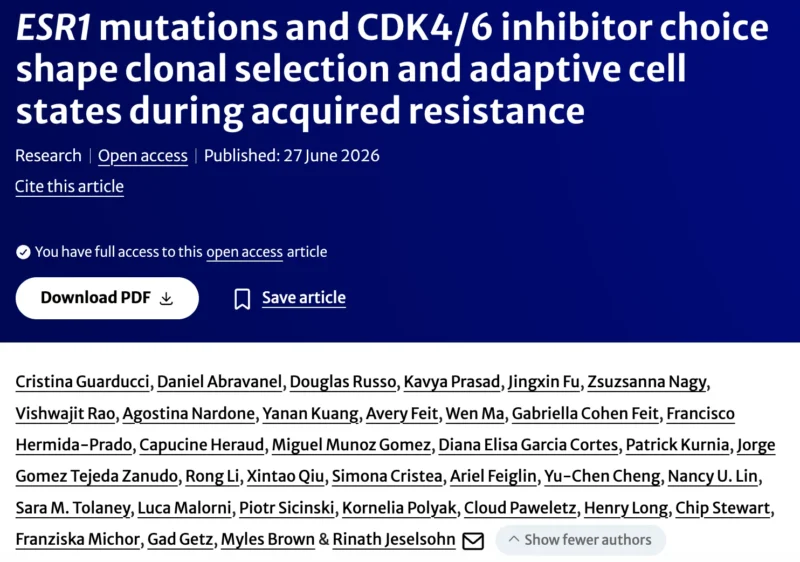
Title: ESR1 mutations and CDK4/6 inhibitor choice shape clonal selection and adaptive cell states during acquired resistance
Authors: Cristina Guarducci, Daniel Abravanel, Douglas Russo, Kavya Prasad, Jingxin Fu, Zsuzsanna Nagy, Vishwajit Rao, Agostina Nardone, Yanan Kuang, Avery Feit, Wen Ma, Gabriella Cohen Feit, Francisco Hermida-Prado, Capucine Heraud, Miguel Munoz Gomez, Diana Elisa Garcia Cortes, Patrick Kurnia, Jorge Gomez Tejeda Zanudo, Rong Li, Xintao Qiu, Simona Cristea, Ariel Feiglin, Yu-Chen Cheng, Nancy U. Lin, Sara M. Tolaney, Luca Malorni, Piotr Sicinski, Kornelia Polyak, Cloud Paweletz, Henry Long, Chip Stewart, Franziska Michor, Gad Getz, Myles Brown, Rinath Jeselsohn
Read The Full Article
Other articles about Breast Cancer on OncoDaily.