






Joshua Omale, Research and Programs Associate at Slum and Rural Health Initiative Network, shared on LinkedIn:
“Chapter 16
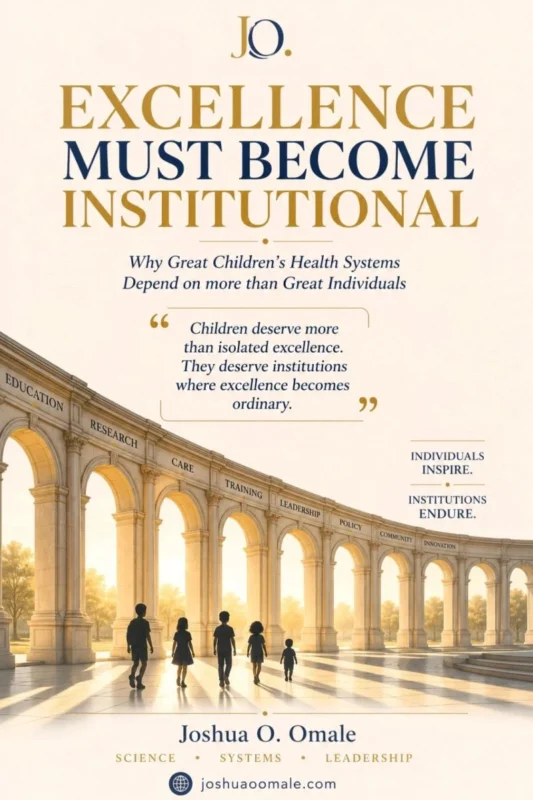
Excellence Must Become Institutional
Why great children’s health systems depend on more than geat Individuals. There is a temptation that quietly shapes many conversations about children’s health.
When remarkable outcomes emerge, we instinctively search for remarkable people:
- The brilliant surgeon.
- The visionary researcher.
- The committed policymaker.
- The generous philanthropist.
- The passionate advocate.
These people matter.
History has always been moved forward by individuals with extraordinary conviction. But history is sustained by something else. Institutions. Children deserve more than moments of excellence. They deserve systems where excellence becomes ordinary.
Institutions do something individuals never can:
- They preserve memory.
- They establish standards.
- They train future generations.
- They create continuity.
- They improve with experience.
Most importantly, they continue serving children long after their founders have gone. It does not depend on whether one gifted clinician is available.It does not disappear when one leader retires. It becomes part of the culture.
A child should never have to hope that the ‘right’ doctor happens to be on duty. Or that one passionate organisation happens to be working in their community. Or that one extraordinary researcher happens to focus on their disease. Children deserve something far more dependable than chance. They deserve systems intentionally designed to make high-quality care the expectation rather than the exception.
This matters profoundly for Africa. The future of children’s health will not be secured by isolated centres of excellence alone. It will be shaped by institutions that strengthen one another.
- Hospitals connected to research.
- Research connected to policy.
- Policy connected to communities.
- Communities connected to primary healthcare.
- Primary healthcare connected to specialist care.
And all of them connected by a shared commitment to learning.
That is how excellence becomes scalable. That is how equity becomes possible. That is how children inherit something stronger than individual brilliance.
They inherit institutions capable of protecting generations they will never meet. Every generation leaves children more than infrastructure.
- It leaves them habits.
- Standards.
- Cultures.
- Expectations.
- Institutions.
The question before us is not whether Africa has extraordinary people. It does. The defining question is whether we will build institutions worthy of the extraordinary children who will inherit them.
Building at the intersection of science, systems, and leadership for the future of children’s health in Africa.”
Other articles featuring Joshua Omale on OncoDaily.