





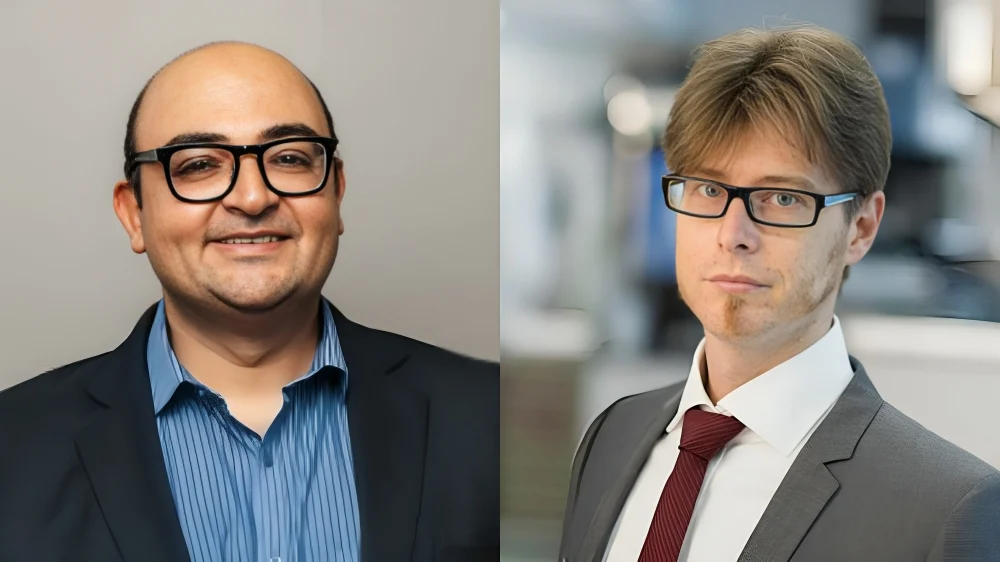
Jorge Reis-Filho, Chief of AI for Science Innovation, Enterprise AI Unit at AstraZeneca, shared a post by Faisal Mahmood, Associate Professor at Harvard, adding:
“Discoveries in medicine have traditionally been based on phenomenology and hypothesis-driven research. Faisal’s team approached it from first principles instead. What if we built a single vector, a single representation, for each patient, across 28 data modalities, with time as the first dimension?
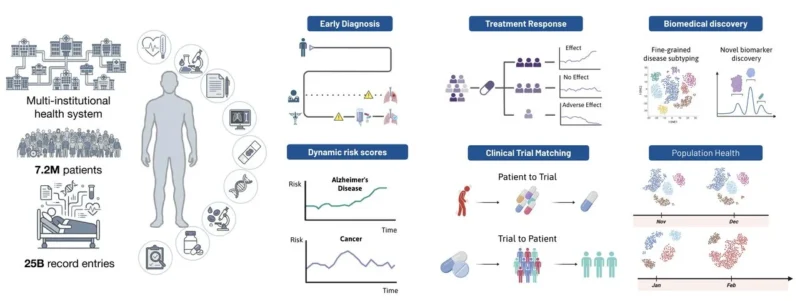
That is APOLLO: a healthcare system-scale multimodal temporal foundation model trained on 25 billion clinical events from 7.2 million patients over 33 years. Labs, notes, pathology, medications, diagnoses, all rendered into coherent, computable longitudinal trajectories of human health and disease.
APOLLO is disease-agnostic by design. One model across specialties and stages of care. The implications are enormous: earlier risk prediction, treatment response modeling, clinical trial matching, biomarker discovery and a new generation of agentic systems built on genuinely rich patient representations.
Virtual patient representations are no longer a thesis or hypothesis. Defining the most impactful use cases, the right evaluations and benchmarks, and rigorous validation for the solutions that stem from this model will be essential. I look forward to the next wave of discoveries that will come from APOLLO and similar models.
Chapeau Faisal Mahmood, Andrew Zhang, Tong Ding, Sophia J. Wagner and the team!
Read the pre-print here.
Read the blog post here.”
Quoting Faisal Mahmood‘s post:
“We are excited and thrilled to announce APOLLO, a healthcare system-scale multimodal temporal foundation model for virtual patient representations.
Trained on 25 billion clinical events from 7.2 million patients across 33 years and 28 modalities, APOLLO learns a unified atlas of medicine. Turning labs, notes, pathology images, medications, and diagnoses into coherent, computable longitudinal trajectories. APOLLO is disease-agnostic by design, a single model that learns the shared structure underlying human health and disease across every specialty, modality, and stage of care.
The possibilities are enormous: earlier risk prediction, treatment response modeling, clinical trial matching, biomarker discovery, and a new generation of agentic systems built on rich patient representations.”
Other articles featuring Jorge Reis-Filho on OncoDaily.